

Why Modernizing Existing Manufacturing Has Become a Strategic Advantage for U.S. Industry in 2026


Can the United States remain competitive in the era of advanced manufacturing without relying exclusively on building new factories and completely replacing existing equipment? This question is increasingly raised not only in academic discussions but also at the level of individual production facilities. It has become clear that the core challenge lies not so much in a lack of capital or technology, but in the ability to adapt and modernize existing production systems without halting operations.

According to data from the U.S. Census Bureau and the Bureau of Economic Analysis, the U.S. trade deficit in goods and services exceeded $918 billion in 2024, increasing by approximately 17 percent compared to 2023. At the same time, the deficit in the Advanced Technology Products category remained consistently high throughout 2023-2025, pointing to structural limitations in adapting existing industrial capacity to the requirements of modern manufacturing.

In practice, this issue is particularly acute at facilities that rely on non-standard or highly customized equipment. Such production lines cannot simply be shut down for months to allow for a complete replacement of machinery or control systems. Any prolonged downtime results in contract failures, direct financial losses, and disruptions to supply chains. Under these conditions, modernization ceases to be a one-time investment and instead becomes a continuous engineering process that requires rapid diagnostics, phased solutions, and a deep understanding of production logic.

After industrialization, the same challenge inevitably emerges: equipment can be purchased, but it is far more difficult to find specialists capable of maintaining it, quickly identifying failures, and simultaneously adapting production systems to new market demands. “Once any production system is launched, specialists are needed who can go beyond routine maintenance and evaluate equipment performance at the level of the entire technological chain, identifying critical points and implementing solutions to modernize both equipment and production processes,” notes applied mechanics engineer Mykola Nazarenko.

Today, such highly qualified engineers form a hidden competitive advantage for American industry. The decisive factor is the ability of engineering teams to carry out modernization within active production environments while minimizing downtime and capital expenditures.

Nazarenko’s approach differs fundamentally from the traditional model of a maintenance engineer. He works as a systems diagnostic engineer, structuring his process around a comprehensive analysis of the production cycle and equipment interdependencies. This makes it possible to identify accumulated engineering compromises and bottlenecks and only then proceed with the phased modernization of control systems, automation, and equipment interaction. This approach improves reliability and productivity without the need for capital-intensive full machine replacement.

Nazarenko’s professional experience was shaped in environments where the cost of error was measured not in theory, but in direct financial losses. From 2020 to 2022, he was responsible for the uninterrupted operation of complex production lines at the woodworking enterprise LLC FPK Korobel. The production environment did not allow for extended downtime: stopping a line meant immediate financial losses. It was there that he implemented a phased equipment modernization practice that stabilized production and extended machine service life through process and control system optimization rather than mechanical component replacement.

After relocating to the United States in 2022, this experience proved directly applicable. At Toufayan Bakery, a large-scale food manufacturing operation with a continuous production cycle, Nazarenko advanced from equipment operator to production supervisor within one year. His role included not only shift management but also support for CNC equipment and automated lines operating under high load. During this period, the frequency of emergency stoppages was reduced, line stability improved, and production scheduling became more predictable, directly enhancing the company’s operational efficiency.

A sound engineering approach often becomes the key driver of modernization. “My experience shows that the longer a person works within a single system, the fewer opportunities for adaptation and improvement they tend to see. Over time, a habituation effect emerges, and production begins to be maintained by inertia,” Nazarenko observes. His approach is based on identifying such “blind spots” and systematically re-evaluating processes that have long been considered unchangeable.

In 2025, Nazarenko continued his professional career in the United States after receiving a confirmed job offer from Fair Wind East Inc., a company specializing in the manufacture and repair of marine canvas structures and upholstery for boats and yachts. Most products are made to the individual dimensions of a specific vessel, and the quality and stability of production equipment directly determine schedule adherence and contract fulfillment. His responsibilities include rapid diagnostics, optimization, and phased modernization of production equipment and workflows with minimal downtime.

In the broader context of U.S. industry during 2023-2025, it has become evident that the limitations of advanced manufacturing are not solely financial but also structural and engineering-related. The persistent deficit in industrial and high-technology products underscores the need to adapt existing capacity to evolving market requirements.

Mykola Nazarenko represents a type of engineering expertise that enables the United States to remain competitive not by rebuilding everything from scratch, but by gaining an advantage through the intelligent modernization of existing production systems. Such specialists strengthen the resilience of American industry where real competitiveness is determined – on the shop floor, at the level of equipment and processes that directly shape the future of U.S. manufacturing.


Free Training

Source link

U.S. lawmakers move to reverse Canadian tariffs amid manufacturing concerns


The United States House of Representatives has voted to overturn tariffs on Canadian imports, delivering a rare bipartisan rebuke of the administration’s trade policy and offering a measure of relief to North American manufacturers and cross-border supply chains.

Lawmakers backed a resolution disapproving of the “national emergency” used to justify tariffs that President Donald Trump imposed last year on Canadian goods, which critics say have raised costs for U.S. consumers and businesses. The chamber approved the measure 219–211, with six Republicans joining nearly all Democrats in support.

Although the resolution is largely symbolic, due to the fact it would likely face a presidential veto and require a two-thirds majority to override, the vote highlights growing unease in Congress about the economic effects of unilateral trade actions on manufacturing sectors and allied relationships.

Industry and political pressure

Manufacturers that depend on integrated North American supply chains argued the tariffs have disrupted production and raised input costs, complicating planning and competitiveness. Some lawmakers echoed these concerns, saying Congress should reclaim authority over trade policy and protect jobs and economic stability at home.

Proponents of the rollback emphasized that Canada is a close ally and critical trading partner, particularly in automotive parts, machinery and raw materials — sectors heavily intertwined with U.S. manufacturing. Critics of the tariffs point to data showing that much of the tariff burden falls on U.S. consumers and importers rather than on foreign exporters.

The resolution now moves to the U.S. Senate, where a similar bipartisan vote has already occurred, though passage and enactment remain uncertain. Business leaders and lawmakers say long-term stability will depend on broader cooperation on trade and updated policies that reflect the realities of continental manufacturing integration.

Free Training

Source link

Manufacturing jobs in the United States declined in 2025


I would say the Trump tariffs are not helping. I mean, mostly because there’s no larger coherent plan attached to them. Like they’re very chaotic in terms of like what country faces what raid and maybe that changes and it differs across industry. And even the rationale, like sometimes the tariffs are invoked as we’re trying to bring back manufacturing jobs. Sometimes they’re somehow related to things like fentanyl, and what they’re doing in the meantime is they’re making imports or inputs into *** lot of manufacturing goods. And so when they get more expensive, all of *** sudden the output of manufacturing. Firms gets very expensive and not competitive in global markets and other countries retaliate and we’ve seen *** really big reduction in manufacturing exports as *** share of the total economy so I think all in all um there’s just no plan here and the tariffs have definitely done more damage than help.

Get the Facts: Are Trump’s tariffs bringing back manufacturing jobs? Here’s the data

KOCO logo

Updated: 4:40 PM CST Feb 11, 2026

Editorial Standards

When President Donald Trump announced “reciprocal” tariffs last April, he promised it would help revitalize America’s manufacturing industry. Since that announcement, employment in the manufacturing industry has been in decline, according to an analysis by the Get the Facts Data Team using data from the Bureau of Labor Statistics.The loss of manufacturing jobs coincides with the softening in the labor market, said Josh Bivens, chief economist at the Economic Policy Institute, a Washington, D.C.-based nonpartisan think tank. There were about 12.2 million manufacturing employees in the sector when former President Joe Biden began his term. By the end of December 2024, near the end of his administration, the U.S. had about 12.7 million manufacturing employees.A year later, that number dropped by 108,000, according to the latest BLS jobs report. The industry has seen job losses each month since January 2025, but added 5,000 last month. Manufacturing is a major sector of the U.S. economy and supports other industries. But over the past 25 years, it’s been battered by globalization and policy mistakes that have put pressure on the industry, said Bivens. During the 2008 financial crisis, the manufacturing sector had steep job losses. Job growth began stabilizing in the late 2010s and held steady through the end of 2019 under President Trump’s first term. However, employment declined again following COVID-19. Since 2000, the sector has lost approximately five million jobs.Another challenge the industry is facing right now: Trump’s tariffs. According to Bivens, tariffs are currently doing more damage than helping the sector. Tariffs make imports expensive, which also makes manufacturing outputs expensive, making it harder for firms to compete in global markets. Countries can also retaliate and add their own tariffs on their goods.But Bivens points out tariffs can be beneficial in some cases; however, what he’s seeing from this administration doesn’t show evidence of a larger plan, and tariff decisions tend to be erratic. Some U.S. states, particularly in the Midwest, have a higher share of manufacturing jobs and rely on the sector. But more than half of U.S. states had a decline in manufacturing employment over the past year. Alaska had the steepest percentage drop at 6%, a loss of 800 employees. Montana and Oregon followed, with declines of roughly 5% and 3%.California, Texas and Ohio have the highest total number of manufacturing employees, but only Ohio reported job growth, gaining 8,500 employees over the year. California lost 32,600 employees, a 2.3% loss. “Manufacturing is still a place where you have a lot of workers without a college degree,” said Bivens. “When they lose a manufacturing job, they’re a little less likely to find a job with equivalent pay and equivalent benefits.” PHNjcmlwdCB0eXBlPSJ0ZXh0L2phdmFzY3JpcHQiPiFmdW5jdGlvbigpeyJ1c2Ugc3RyaWN0Ijt3aW5kb3cuYWRkRXZlbnRMaXN0ZW5lcigibWVzc2FnZSIsKGZ1bmN0aW9uKGUpe2lmKHZvaWQgMCE9PWUuZGF0YVsiZGF0YXdyYXBwZXItaGVpZ2h0Il0pe3ZhciB0PWRvY3VtZW50LnF1ZXJ5U2VsZWN0b3JBbGwoImlmcmFtZSIpO2Zvcih2YXIgYSBpbiBlLmRhdGFbImRhdGF3cmFwcGVyLWhlaWdodCJdKWZvcih2YXIgcj0wO3I8dC5sZW5ndGg7cisrKXtpZih0W3JdLmNvbnRlbnRXaW5kb3c9PT1lLnNvdXJjZSl0W3JdLnN0eWxlLmhlaWdodD1lLmRhdGFbImRhdGF3cmFwcGVyLWhlaWdodCJdW2FdKyJweCJ9fX0pKX0oKTs8L3NjcmlwdD4=

When President Donald Trump announced “reciprocal” tariffs last April, he promised it would help revitalize America’s manufacturing industry.

Since that announcement, employment in the manufacturing industry has been in decline, according to an analysis by the Get the Facts Data Team using data from the Bureau of Labor Statistics.

The loss of manufacturing jobs coincides with the softening in the labor market, said Josh Bivens, chief economist at the Economic Policy Institute, a Washington, D.C.-based nonpartisan think tank.

There were about 12.2 million manufacturing employees in the sector when former President Joe Biden began his term. By the end of December 2024, near the end of his administration, the U.S. had about 12.7 million manufacturing employees.

A year later, that number dropped by 108,000, according to the latest BLS jobs report. The industry has seen job losses each month since January 2025, but added 5,000 last month.

Manufacturing is a major sector of the U.S. economy and supports other industries. But over the past 25 years, it’s been battered by globalization and policy mistakes that have put pressure on the industry, said Bivens.

During the 2008 financial crisis, the manufacturing sector had steep job losses. Job growth began stabilizing in the late 2010s and held steady through the end of 2019 under President Trump’s first term. However, employment declined again following COVID-19. Since 2000, the sector has lost approximately five million jobs.

Another challenge the industry is facing right now: Trump’s tariffs. According to Bivens, tariffs are currently doing more damage than helping the sector. Tariffs make imports expensive, which also makes manufacturing outputs expensive, making it harder for firms to compete in global markets. Countries can also retaliate and add their own tariffs on their goods.

But Bivens points out tariffs can be beneficial in some cases; however, what he’s seeing from this administration doesn’t show evidence of a larger plan, and tariff decisions tend to be erratic.

Some U.S. states, particularly in the Midwest, have a higher share of manufacturing jobs and rely on the sector.

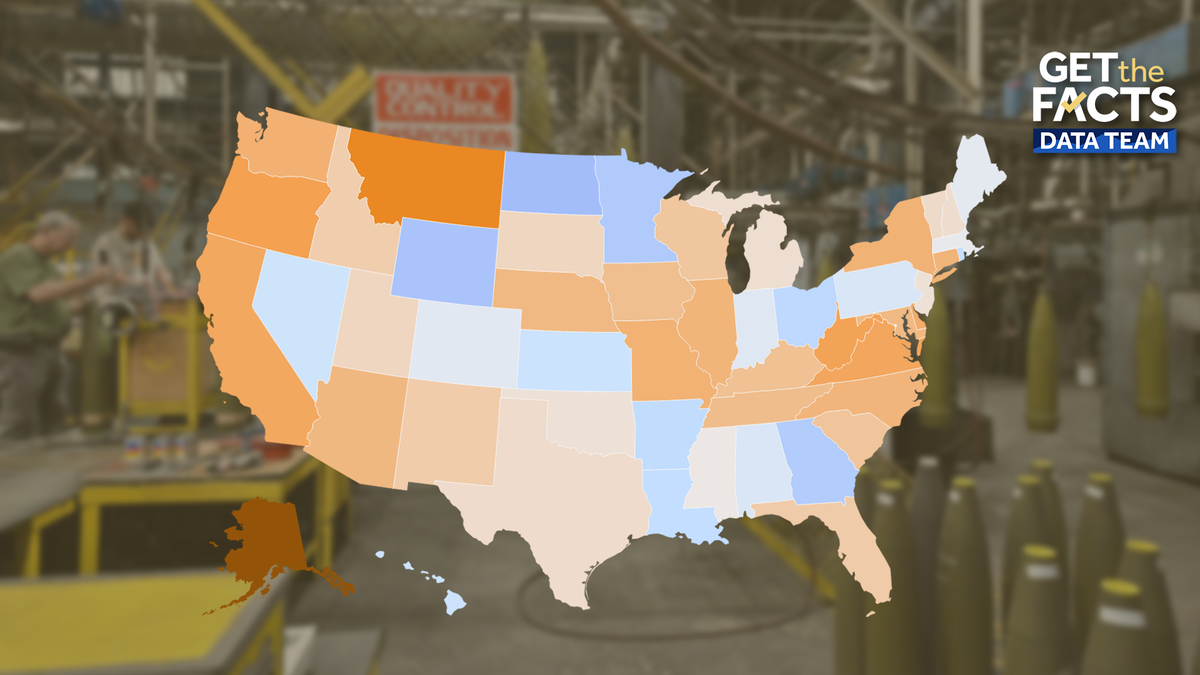
But more than half of U.S. states had a decline in manufacturing employment over the past year. Alaska had the steepest percentage drop at 6%, a loss of 800 employees. Montana and Oregon followed, with declines of roughly 5% and 3%.

California, Texas and Ohio have the highest total number of manufacturing employees, but only Ohio reported job growth, gaining 8,500 employees over the year. California lost 32,600 employees, a 2.3% loss.

“Manufacturing is still a place where you have a lot of workers without a college degree,” said Bivens. “When they lose a manufacturing job, they’re a little less likely to find a job with equivalent pay and equivalent benefits.”

Free Training

Source link