
Samsung Biologics to establish first U.S. manufacturing base in Maryland


ROCKVILLE, MD—In a major win for Maryland’s life sciences sector, Governor Wes Moore announced this week that South Korea-based Samsung Biologics will open its first United States manufacturing facility in Rockville. The move follows a strategic international trade mission led by the Governor earlier this year to strengthen economic ties with East Asian tech leaders.

Samsung Biologics, the world’s largest contract drug manufacturer, has reached an agreement to acquire a manufacturing campus in Rockville from GSK for $280 million. The facility will serve as a cornerstone for the company’s expansion into the American market, providing a localized hub for the production of critical biologic medicines.

Strengthening the Global Supply Chain

The acquisition secures a site that currently houses two high-standard manufacturing plants with a combined capacity of 60,000 liters. Samsung Biologics plans to not only maintain the current production of existing medicines but also invest in significant technology upgrades and capacity expansions.

By establishing a footprint in Maryland, the company aims to create a more resilient supply chain for life-saving therapeutics, offering clinical and commercial production capabilities on U.S. soil.

Economic Impact and Job Retention

A primary component of the agreement is the preservation of Maryland’s specialized workforce. Samsung Biologics has committed to:

  • Retaining more than 500 existing jobs at the Rockville site.
  • Creating additional high-skilled positions as production capacity grows.
  • Generating new opportunities for local Maryland suppliers.

Governor Moore noted that the deal is a testament to the state’s highly skilled workforce and its status as a premier global bio-cluster. The announcement builds on a record year for Maryland’s biopharmaceutical industry, which recently saw a $2 billion investment from AstraZeneca and the arrival of several other international firms.

Strategic Location in the I-270 Tech Corridor

Montgomery County officials emphasized that Rockville’s proximity to federal institutions like the FDA and the NIH makes it an ideal location for global companies navigating complex regulatory environments. County Executive Marc Elrich described the investment as a robust endorsement of the local ecosystem, which relies on a combination of talent, diversity, and public-private partnerships.

The transition is expected to be finalized following the formal close of the acquisition, with Samsung Biologics integrating the Rockville campus into its global network that already spans five major plants in South Korea.

Please follow and like us:

fb-share-icon
Tweet


Chris Montcalmo - Baltimore Acoustic Musician


Free Training

Source link

Tariffs and Deportations – Will They Revive U.S. Manufacturing?


The good news: Tariffs can increase overall U.S. manufacturing employment in the long run. The bad news: Tariffs are likely to reduce U.S. manufacturing employment in the short term, and to cause more reallocation of workers across individual sectors than bring overall employment growth.

Moreover, employment could fall sharply in the short run and remain depressed for many years before it eventually recovers, due to supply-chain adjustment frictions.

That’s the conclusion from Joseph B. Steinberg, in his recent paper for the National Bureau of Economic Research (NBER), titled “Tariffs, Manufacturing Employment, and Supply Chains.”

Steinberg is a professor at the University of Toronto’s economics department, and an NBER Research Associate in the International Finance and Macroeconomics program.

Regarding the overall economic impact of tariffs, Steinberg says that, while they can increase employment of people making goods such as toys, the tradeoff is that the economy would shrink. If tariffs were levied mostly on, say, “upstream” or non-finished materials for which demand fluctuates in line with price (e.g. gasoline), economic output would increase, but then that would cause a fall in employment. All in all, it appears impossible to use tariffs to both increase manufacturing employment and simultaneously improve the overall economy, Steinberg concludes.

The models Steinberg has run worsen if other countries retaliate with symmetrical tariffs, with overall employment in the U.S. goods sector dropping slightly in the long run, and falling almost twice as much in the short run. Only specific sectors with “high elasticity” — goods and services that see significant changes in consumer demand or supply in response to even small changes in price, such as toys — would experience a long-run gain in employment. “Thus, reindustrialization through tariffs hinges on the rest of the world not retaliating,” Steinberg warns.

A similar conundrum comes with the impact on jobs and the economy of the deportation of workers who do not have legal employment status — another high-profile target of the Trump administration. 

The U.S. has long tolerated the fact that a huge proportion of workers in the agriculture, construction and hospitality industries are working illegally, what a 2004 Boston Globe editorial called “the dirty little secret of the American economy.” For example, more than 40% of U.S. farmworkers are undocumented immigrants, according to a 2022 report by the US Department of Agriculture. In California, more than 75% are undocumented, according to the University of California, Merced

Read More: U.S. Tariff and Deportation Policies on Collision Course in Agribusiness

A July 2025 report from the Economic Policy Institute by Ben Zipperer finds that, if the Trump administration follows through on its goals of deporting 4 million people over four years, there will be 3.3 million fewer employed immigrants and 2.6 million fewer employed U.S.-born workers at the end of that period.

It sounds counter-intuitive, but the research is solid, says Zipperer. For example, aggressive deportations can cause a sharp and abrupt enough fall in labor supply that some employers will respond by shutting down operations entirely. This has been clearly seen already in small businesses such as restaurants that serve farming communities in Southern California and the Rio Grande agricultural regions, for example, where fear of ICE crackdowns has kept their customers and employees at home. 

Zipperer points to an earlier, ambitious U.S. immigration enforcement program, “Secure Communities,” that began in 2008 under the administration of President W.H. Bush, which resulted in around 1.2 million deportations that year.  (The Clinton administration still holds the record for numbers of deportations in a single year, at close to 1.9 million in 2000.) Increased immigration-related arrests and deportations reduced the number of childcare facilities, harming both immigrant and U.S.-born employment in the childcare sector, as well as the ability for those who rely on childcare to work, whether U.S. or foreign born.

Further, Zipperer says, the rising threat of arrest or deportation makes it harder for immigrants to find new employment opportunities that do not risk their ability to stay in the U.S., compelling them to stay with a bad or law-breaking employer. With shrinking alternative job options, immigrants are forced to settle for lower wages and poor working conditions. These deteriorating conditions drag down wages and conditions for all workers, Zipperer says. Employment will decline for U.S.-born workers, he adds, as they are less likely to work at jobs with falling wage rates.

Another argument in favor of widespread deportation is that illegal immigrants sap state and federal resources. But, according to U.S. News & World Report, research has shown that immigrants pay more in federal taxes than they receive in government benefits.

“The available evidence suggests that immigration leads to more innovation, a better educated workforce, greater occupational specialization, better matching of skills with jobs, and higher overall economic productivity,” concludes a 2016 report from the Wharton School at the University of Pennsylvania, republished by U.S. Congress in January 2024.

Free Training

Source link

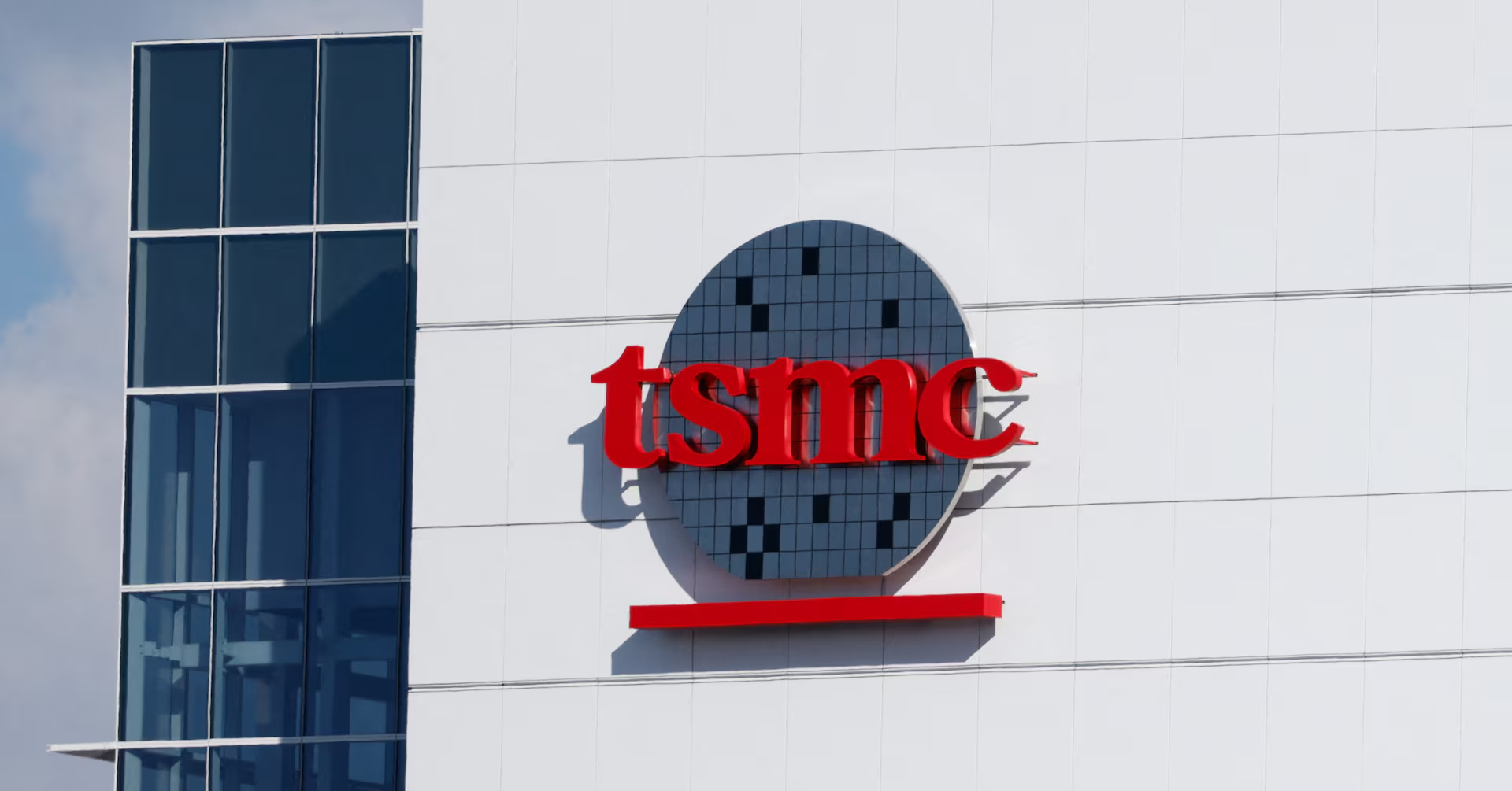
U.S. grants TSMC annual licence to import U.S. chipmaking tools into China


SEOUL, Jan 1 (Reuters) – The U.S. government has granted an annual licence to Taiwan Semiconductor Manufacturing (2330.TW), opens new tab to import U.S. chip manufacturing equipment to its facilities in Nanjing, China, the chipmaker said on Thursday.

The approval “ensures uninterrupted fab operations and product deliveries,” the company said in a statement to Reuters.

Sign up here.

South Korea’s Samsung Electronics and SK Hynix (000660.KS), opens new tab have also received similar import licences.

Previously, the Asian companies had benefited from exemptions from Washington’s sweeping restrictions on chip-related exports to China, part of U.S. efforts to try to stay ahead of China in technological development.

But those privileges – known as validated end-user status – expired on December 31 and the companies had to seek U.S. export licences instead for 2026.

“The U.S. Department of Commerce has granted TSMC Nanjing an annual export license that allows U.S. export-controlled items to be supplied to TSMC Nanjing without the need for individual vendor licenses,” TSMC said in its statement.

It added the licence “ensures uninterrupted fab operations and product deliveries”.

The Nanjing plant makes 16-nanometre and other mature node chips – not TSMC’s most-advanced semiconductors. TSMC also has a chipmaking plant in Shanghai.

In its 2024 annual report, TSMC said its Nanjing site generated about 2.4% of overall revenue.

Reporting by Hyunjoo Jin and Wen-Yee Lee; Editing by Chizu Nomiyama, Rod Nickel, Neil Fullick

Our Standards: The Thomson Reuters Trust Principles., opens new tab

Purchase Licensing Rights

Free Training

Source link