

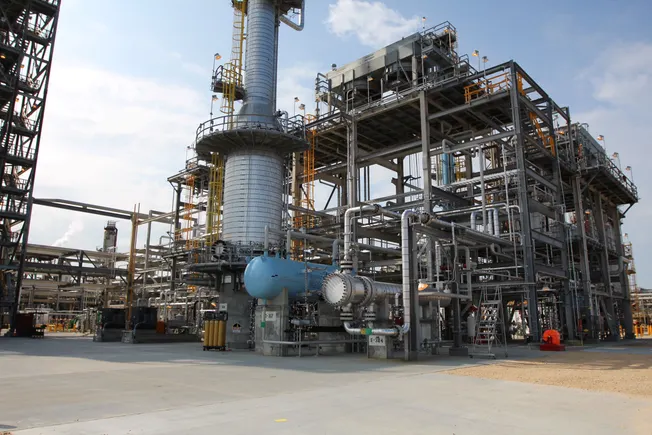
US manufacturing activity drops to lowest point of 2025: PMI


Listen to the article
4 min

This audio is auto-generated. Please let us know if you have feedback.

U.S. manufacturing activity decreased to its lowest point of 2025 last month, affected by continued tariff uncertainty and weak demand, according to the Institute for Supply Management’s latest Purchasing Managers’ Index.

ISM’s index registered 47.9% in December, down 0.3 percentage points compared with November. A PMI index below 50% shows an industry in contraction.

Despite improvements in three of the four main demand areas — including new orders, backlog of orders and new export orders — the indexes continued to be in contraction as they have been for months. Meanwhile, production slipped 0.4 percentage points, but was in expansion for the second month in a row.

Susan Spence, chair of ISM’s Manufacturing Business Survey Committee, said on a call with reporters Monday that the demand improvements are good, but the question remains if this could be the start of a turnaround or “just another blip.” She also noted that production expansion is likely in a “bubble” following four months of new orders in contraction.

“When new orders start turning around and expand for more than a month at a time — one, two, three, four, five months — then you’re going to see it flow to production and backlog, and then everything should follow,” Spence said.

Last month, new orders expanded in two of the 18 manufacturing sectors that ISM tracks, and only one of them was in computer and electronic products, which has seen major growth last year driven by data center buildouts to accommodate artificial intelligence demand.

Surveyed panelists cited tariffs as the biggest issue for them last month. Executive participants reported softer international orders as uncertainty around U.S. economic policy continues, Spence said, citing a ratio of 1.5 negative comments for every positive one regarding export orders.

Separately, employment contracted at a slower rate, with a majority of panelists saying that their companies are managing head counts instead of hiring. Additionally, supplier deliveries are slower compared to November and customer inventories are in the “too low” category, which can be a positive indicator for future production.

A mix of staff reductions, a lack of backfilling and continued price increases signals “that we’re still in a struggling economy,” Spence said. Compared to the overall economy, which has grown steadily every month since April 2020, the manufacturing sector has contracted for most of 2025.

Of the big six sectors that PMI follows, Spence said the computer and electronics products category expanded for half of the year, while other areas like transportation equipment and chemical products contracted most months. Meanwhile, petroleum and coal products expanded for the first nine months of the year and declined in the last three, she added.

“We’ll see what happens with the latest news out of Venezuela,” said Spence, who oversaw sourcing and procurement at FedEx for 10 years. President Donald Trump’s military operation in the South American country could shock U.S. and global oil prices.

Currently, companies like Chevron and ConocoPhillips are monitoring the situation and say it’s too early to speculate on future business activities or investments, News Nation reported. Chevron has infrastructure and workforces in Venezuela, while ConocoPhillips does not.

“It depends on what the plan is and if the country can come roaring back from an … infrastructure issue,” Spence said.

S&P’s December manufacturing PMI report provided a similar picture for the month as new orders fell for the first time over the past year and international sales continued to decline, due in part to tariffs. On the brighter side, the credit rating agency saw employment growth for most of the year and job creation was its most pronounced since August.

Although manufacturers ramped up production in December, prospects for the start of 2026 are “looking less rosy,” Chris Williamson, chief business economist at S&P Global Market Intelligence, said in a statement.

“Factories are continuing to produce goods despite suffering a drop in orders,” he said, adding that the gap between production and orders is the widest it has been since the height of the 2008 global financial crisis.

“Unless demand improves, current factory production levels are clearly unsustainable,” Williamson said.


Free Training

Source link

America is having a manufacturing renaissance


President Trump and his administration are adjusting to changes in the global economic and strategic landscape, positioning America to remain the global military and economic leader in the face of unprecedented challenges.

The president began this work a year ago with the signing of the America First Trade Policy executive order. In December, the White House expanded its strategic view by issuing its National Security Strategy. Both are strong statements outlining a bold new direction affecting a wide range of policy disciplines and spending.

American manufacturing is a central pillar in the overarching strategy. Over the past year and in the years to come, manufacturing policies will be evaluated based on their ability to advance national economic power and support national defense. Over the past 12 months, we have made significant progress. As a result, America will experience a manufacturing renaissance in 2026.

In November, the Dallas Federal Reserve published its Texas Manufacturing Outlook Survey, showing that manufacturing activity has been positive for the past three quarters and surged more than 20 points from 2024, which is a reliable indicator of national trends. Also, the U.S. Bureau of Economic Analysis announced that the economy grew at an annualized rate of 4.3% in the third quarter of 2025, an enormous achievement.

The America First Trade Policy’s stated purpose was to promote investment and productivity, enhance industrial and technological advantages and defend our economic and national security. The following five areas play an outsize role in driving results: tariffs, fair and balanced trade, enforcement, industrial policy and macroeconomic policy.

Tariff implementation corrected years of trading partners’ unfair practices, which had driven many good U.S. companies out of business or forced them to move operations overseas. Tariffs are incentivizing the reshoring of manufacturing and increasing domestic investment. Tariffs will also spur foreign direct investment by incentivizing international companies to set up new facilities or expand existing ones in the U.S.

Fair and balanced trade through new agreements is leveraging strategic investments, fostering high-tech manufacturing opportunities and thwarting mercantilist policies of competing countries that have absorbed critical elements of American manufacturing. Our challenge will be to retain the valuable free market allocation of capital while protecting strategic elements of our manufacturing sector.

The recent trade deals with Britain and the European Union replace existing trade barriers with market-opening agreements, allowing U.S. goods to compete. Additionally, these agreements leverage greater foreign direct investment, with recent deals securing $550 billion and $350 billion, respectively, from Japan and South Korea. In 2025 alone, the administration was able to garner more than $20 trillion in investment, leveraging America’s global spending to spur industrial revitalization.

Enforcement through investigations is being conducted to ensure foreign companies do not have an unfair advantage in the U.S. marketplace. The Commerce Department’s Section 232 and the U.S. Trade Representative’s Section 301 investigations now support a fair marketplace. These investigations determine whether importing certain goods within specific sectors poses a threat to national security and then recommend remedies and measures to prevent recurrence, ensuring that both economic and national security are protected.

Using these tools gives the president options for addressing predatory actions by non-free-market economies.

Industrial policy by executive order has given clear guidance to the government and the private sector. Recent executive orders, such as investments in artificial intelligence infrastructure, energy dominance and maritime shipbuilding dominance, are core to the president’s plan. They expand industrial capacity, unlock financial incentives and streamline permitting. Collectively, these executive orders reinforce our industrial and technological advantages, which will be key to the revitalization and growth of large and complex industries.

Macroeconomic policy, such as business-friendly tax policy and lowering interest rates, is encouraging companies to allocate capital into manufacturing and machinery investments. Tax policy improvements within the One Big Beautiful Bill Act will provide tax certainty for small manufacturers by extending the 20% pass-through deduction, preserving individual tax rates, and protecting small, family-owned manufacturers from estate taxes.

The One Big Beautiful Bill Act also supports investment and innovation by restoring immediate research and development expensing, preserving the 21% corporate tax rate, and creating a deduction that allows companies to immediately expense the cost of new factories and the costs of improvements to existing facilities.

Under Mr. Trump, manufacturing output and productivity are increasing, negative trade balances are being reduced, and economic and national security are being strengthened. Guided by the America First Trade Policy and National Security Strategy, the U.S. is entering a golden era of policy certainty, manufacturing incentives, the revitalization of key industries, and a resurgence in dormant industries.

Ultimately, the America First Trade Policy and National Security Strategy are enabling America’s global competitiveness by recharging existing industries and igniting a manufacturing renaissance.

• Alex Krutz is the managing director for Patriot Industrial Partners, an industrial consulting firm. Until December, he served as the deputy assistant secretary for manufacturing at the Commerce Department, where he advanced policies in support of U.S. manufacturing.

Free Training

Source link