


Novartis charts next US investment with new radiopharma plant


As Novartis turns the calendar on a new year, the Swiss drugmaker is elaborating further on plans for the $23 billion U.S. investment it unveiled last April.

Next on the docket will be a new, 35,000-square-foot radioligand therapy (RLT) facility in Winter Park, Florida, Novartis reported Friday. 

Joining established plants in Novartis’ American RLT network in Indiana, New Jersey and California, the new facility will boost the company’s radiopharmaceutical manufacturing to “optimize the delivery” of the cutting-edge cancer treatments to patients across the southeastern United States, Novartis said in a Jan. 9 press release. The upcoming site is expected to come online by 2029, the company added. 

While radiopharmaceuticals, which target cancer cells with a radioactive drug, have become an increasingly popular oncology development target, few have crossed the regulatory finish line so far. Novartis, however, boasts two approved RLTs in Lutathera and Pluvicto, which have been cleared by the FDA to treat neuroendocrine tumors and prostate cancer, respectively.

“Building this new facility in Florida marks an important step in fulfilling the promise of RLT for patients,” Novartis CEO Vas Narasimhan said in a statement Friday. “Radioligand therapy has fundamentally changed how we approach certain cancers, and our growing U.S. manufacturing network ensures we can continue to deliver these critical medicines with speed and reliability to patients who need them.”

As for why the company selected Florida for its new site, RLT manufacturing requires “specialized talent,” and the state has that in droves thanks to steady investments in higher education for life sciences and technology, Novartis explained in its release. 

The Florida RLT facility marks the latest stop on Novartis’ $23 billion U.S. investment drive. The company revealed the investment plan early last year as drugmakers sought to counter the Trump administration’s pharmaceutical tariff threats by building or expanding production facilities on U.S. soil.

Novartis specifically pledged to build and expand 10 U.S. sites through 2030, including four new manufacturing plants and fresh radioligand facilities in Florida and Texas. Novartis’ plans for its fifth U.S. RLT plant have yet to be revealed. At the same time, the company also said it would chart expansions at the RLT facilities in Indiana, New Jersey and California.

The Carlsbad, California, site officially came online last November, at the time marking the company’s third production hub for radiopharmaceuticals in the U.S. The 10,000-square-foot facility has been designed to enable Novartis to “seamlessly meet future demand for RLT,” the company said at the time of the ribbon cutting.

RLTs, also known as radiopharmaceuticals, are a form of precision medicine that wed a tumor-targeting molecule—known as a ligand—with a therapeutic radioisotope. The class is designed to deliver radiation to tumors while limiting damage to surrounding cells, Novartis has explained.

However, the radioactive isotopes used to create the drugs have posed production and supply challenges for the industry.

Given the close relationship between the production of the product and the end-therapy itself, many radiopharmaceutical developers have embraced manufacturing early on in their work.

Recognizing the supply hurdles, Novartis in Sept. 2024 announced that it was building a new plant on its Indiana RLT campus to produce radioactive isotopes. The reveal came in tandem with news that Novartis would establish its RLT manufacturing site in California.

“We are investing in our supply chain capabilities today to ensure that we are prepared to consistently deliver these complex treatments to the growing number of eligible patients in the long term,” Victor Bultó, Novartis’ U.S. president, said in a statement at the time.

In addition to its U.S. sites, Novartis also operates RLT facilities in Ivrea, Italy, and Zaragoza, Spain.

Elsewhere, Novartis revealed another major piece of its $23 billion outlay in November when it sketched out plans for a “flagship” production hub in North Carolina, where it intends to create some 700 new jobs.

Free Training

Source link

US factory headcount falling despite Trump’s promised manufacturing boom


  • US manufacturing jobs continue to decline
  • Unemployment rate falls slightly, but job creation estimates revised lower
  • Black unemployment rate rises, manufacturing sector loses 70,000 jobs since April

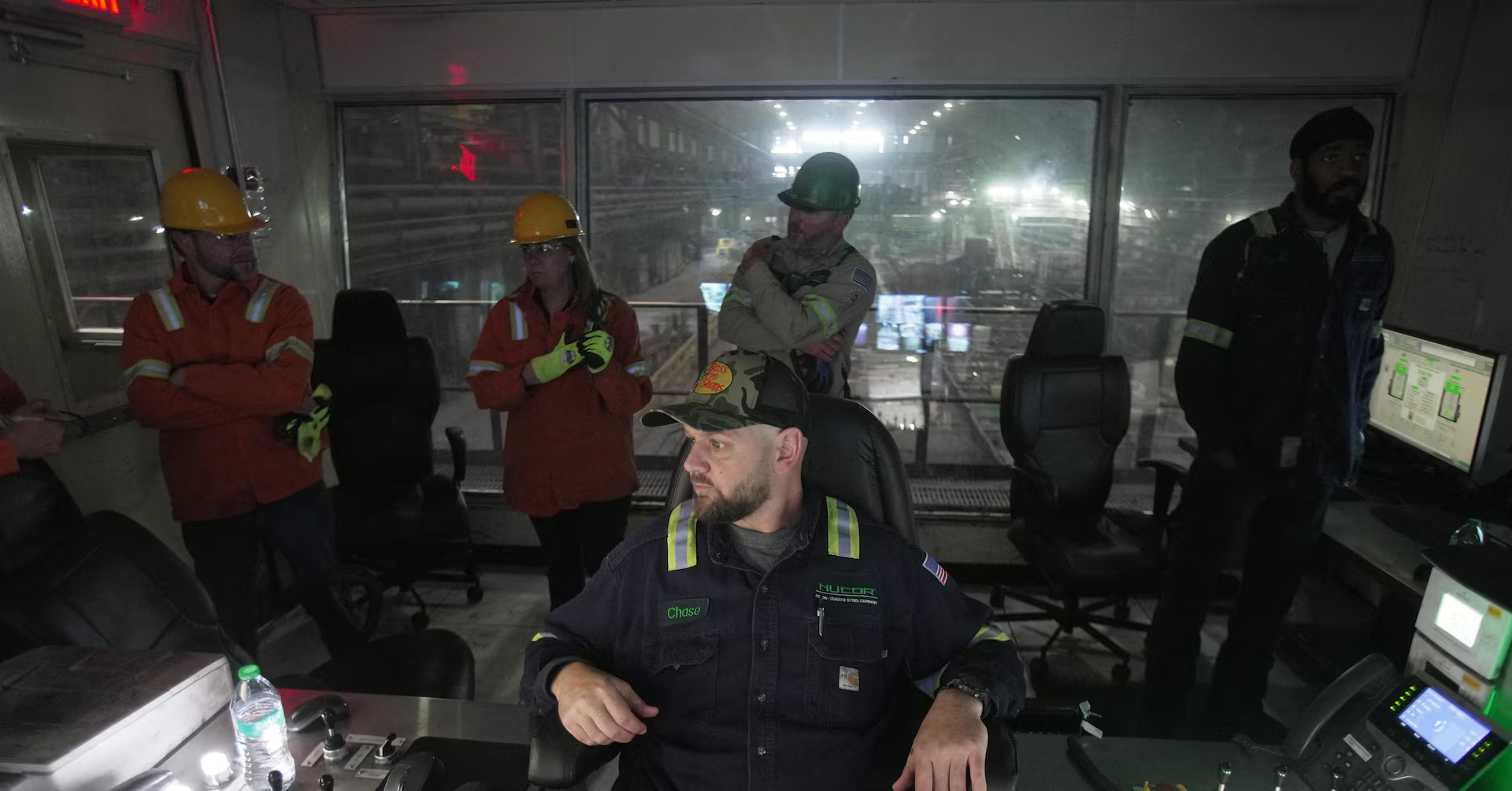
WASHINGTON, Jan 9 (Reuters) – U.S. manufacturing jobs in December continued an eight-month skid that began last spring after President Donald Trump rolled out aggressive import taxes that he pledged would lead to a resurgence of blue-collar jobs by reshuffling world trade to favor U.S. workers.

The reshuffling has certainly occurred, with the U.S. collecting around $30 billion a month in tariff revenue, spread among U.S. consumers, importers, and overseas exporting firms, and as firms first frontloaded goods abroad to stock their shelves with tariff-skirting inventory, then slowed their purchases and brought down U.S. import levels.

Sign up here.

But the blue-collar jobs boom hasn’t materialized, adding to the soured sentiment about Trump’s economic policies among households concerned about still-rising prices and uncertainty about the labor market.Data released on Friday showed the unemployment rate fell slightly to 4.4% in December from 4.5% in November, though estimates of job creation in prior months were revised lower, presenting U.S. Federal Reserve officials with a mixed message of a jobless rate that remains low by historic standards, but hiring trends that seem weak and job growth that seems narrow.

The latest data “is very much in line with the businesses I am talking to, which is that the low-hire environment continues. Some of it is uncertainty. A lot of it is productivity,” Richmond Fed President Tom Barkin said in comments to journalists. “It is hard to find businesses outside of the AI ecosystem or healthcare that are talking about hiring.”

Just ask J.B. Brown, CEO of BCI Solutions Inc., a small metal foundry in Bremen, Indiana, that sells to a range of agriculture and heavy equipment makers.

“Every time I hear that manufacturing is booming, I scream at the TV,” Brown told Reuters. His workforce is down to 130 from 240 people over the past 27 months. That’s the fewest the family-owned business has had since at least 1993, when he joined the company.

Brown said he eliminated a shift in September 2023 and has let attrition steadily reduce numbers since then. He said he could cut another 5% of his workers, if necessary, but he’s trying to avoid that to keep ready for the eventual upturn in orders. His capacity now stands at 52%, another low point. “I’ve never been below 70 to 65%,” he said. “This is our first time experiencing that.”

MANUFACTURING EMPLOYMENT LOWER THAN IN TRUMP’S FIRST TERM

The pace of job creation in the first year of Trump’s second term has fallen more than two-thirds from what it was in the final year under President Joe Biden, to an estimated 49,000 per month in 2025 versus 168,000 per month the prior year.

The unemployment rate has increased only modestly because the number of people looking for jobs has remained flat under Trump, with tougher immigration and deportation rules and enforcement curbing what had been steady labor force growth under Biden’s looser immigration policies.

“The healthcare sector is the only sector that is adding jobs right now, and it always does. It’s completely insensitive to the economic cycle,” Luke Tilley, chief economist at Wilmington Trust, said at a Maryland Bankers Association event on Friday.

Some parts of the economy have felt the pressure more than others. The Black unemployment rate has risen from 6.2% as of January, when Trump resumed office, to 7.5% the past two months. The white unemployment rate by contrast has been between 3.5% and 3.8% since April of 2024, and was below that for more than two years prior.

Shows hiring breadth in factory employmentShows hiring breadth in factory employment

Hiring in manufacturing, meanwhile, has been in the doldrums. The sector lost another 8,000 jobs in December, the Bureau of Labor Statistics estimated, and factory employment has dropped more than 70,000 since April to 12.69 million as of last month – the lowest reading since March of 2022. Construction jobs by contrast, while dropping in December, have continued the slow but steady growth seen throughout the post-pandemic era, goaded along recently by a boom in data-center investment.

The much smaller mining and logging industry has also been losing jobs, down to 608,000 as of December versus 626,000 in April.

That was the month Trump rolled out the “Liberation Day” tariffs that, while quickly scaled back after a brutal market reaction, set the stage for an upheaval in world trade and investment patterns that is still unresolved.

The U.S. Supreme Court is expected to rule soon on a case that challenged the legality of many of the tariffs imposed under national security laws but touted by Trump as a source of revenue and meant to reclaim U.S. manufacturing supremacy.

The path of employment since the new strategy was put in place, however, shows if anything how difficult it is to reshape labor market dynamics in a $30 trillion economy whose population is aging and in need of aging-related services, where growth is dependent on consumer spending that tends to be concentrated on services like education, healthcare, leisure, and restaurants, and whose workers command a wage premium that causes firms and managers to invest in productivity so they can make goods with fewer man-hours.

Manufacturing employment in the U.S. is now lower than it was for much of Trump’s initial term, which ran from 2017 until his loss to Biden in the 2020 election.

Shows US manufacturing employmentShows US manufacturing employment

Overall, hiring has been narrowly focused, with a measure of hiring breadth showing more industries shedding employment than adding.

The economy is generating jobs based on what people want to buy and what firms can profitably sell, and so hiring patterns haven’t shifted all that much.

“Nothing in the…data points towards significant, near-term change to this now familiar pattern,” Laura Ullrich, director of economic research in North America at the Indeed Hiring Lab, wrote after the release of the December employment data. “That said, a low-hire/low-fire environment can’t last forever in a growing economy. While a long-stagnant labor market might not be as directly alarming as an obviously broken one, it can still feel quite broken for many job seekers.”

Reporting by Howard Schneider; Addtional reporting by Tim Aeppel; Editing by Andrea Ricci

Our Standards: The Thomson Reuters Trust Principles., opens new tab

Purchase Licensing RightsHoward Schneider

Covers the U.S. Federal Reserve, monetary policy and the economy, a graduate of the University of Maryland and Johns Hopkins University with previous experience as a foreign correspondent, economics reporter and on the local staff of the Washington Post.

Free Training

Source link