

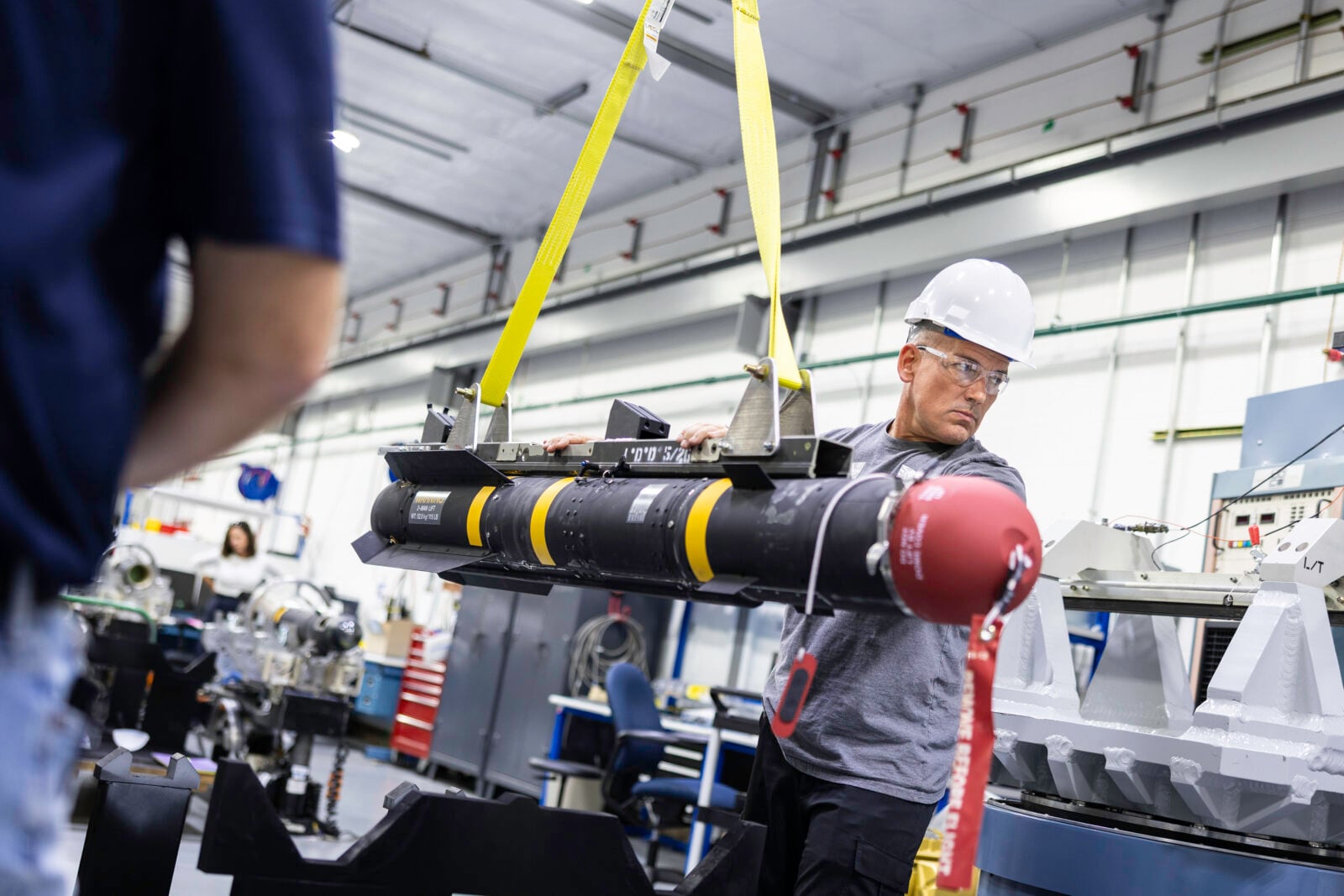

U.S. missile manufacturing fails to match wartime tempo
United States missile manufacturing is failing to keep pace with the tempo of modern warfare, raising concerns about how quickly the military can replace precision weapons in a high-intensity conflict. To examine where the bottlenecks lie and how they affect readiness, Defence Blog sought comment from John Borrego, Senior Vice President of Aerospace and Defense at Machina Labs, who has held senior technical and leadership roles at Northrop Grumman, SpaceX, Rocketdyne, and Los Alamos National Laboratory.
In responses provided to Defence Blog, Borrego said manufacturing speed should be measured not by machine output alone, but by how quickly the United States can turn a validated military requirement into fielded weapons at scale.
“In modern missile and advanced weapons production, manufacturing speed means the ability to translate design intent into flight-ready components, iterate quickly, and surge output without months or years of retooling,” Borrego said. “Manufacturing speed isn’t just about how fast machines operate, it’s about how quickly we can turn a validated military need into field-ready firepower.”
– ADVERTISEMENT – CONTINUE READING BELOW –
Borrego defined the concept as “time-to-fielded-firepower,” describing it as the full timeline from identifying a requirement or replacing combat losses to delivering qualified, accepted weapons in volume. According to him, this timeline is increasingly out of sync with the pace of modern conflict.
“This matters for readiness because today’s threat environment evolves on operational, not industrial, timelines,” Borrego said. “Adversaries iterate weapons, tactics, and countermeasures faster than legacy defense manufacturing can traditionally respond. If production takes years to adapt, even technically superior systems arrive too late to matter.”
Borrego said manufacturing speed depends on four interconnected timelines that determine whether factories can respond to wartime demand.
The first is “design to producible,” which measures how quickly a concept becomes a buildable and testable design using model-based systems and controlled interfaces. The second is “qualify to ship,” covering how fast materials, processes, suppliers, and first articles can be certified without restarting qualification for every batch. The third is “cycle to throughput,” which reflects how efficiently a factory converts raw inputs into quality-assured hardware. The final clock is “ramp to surge,” or how rapidly output can double or triple without compromising safety, quality, or cost.
According to Borrego, most U.S. defense factories struggle to keep these clocks aligned, especially when demand rises suddenly.
Borrego said the most serious bottlenecks are structural, with tooling at the top of the list. Traditional tooling, he noted, can take years to design and qualify, making rapid scale-up or design changes difficult.
“Most legacy manufacturing processes were built for stable, predictable production,” he said. “When requirements shift, the entire system slows down. By removing tooling from the critical path and digitizing production, surge capacity can scale through machines and software, not timelines.”
He also identified persistent constraints in energetics, including propellants, explosives, cast-cure capacity, and strict handling requirements. Seeker and guidance electronics remain limited by microelectronics, radiation-hardened components, specialized sensors, and secure supply chains. Motors, casings, and specialty materials are constrained by long-lead forgings, castings, composites, and integrated structures.
Single-source sub-tier suppliers present another risk, Borrego said, because many have fragile capacity and no business case for maintaining surge readiness.
Testing infrastructure also delays output, particularly in thermal vacuum testing, vibration testing, ordnance trials, non-destructive testing, metrology, and calibration. Workforce shortages add to the problem, with a limited number of cleared and experienced manufacturing engineers, inspectors, NDT technicians, and energetic handlers, and critical knowledge often concentrated in only a few individuals.
Borrego said an agile, multi-process manufacturing model could change how the U.S. responds to rapid demand spikes or prolonged high-intensity conflict by allowing factories to shift production without waiting for new tooling or facility redesigns.
“In a real surge or drawn-out fight, the challenge isn’t knowing what to build,” he said. “Most factories are locked into doing one thing, one way, and changing that can take months or even years. An agile, multi-process manufacturing model removes that constraint.”
Under this approach, production would rely on modular cells capable of machining, forming, additive manufacturing where appropriate, hybrid layup, assembly, and inspection, all connected by a digital thread. Reconfigurable tooling, reusable fixtures, programmable robotic paths, and parameterized workholding would reduce changeover times and dependence on long-lead hard tools.
Borrego said qualification would also need to be standardized across sites using pre-qualified materials, standardized inspection plans, digital acceptance records, in-line monitoring, and model-based design definitions. This would allow distributed production instead of reliance on a single factory.
Borrego’s warning echoes findings from U.S. government assessments. A 2023 wargame conducted for the House Select Committee on Strategic Competition concluded that, in a conflict with China, the United States would expend its stock of advanced missiles and bombs in less than a month and run out of some critical weapons in a matter of days.
According to Borrego, agile manufacturing is the only way to close that gap without relying on stockpiles that cannot be replenished in time.
“In a prolonged or high-intensity conflict, the central question becomes: can the U.S. sustain both precision and volume?” he said. “Agile, multi-process manufacturing makes this achievable, by building manufacturing depth, not just relying on unreplenishable stockpile depth.”