Meta Announces Up to $6 Billion Agreement With Corning to Support US Manufacturing


Building and operating data centers – the infrastructure that brings our technologies to life and supports our goal of personalized superintelligence – requires strong servers and hardware that connect and transfer information in near real time. Fiber optic cables are a critical part of supplying this connectivity, helping us power everything from wearable technology like Ray-Ban Meta AI glasses to our apps, which connect billions of people and businesses around the world.

Today, we’re announcing an up to $6 billion multi-year partnership with Corning that will supply fiber optic cables for our data center infrastructure. This agreement enables Corning to expand its manufacturing operations in North Carolina and add new jobs in the state.

“Building the most advanced data centers in the US requires world-class partners and American manufacturing. We’re proud to partner with Corning – a company with deep expertise in optical connectivity and commitment to domestic manufacturing – for the high-performance fiber optic cables our AI infrastructure needs. This collaboration will help create good-paying, skilled US jobs, strengthen local economies, and help secure the US lead in the global AI race.”

Joel Kaplan, Chief Global Affairs Officer, Meta

As part of this agreement, Corning will grow its manufacturing capabilities across its operations, which includes a significant capacity expansion at the Trivium Corporate Center in Catawba County, North Carolina.


“This long-term partnership with Meta reflects Corning’s commitment to develop, innovate, and manufacture the critical technologies that power next generation data centers here in the US,” said Wendell P. Weeks, Chairman and Chief Executive Officer of Corning Incorporated. “The investment will expand our manufacturing footprint in North Carolina, support an increase in Corning’s employment levels in the state by 15 to 20 percent, and help sustain a highly skilled workforce of more than 5,000, including the scientists, engineers, and production teams at two of the world’s largest optical fiber and cable manufacturing facilities. Together with Meta, we’re strengthening domestic supply chains and helping ensure that advanced data centers are built using US innovation and advanced manufacturing.”

Meta’s data centers – 26 of which are under construction or operational in the US – have already supported 30,000 skilled trade jobs during construction and support 5,000 operational jobs. This includes electricians, HVAC specialists, server and network technicians, safety and security experts, and engineers who work together to run some of the world’s most advanced facilities.

As digital tools and generative AI continue to transform our economy – in fields like healthcare, finance, agriculture, and more – the demand for fiber connectivity will continue to grow. By supporting American companies like Corning and building and operating data centers in America, we’re helping ensure that our nation maintains its competitive edge in the digital economy and the global race for AI leadership.

Free Training

Source link

Century Takes 40% Stake in EGA US Aluminum Smelter


Critical Supply Chain Dependencies Drive American Manufacturing Renaissance

The United States faces an unprecedented vulnerability in aluminum production, with domestic capacity meeting less than 20% of national demand while imports flood critical defense and aerospace manufacturing sectors. Century takes 40% stake in EGA’s US aluminum smelter project, representing a strategic response to this vulnerability that could reshape America’s manufacturing independence. Furthermore, this partnership transcends traditional investment models, creating new frameworks for technology transfer and capacity building that address critical minerals energy security concerns.

Traditional aluminum production economics have historically favoured regions with abundant, low-cost electricity and proximity to bauxite resources. However, recent geopolitical tensions and supply chain disruptions have elevated national security considerations above pure cost optimisation, forcing American industrial policy makers to reconsider the true value of domestic production capacity.

The Chicago-based Century Aluminum Company’s decision to acquire a 40% stake in Emirates Global Aluminium’s US smelter project represents a calculated pivot toward domestic capacity expansion through international technology partnerships. This joint venture structure enables Century to leverage EGA’s advanced EX smelting technology while maintaining significant operational control and benefiting from their established relationships with American industrial customers.

Century’s strategic positioning within this partnership reflects deep understanding of US market dynamics and regulatory requirements. In addition, the company’s existing operational footprint provides crucial advantages in workforce development, supply chain integration, and compliance with increasingly stringent environmental standards that foreign operators often struggle to navigate independently.

Risk-Reward Analysis for Century’s Expansion Strategy

The partnership structure allows Century to access proven technology without the capital intensity of developing proprietary smelting capabilities. EGA’s EX technology has demonstrated operational efficiency improvements of approximately 15-20% compared to conventional smelting processes, translating to significant cost advantages in energy-intensive aluminum production.

Key financial metrics supporting Century’s strategic rationale include:

Lower capital requirements through shared investment structure
Technology transfer benefits worth an estimated $200-300 million in avoided R&D costs
Market access advantages through EGA’s global trading relationships
Risk mitigation via operational expertise sharing

Production Capacity Impact on North American Markets

The 750,000 metric tons annual capacity planned for the Inola, Oklahoma facility would fundamentally alter US aluminum market dynamics, effectively doubling domestic primary production and reducing import dependency by approximately 25-30%. This scale represents the most significant capacity addition to American aluminum production since the 1970s industrial expansion period.

Market Dynamics and Price Impact Modelling

Current US aluminum consumption patterns reveal critical vulnerabilities in automotive and aerospace supply chains, where over 60% of material requirements depend on imported metal. The new facility’s capacity would specifically target these high-value applications, potentially reducing price volatility for domestic manufacturers while improving supply chain resilience.

Market Segment
Current Import Dependency
Projected Reduction

Automotive
65%
18-22%

Aerospace
70%
25-30%

Defence
55%
35-40%

Construction
45%
12-15%

Consequently, the facility’s strategic location in Oklahoma provides optimal access to both raw material supply chains and key industrial markets. Transportation cost analysis indicates potential $150-200 per ton savings for automotive manufacturers in the Midwest compared to imported aluminium, creating substantial competitive advantages for domestic producers.

Technology Transfer and Operational Excellence

EGA’s EX technology platform represents significant advancement in aluminium smelting efficiency, incorporating advanced process control systems and energy optimisation protocols that have achieved industry-leading power consumption rates of approximately 13,200 kWh per ton of aluminium produced. This efficiency level positions the facility competitively against global producers while meeting increasingly stringent environmental standards.

Innovation Potential for Future US Manufacturing

The technology transfer agreement extends beyond basic operational protocols to include:

Process optimisation methodologies developed across EGA’s global operations
Advanced automation systems for quality control and efficiency monitoring
Environmental management frameworks meeting international sustainability standards
Workforce training programs adapted for American operational requirements

These capabilities create foundation for potential expansion of advanced mining industry innovation throughout the United States, establishing technological precedents that could influence future industrial development policies.

Economic Impact Assessment for Regional Development

The Oklahoma facility represents $2.5 billion total investment with economic multiplier effects extending throughout the regional economy. Beyond direct employment creation, the project catalyses infrastructure development, supplier network expansion, and educational institution partnerships that generate sustained economic benefits.

Employment and Regional Development Metrics

Impact Category
Direct Numbers
Economic Multiplier Effect

Permanent Jobs
1,000 positions
$80 million annual wages

Construction Phase
4,000 workers
$500 million local spending

Indirect Employment
2,500 positions
$120 million economic impact

Tax Revenue
$1.5 billion incentives
20-year payback projection

The facility’s workforce requirements necessitate substantial investment in technical training programs, creating partnerships with regional universities and community colleges that extend educational benefits beyond immediate project needs. These institutional relationships establish long-term capacity for advanced manufacturing workforce development.

Infrastructure and Supply Chain Optimisation

Raw material sourcing strategies for the facility emphasise diversified supply chains combining Australian bauxite imports with potential future domestic alumina production. Transportation infrastructure improvements including rail capacity expansion and port facility upgrades create lasting benefits for regional industrial development.

Energy infrastructure requirements total approximately 900 megawatts of reliable power supply, driving renewable energy development and grid modernisation projects that benefit broader regional economic development. However, Oklahoma’s renewable energy resources, particularly wind power capacity, align with aluminium industry sustainability requirements while providing cost advantages.

The Century-EGA partnership reflects broader consolidation patterns within global aluminium markets, where joint venture structures increasingly replace traditional acquisition models for international capacity development. This approach enables technology sharing while respecting national security considerations that limit foreign ownership in critical industrial sectors.

Comparative Analysis with Global Partnership Models

Recent international aluminium partnerships demonstrate similar strategic frameworks:

Norsk Hydro-Qatalum partnership in Qatar combining Norwegian technology with Middle Eastern capital
Rio Tinto-China Hongqiao joint ventures leveraging complementary operational expertise
Alcoa-Saudi Arabian partnerships focusing on integrated aluminium production chains

These precedents validate joint venture approaches for complex industrial projects requiring substantial capital investment and advanced technical capabilities. Furthermore, Century Aluminum joins EGA for a major US aluminum production facility, marking the first such smelter construction in the United States since 1980.

Competitive Response Scenarios

Existing US aluminium producers face strategic decisions regarding capacity expansion versus market share protection. Alcoa Corporation and Norsk Hydro’s US operations may accelerate modernisation programs to maintain competitive positioning, while recycling sector operators could expand capacity to capture increased demand for sustainable aluminium sources.

Industry analysts project that successful completion of the Oklahoma facility could catalyse additional foreign investment in US aluminium production, potentially adding 1.5-2 million tons of annual capacity by 2035.

National Security and Defence Manufacturing Implications

Defence Department aluminium requirements total approximately 400,000 tons annually across military aircraft, naval vessels, and land-based systems manufacturing. Current supply chain analysis reveals concerning dependencies on imported materials for critical defence applications, creating strategic vulnerabilities during potential supply disruptions.

Aerospace Industry Supply Chain Security

Commercial aerospace manufacturers including Boeing and Lockheed Martin require high-grade aluminium products meeting stringent specifications for strength, corrosion resistance, and quality consistency. The new facility’s capacity specifically targets these premium applications, reducing reliance on international suppliers while improving supply chain predictability.

Strategic reserve considerations involve establishing buffer inventory systems for critical aluminium grades used in defence applications. The facility’s domestic location enables more effective integration with national strategic materials policies while reducing transportation vulnerabilities associated with imported supplies.

Risk Assessment and Mitigation Strategies

Construction timeline risks represent the most significant threat to project success, with complex environmental permitting processes and skilled workforce availability creating potential delays. Federal and state regulatory coordination mechanisms established for the project provide templates for future critical infrastructure development while streamlining approval processes.

Market Risk Scenarios and Financial Resilience

Aluminium price volatility analysis indicates potential $200-400 per ton price swings based on global economic conditions and trade policy changes. The joint venture structure provides resilience through:

Diversified revenue streams across multiple end-use markets
Operational flexibility enabling production adjustments during market downturns
Long-term supply contracts with major industrial customers providing price stability
Technology advantages maintaining cost competitiveness across market cycles

Trade policy uncertainty remains significant risk factor, particularly regarding tariffs impact on markets and international trade agreements affecting competitive dynamics. The domestic production advantage provides natural hedge against trade policy volatility while supporting industrial policy objectives.

Future Strategic Implications for Critical Minerals Policy

The partnership establishes precedent for technology-sharing joint ventures in other critical mineral sectors including lithium processing, rare earth element production, and copper refining. Federal policy frameworks supporting similar partnerships could accelerate domestic capacity development across strategic material supply chains.

Integration with Broader Industrial Policy

State-level incentive structures pioneered for the Oklahoma facility demonstrate effective public-private partnership models for strategic industrial development. $1.5 billion in state and local incentives create frameworks applicable to future critical mineral processing projects while establishing performance metrics for measuring economic returns on public investment.

For instance, the initiative aligns with broader policy objectives outlined in the recent mineral production order, which emphasises domestic capacity building for national security materials. Furthermore, EGA and Century Aluminum’s partnership demonstrates successful international collaboration models that could be replicated across other critical sectors.

Long-term strategic positioning involves developing integrated aluminium production chains from bauxite processing through finished product manufacturing, reducing dependencies at multiple supply chain levels while creating additional high-value employment opportunities.

Measuring Success Through Strategic Performance Indicators

Project success measurement requires comprehensive frameworks addressing production metrics, market impact, and strategic objectives. Key performance indicators include capacity utilisation rates, market share capture in target sectors, and technology transfer effectiveness measured through operational efficiency improvements.

Timeline Milestones and Capacity Development

Critical success factors for the next decade include:

2026: Construction commencement and regulatory approval completion
2028: Infrastructure development and workforce training programme implementation
2029: Equipment installation and commissioning phase initiation
2030: Production ramp-up and initial market penetration
2032: Full capacity operation and market share stabilisation

Return on investment projections indicate 12-15% internal rate of return over the facility’s 30-year operational lifespan, assuming stable market conditions and successful technology implementation. These metrics support additional investment in domestic aluminium production capacity while demonstrating viability of international partnership models.

The transformation of American aluminium production through strategic international partnerships represents fundamental shift toward manufacturing independence that balances technological advancement with national security requirements. However, ongoing challenges from the US-China trade war and global supply chain disruptions emphasise the critical importance of domestic capacity development.

Success of the Century takes 40% stake in EGA’s US aluminum smelter project could establish templates for critical mineral sector development that reshape industrial policy for the next generation. Consequently, this partnership model offers a blueprint for addressing America’s strategic material vulnerabilities while maintaining technological competitiveness in global markets.

Looking to Capitalise on Critical Minerals and Industrial Development Opportunities?

Discovery Alert’s proprietary Discovery IQ model delivers real-time alerts on significant ASX mineral discoveries, instantly empowering subscribers to identify actionable opportunities in critical minerals, aluminium, and industrial metals sectors ahead of the broader market. Begin your 30-day free trial today and secure your market-leading advantage in this rapidly evolving sector.

Free Training

Source link

EOS expands U.S. manufacturing and logistics with $3 million investment in Texas


EOS, a company that develops industrial metal and polymer 3D printing systems, has expanded its U.S. manufacturing and logistics operations through a $3 million investment in central Texas. The expansion includes changes to its manufacturing campus in Pflugerville, Texas, and the opening of a new warehouse facility in Belton, Texas. According to the company, the investment is intended to support regional assembly and delivery of metal additive manufacturing systems for North American customers.

The Pflugerville site has been reconfigured to support expanded assembly of several metal 3D printing platforms, including the EOS M 290-1, EOS M 290-2, and EOS M 400-4 systems.The facility now includes a dedicated powder handling area and an in-house machine shop. Ten new jobs were created at the Pflugerville production site, covering operations, quality assurance, engineering, and machine commissioning roles.

EOS Pflugerville metal 3D printing assembly line. Photo via EOS.EOS Pflugerville metal 3D printing assembly line. Photo via EOS.Technician operating an EOS M 290 metal 3D printing system. Photo via EOS.

Expanded manufacturing space in Pflugerville was made available following the consolidation of the manufacturer’s North American warehouse and logistics operations into a new facility in Belton, Texas. The Belton warehouse spans 40,000 square feet and is intended to support a larger inventory of spare parts, peripheral equipment, and products. The company said the facility will support its U.S. customer base by increasing the availability of components and equipment used alongside its additive manufacturing systems.

Company representatives linked the expansion to growing demand for metal additive manufacturing systems in North America and to domestic procurement requirements. Kent Firestone, senior vice president of operations at EOS North America, said the Texas expansion allows the company to scale metal system assembly in the region. “Our Texas expansion enables us to scale North American metal AM assembly with both precision and consistency,” Firestone said. “From optimizing our production areas to onboarding new team members, every step has been carefully designed to accelerate turnaround times while maintaining the quality and reliability our customers expect from EOS.”

EOS Pflugerville metal 3D printing assembly line. Photo via EOS.EOS Pflugerville metal 3D printing assembly line. Photo via EOS.EOS Pflugerville metal 3D printing assembly line. Photo via EOS.

The expansion builds on existing U.S. activities, including assembly of the EOS M 290 system announced in September 2024, production of the INTEGRA P 450 polymer additive manufacturing system in Texas, and polymer material development and manufacturing through Advanced Laser Materials in Temple, Texas. The company also cited nearly two decades of experience supporting additive manufacturing hardware, software, and materials in North America, operating under ISO 9001-certified processes.

Glynn Fletcher, president of EOS North America, described the expansion as part of the company’s long-term presence in the United States. “This expansion demonstrates our continued commitment to support the resurgence of American manufacturing,” Fletcher said. “This manufacturing facility is not just an investment in our own infrastructure; it is also about standing shoulder-to-shoulder with the U.S. manufacturing community to provide products and services for a superior customer experience.” Fletcher added that EOS views additive manufacturing as an important component of future domestic manufacturing activity and said the Texas facilities position the company to continue supporting U.S. markets where demand for its technology is growing.

EOS certifications and installed base highlight manufacturing constraints

EASA Part-21/G qualification put EOS metal 3D printing into a certified aviation production workflow through the Aviation AM Centre (AAMC), an EASA-approved aviation production organization. AAMC became the first independent additive manufacturing company to qualify EOS metal technology under its EASA Part-21/G approval, enabling certified aircraft components produced via powder bed fusion. The approval allows issuance of EASA Form 1 airworthiness certification for parts made from aluminum, titanium, stainless steel, and copper, with certified spares delivered directly to maintenance providers instead of routing certification through OEMs. 

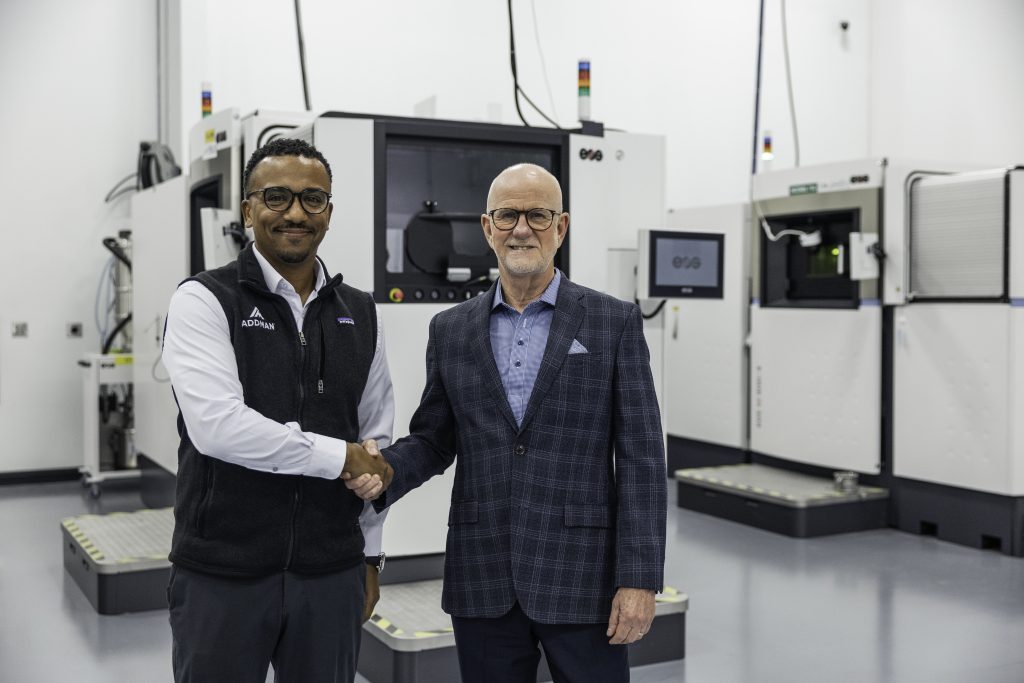
5,000th industrial 3D printer installation marked a separate scale milestone when EOS reported deployment of its 5,000th industrial system, an EOS M 400-4 installed at Keselowski Advanced Manufacturing in Statesville, North Carolina. Keselowski Advanced Manufacturing, founded by race car driver and entrepreneur Brad Keselowski, said it applies advanced engineering solutions and 3D printing technologies to industrial applications. The installation brought the site’s total EOS machine count to 18, reflecting expanded metal additive manufacturing capacity within a single U.S. production operation.

Joe Calmese, CEO of ADDMAN, and Glynn Fletcher, president of EOS North America, mark the installation of EOS’s 5,000th industrial 3D printer. Photo via ADDMAN.Joe Calmese, CEO of ADDMAN, and Glynn Fletcher, president of EOS North America, mark the installation of EOS’s 5,000th industrial 3D printer. Photo via ADDMAN.Joe Calmese, CEO of ADDMAN, and Glynn Fletcher, president of EOS North America, mark the installation of EOS’s 5,000th industrial 3D printer. Photo via ADDMAN.

The 3D Printing Industry Awards are back. Make your nominations now.

Are you building the next big thing in 3D printing? Join the 3D Printing Industry Start-up of the Year competition and expand your reach.

Subscribe to the 3D Printing Industry newsletter to stay updated with the latest news and insights.

Featured photo shows Technician operating an EOS M 290 metal 3D printing system. Photo via EOS.

Free Training

Source link

Hadrian Launches Additive Manufacturing Division to Expand U.S. Defense Production Capacity


New division brings production-ready additive manufacturing capacity online in 2026

TORRANCE, Calif., Jan. 22, 2026 /PRNewswire/ — Hadrian, the advanced manufacturing company building AI-powered factories for America, today announced the launch of Hadrian Additive. This dedicated division is designed to deliver scalable, production-ready additive manufacturing capacity for the U.S. Defense Industrial Base and allied partners.

The new division expands Hadrian’s Opus factory platform to include additive manufacturing systems built for qualification, repeatability, and sustained throughput—enabling defense programs to move from validated designs into reliable, at-scale production. Initial additive manufacturing capacity is expected to come online in 2026 as part of Hadrian’s expanding U.S. factory footprint.

Hadrian Additive integrates additive manufacturing directly into the company’s existing factory model, allowing additive production to support mission-critical systems within a single, end-to-end manufacturing environment.

“America’s defense industrial base needs additive manufacturing that works in real production, not just in prototypes,” said Chris Power, Founder and CEO of Hadrian. “We’re building this capacity the same way we build our factories—engineered for qualification, throughput, and speed—so critical programs can scale when it matters most.”

The division will be led by Matthew Parker, Vice President of Additive Manufacturing at Hadrian, and will focus on meeting the reliability, quality, and traceability requirements of defense and national security programs.

“Additive manufacturing only becomes strategic when it’s industrialized,” Parker said. “Hadrian Additive is designed as a production system from day one, integrated with our factory stack and capable of scaling as demand grows.”

The launch of Hadrian Additive builds on the company’s recent factory expansions and manufacturing initiatives, further strengthening domestic production capacity for priority defense programs.

About Hadrian
Hadrian is a next-generation manufacturing company transforming the U.S. industrial base by rapidly adding domestic manufacturing capacity through its highly automated factories. By integrating process engineering, artificial intelligence, machine learning, and robotics, Hadrian strengthens American manufacturing capabilities and enables U.S. workers to compete globally.

Hadrian’s mission is to enable space and defense manufacturers to produce domestically at scale, supporting production at every level, from individual components to full-scale programs. The company currently operates three advanced manufacturing facilities totaling approximately 600,000 square feet, including two sites in Torrance, California, and a newly launched facility in Arizona. Hadrian is actively developing additional production sites across the United States. More information at https://www.hadrian.co/.

About Matthew Parker
Matthew Parker is Vice President, Additive Manufacturing at Hadrian, where he leads the company’s Additive Manufacturing business unit and the buildout of a large-scale additive manufacturing capability supporting defense and aerospace customers. He is an engineering and operations leader in industrial AM, with a track record of standing up manufacturing capacity, industrializing processes, and transitioning additive programs into repeatable production.

Prior to joining Hadrian, Parker held senior leadership roles in additive manufacturing operations and engineering, leading cross-functional teams spanning production, engineering, quality, and customer delivery. A U.S. Army veteran, he brings a mission-first perspective and an emphasis on readiness—prioritizing speed, reliability, and disciplined execution—directly aligned with scaling additive manufacturing into dependable production capacity. His background includes large-format AM deployment, process qualification, industrialization, and partnership development across industry and standards organizations to advance material and process maturity for demanding applications.

Media contact: [email protected]

SOURCE Hadrian

Free Training

Source link

Construction of a Hypersonic Weapons Manufacturing Facility Begins in the United States


Construction of a Hypersonic Weapons Manufacturing Facility Begins in the United States – Militarnyi

Приват: 5169 3351 0164 7408 PayPal – [email protected] Стати нашим патроном за лінком ⬇

modal-success lazyload

You are subscribed to our newsletter

Free Training

Source link

Pegatron to Complete US Manufacturing Plant by End of March, Supplies Apple and Dell


Global manufacturing is entering a new phase, and Pegatron is placing a big bet on the United States. The Taiwan-based electronics manufacturer, known worldwide as a key supplier to Apple and Dell, has confirmed that its new US manufacturing plant will be completed by the end of March. This move marks a major step in reshaping global supply chains and reflects how electronics makers are responding to trade pressure, geopolitical risks, and customer demand for local production.

The announcement has caught the attention of investors, policymakers, and technology watchers. Pegatron is one of Apple’s most important assembly partners, alongside Foxconn and Wistron. Any shift in its production footprint signals broader changes in how and where the world’s most popular devices are made.

So why is this move happening now, and what does it mean for Apple, Dell, and the wider tech industry? Let us break it down in simple terms.

Pegatron Confirms US Plant Timeline and Strategy

Pegatron said the US manufacturing plant is expected to be completed by the end of March, with initial operations starting soon after. The facility is part of the company’s long-term plan to diversify production away from an over-reliance on Asia, especially China.

According to company executives, construction work is moving on schedule, and the plant will focus on advanced electronics assembly and system integration. While Pegatron has not disclosed the full list of products to be made at the site, it confirmed that the facility will support orders for major clients, including Apple and Dell.

Why does this timeline matter?
Because large electronics plants take months to test and scale. Completing the site by March allows Pegatron to align production with new product cycles later in the year.

The move was widely discussed online as a signal that global manufacturing is shifting faster than expected.

$AAPL $TSM

Pegatron expects US plant construction to finish by end of March; Taiwan-US trade deal includes $250B investment

— 이코노믹캣 (@theconomicat) January 23, 2026

That reaction highlights how investors see Pegatron’s decision as part of a bigger trend rather than a one-off move.

Why Pegatron Is Expanding Manufacturing in the US

The decision to build a US plant did not happen overnight. Several forces are pushing companies like Pegatron to rethink where they make products.

First, geopolitical tensions and trade policies have made companies cautious about concentrating production in one region. Tariffs, export controls, and policy uncertainty have raised costs and risks.

Second, major customers such as Apple and Dell are asking suppliers to localize parts of their supply chain. Producing closer to end markets reduces shipping delays and improves response times.

Third, US incentives and state-level support have made domestic manufacturing more attractive. Tax credits, infrastructure support, and workforce programs help offset higher labor costs.

In short, Pegatron is responding to both pressure and opportunity.

What Will the US Plant Produce for Apple and Dell

While Pegatron has not released a full product list, industry sources suggest the US plant will focus on final assembly, testing, and customization rather than full-scale component manufacturing.

For Apple, this could include limited production runs or specialized configurations of devices for the US market. For Dell, the plant may support enterprise hardware and custom systems that benefit from local assembly.

Why not move everything to the US?
Because full electronics manufacturing requires complex supplier networks. The US plant is meant to complement, not replace, existing facilities in Asia.

This hybrid model allows Pegatron to balance cost efficiency with flexibility and political resilience.

Impact on Apple’s and Dell’s Supply Chains

For Apple, Pegatron’s US expansion supports its broader goal of supply chain diversification. Apple has already increased production in India and Vietnam, and the addition of US capacity adds another layer of resilience.

Dell, which sells a large volume of systems to US businesses and government clients, benefits from local assembly that can meet compliance and delivery requirements more easily.

From a branding point of view, having products assembled in the US also carries symbolic value, especially at a time when governments are encouraging domestic manufacturing.

Does this mean more Apple products will be labeled as US assembled?
Possibly, but likely in limited volumes at first.

Pegatron operates factories across Taiwan, China, Southeast Asia, and now the United States. This global network allows it to shift production based on demand, costs, and policy changes.

The US plant is not Pegatron’s largest facility, but it is strategically important. It gives the company a direct presence in one of its biggest end markets and reduces exposure to sudden trade disruptions.

Executives have said the company will continue to invest in multiple regions rather than betting on a single country.

Market and Investor Reaction

Investors are watching Pegatron closely as supply chains evolve. The company’s move into the US is seen as a long-term investment rather than a short-term profit driver.

Analysts note that margins at the US plant may initially be lower due to higher costs. However, these costs could be offset by stable orders, lower logistics risk, and stronger client relationships.

Some market participants are using AI Stock tools to track how supply chain shifts may affect electronics manufacturers and their customers over time.

Economic and Policy Implications

Pegatron’s US plant also has wider economic implications. New manufacturing facilities create jobs, support local suppliers, and strengthen regional technology ecosystems.

Local governments often welcome such investments, especially when they involve high-skilled manufacturing rather than basic assembly.

At the same time, companies must navigate workforce training, regulatory compliance, and infrastructure challenges.

Is US manufacturing competitive with Asia?
Not on cost alone, but competitiveness improves when stability and speed matter more than price.

Technology Manufacturing and the Bigger Trend

Pegatron’s decision fits into a broader pattern across the tech industry. Semiconductor firms, device makers, and component suppliers are all spreading production across regions.

This trend is driven by risk management rather than pure economics. Companies want to ensure they can deliver products even if one region faces disruption.

Investors studying these changes often rely on AI Stock research to analyze long-term shifts in capital spending and manufacturing strategy.

What Comes Next After March

Once the US plant is completed by the end of March, Pegatron will likely spend several months ramping up operations. Initial output may be modest, with volumes increasing as processes stabilize.

Future expansion will depend on customer demand, policy support, and overall market conditions. Pegatron has said it will review capacity regularly and adjust plans as needed.

For Apple and Dell, the plant provides an option rather than a guarantee of large-scale US production.

Risks and Challenges Ahead

Despite the optimism, challenges remain. Labor availability, cost control, and supply chain coordination will test Pegatron’s execution.

US manufacturing also faces competition from other regions offering lower costs and faster scaling.

Still, most analysts agree that having a US base is a strategic advantage, even if it is not the cheapest option.

Traders and institutions monitoring these risks are increasingly using modern trading tools to react quickly to news about supply chains and capital investment.

Long-Term Outlook for Pegatron

In the long run, Pegatron’s diversified footprint could make it more resilient than competitors tied too closely to one region. The US plant adds flexibility and strengthens ties with key customers.

As technology products become more complex and politically sensitive, suppliers that can adapt quickly may gain an edge.

Some investors are already applying AI stock analysis to Pegatron and similar firms to model how regional production affects earnings stability.

Conclusion

The confirmation that Pegatron will complete its US manufacturing plant by the end of March marks an important milestone for the global electronics supply chain. As a major supplier to Apple and Dell, Pegatron’s move reflects a deeper shift toward diversified and resilient production.

While the US plant will not replace Asia-based manufacturing, it adds a critical layer of flexibility at a time when stability matters as much as cost. For investors, policymakers, and technology partners, Pegatron’s expansion offers a clear signal. The future of manufacturing will be global, balanced, and increasingly close to the customer.

Disclaimer

The content shared by Meyka AI PTY LTD is solely for research and informational purposes. Meyka is not a financial advisory service, and the information provided should not be considered investment or trading advice.


Free Training

Source link

Trump said tariffs would bring factories ‘roaring back.’ So why are manufacturing jobs on the decline?


Just before President Trump announced his sweeping tariffs on “Liberation Day” last spring, the White House celebrated February’s gain of 10,000 manufacturing jobs, noting that more than 100,000 positions in the sector had been shed in the final year of the Biden administration.

“Manufacturing is Roaring Back,” the White House website declared.

But such gains were short-lived. Manufacturing jobs began to slide again in May and haven’t stopped declining. 72,000 manufacturing positions have been lost since April’s tariffs announcement, including 8,000 roles in December alone.

What gives?

“What we’re seeing is certainly a continuation of trends that began before the Trump administration,” Gordon Hanson, an economist and professor in urban policy at the Harvard Kennedy School, told Yahoo Finance. “But the tariffs haven’t helped.”

Indeed, millions of manufacturing jobs have disappeared from the US since 1979 amid a combination of “powerful” trends, Hanson said, including automation, “the continuing effects of the China trade, and the fact that the US has not done a lot of the things you need to do to restore manufacturing prowess.”

Tariffs are hardly the solution to those problems, Hanson said — though Trump insists otherwise. He vowed in April that jobs and factories would “come roaring back into our country” as levies on imports boosted locally produced goods.

While tariffs do reduce import competition, they can also increase the cost of key components for domestic manufacturers. Take US electric vehicle plants that rely on batteries made with rare earth elements imported from overseas, for instance. Some parts simply aren’t made in the United States.

Read more: What are rare earth minerals, and why are they important?

As for sectors that had already largely left the US, like apparel and textile manufacturing, “a lot of those industries are just substantially gone,” Hanson said, meaning there aren’t many existing factories where production could be ramped up and hires could be made.

Do you have a story about navigating the job market? Reach out to Emma Ockerman here.

Manufacturing is hardly the only industry to add few workers these days: Job growth remains paltry across the board, and what hiring does exist is largely being driven by the healthcare and social assistance sectors.

DEARBORN, MICHIGAN - JANUARY 13: U.S. President Donald Trump (2R) tours the assembly line at the Ford River Rouge Complex on January 13, 2026 in Dearborn, Michigan. Trump is visiting Michigan where he will participate in a tour of the Ford River Rouge complex and later give remarks to the Detroit Economic Club. (Photo by Anna Moneymaker/Getty Images) President Trump tours the assembly line at the Ford River Rouge Complex on Jan. 13 in Dearborn, Mich. (Photo by Anna Moneymaker/Getty Images) · Anna Moneymaker via Getty Images
Then there’s the uncertainty caused by the administration’s whipsawing tariff policies, which can lead employers to pull back on hiring as they await greater clarity.

“If Trump just picked a number — whatever it was, 10% or 15% to 20% — we might all say it’s bad, I’d say it’s bad, I think most economists would say it’s bad,” Dean Baker, senior economist at the Center for Economic and Policy Research, said. “But the worst thing is there’s no certainty about it.”

Story Continues

Trump’s tariff threats against several European nations as he sought control of Greenland, for example, appeared and abated within a matter of days, injecting some volatility into the stock market in the process.

Read more: How Trump’s tariffs affect your money

With rates “constantly changing, what becomes very difficult for businesses is to plan,” Baker added. “I think you’ve had a lot of businesses curtail investment plans because they just don’t know whether the plans will make sense.”

Manufacturing job losses could also be more severe than they appear in preliminary data. Fed Chair Jerome Powell said in December that federal statistics may have overstated job growth by “about 60,000” per month.

It’s “too early to say with any certainty” that these manufacturing jobs would be around if not for the tariffs, Baker noted, but there’s also “zero evidence” that they came charging back.

To be sure, the Biden administration also claimed a renaissance in manufacturing jobs, but that was after massive job destruction in 2020. Though employment in the sector eventually jumped above pre-pandemic levels, the growth was uneven regionally and lagged growth in other sectors, the Economic Innovation Group said in a 2024 analysis. Still, spending on manufacturing construction boomed following the 2021 bipartisan infrastructure bill, 2022 CHIPS Act, and 2022 inflation reduction bill.

That spending declined in 2025.

But, tariffs or no tariffs, a manufacturing employment boom would be difficult to construct.

As a country develops, manufacturing might first rise as a share of employment, but “in every single industrial economy” it declines steadily after a certain point, Robert Lawrence, senior fellow at the Peterson Institute for International Economics and professor of international trade and investment at the Harvard Kennedy School, said.

“It doesn’t matter if you have a trade deficit or a trade surplus,” Lawrence said.

Consumers use the money they save on cheaper goods and spend it on services, where there’s more employment growth. That’s what’s happened in the US, where payroll gains for 2025 were concentrated in services like healthcare, food services, and social assistance.

“I think this is deep,” Lawrence said. “We’ve tried industrial policy, we’ve tried trade protection — even before Trump’s initiatives and Liberation Day tariffs — and we haven’t seen much recovery at all. If anything, it continues to decline.”

Emma Ockerman is a reporter covering the economy and labor for Yahoo Finance. You can reach her at emma.ockerman@yahooinc.com.

Sign up for the Mind Your Money newsletter

Click here for the latest personal finance news to help you with investing, paying off debt, buying a home, retirement, and more

Read the latest financial and business news from Yahoo Finance

Free Training

Source link

US solar manufacturing momentum affected by shifting tax credits


The U.S. solar manufacturing and supply chain and the industry at large saw major gains in 2025, but they face an uncertain market heading into 2026.

According to the Solar Energy Industries Association, the U.S. can now produce “every major component of the solar supply chain” with growth across multiple categories. This included a 300% increase in solar cells and a 37% increase in solar module production, bumping capacity beyond 60 gigawatts, between the end of 2024 and late 2025.

Despite those gains, some experts say the industry is still far from supplying what the domestic market requires. And the crosswinds of sunsetting tax credits, increased eligibility thresholds and tariffs create a difficult environment for business decisions.

“You’ve seen pretty distinct growth and investment, particularly on the module side. You’ve seen more of it on the cell manufacturing side in the last five years, thanks to tax credits. But we still have a long way to go as an industry in terms of reshoring the rest of that sector,” said Scott Moskowitz, vice president of market strategy and public affairs at manufacturer Qcells.   

President Donald Trump’s One Big Beautiful Bill Act is among the top uncertainties that could slow momentum. 

OBBBA accelerates the phase-out of the Investment Tax Credit for solar projects started after 2027 and increases content requirements for the Domestic Content Bonus. While the bill maintains the Section 45X Advanced Manufacturing Production Credit for solar manufacturers, it also sets new exclusions to businesses with connections to Foreign Entities of Concern.

On the other hand, Trump’s widely publicized tariffs introduce a level of market protection that may shield companies from international competition.

Experts say these conflicting political decisions are causing collateral damage to the solar industry.

“Unfortunately [OBBBA] got caught up in an ideological back and forth. People started to pick on technologies that they felt had been favored — the solar, the wind,” said Mike Carr, executive director of the Solar Energy Manufacturers for America Coalition.

The road to reshoring

Until recently, support for U.S. solar manufacturing has been largely bipartisan, supported by trade policy and tax credits. “We are on our fourth straight presidential administration of relatively, I wouldn’t call it consistent, but generally support of using trade policy as a tool to support manufacturers,” said Moskowitz.

Trump’s first administration offered the first of such beneficial conditions via the Section 201 safeguard, imposed in 2018. This allowed the U.S. to enact temporary tariffs on a wide range of products when imports surged.

In response, Qcells made its first investment in the U.S. with the opening of a $200 million solar panel manufacturing facility in Dalton, Georgia. The facility was the largest of its kind in the Western Hemisphere at the time. 

“It was really the kind of market protection that they felt like they had been lacking for a long time,” said Carr. “And it was enough to kind of begin to really think about what a reshoring effort could look like.”  

Under President Joe Biden, the Inflation Reduction Act established the Section 45X tax credit and expanded and extended the ITC, offering 30% credit for solar projects through 2032.

Martin Pochtaruk, CEO of solar panel manufacturer Heliene, said the credits and resultant market growth directly helped his company secure a $150 million investment for its new Rogers, Minnesota manufacturing line in 2024. 

However, the accelerated phase-out of the ITC and modification of 45X under OBBBA threatens the momentum of such crucial efforts to grow production capabilities. 

“We took a pretty substantial hit to manufacturing when they prematurely phased out the ITC for solar, and importantly, from our perspective, the domestic content incentive that went with it,” said Carr. “It reintroduced uncertainty into a fairly certain equation.” 

A three-legged stool approach

In the wake of the COVID-19 pandemic, manufacturers are more eager than ever to localize their production networks. 

“We learned a lot as an economy during the pandemic, when supply chains were tested,” said Moskowitz. “We learned that no industry, and particularly a critical industry like energy, wants to be dependent on imported products if they don’t have to be.”

Business leaders say reversing certain tax credits while advancing tariffs has created a precarious situation.

“Tariffs are not a particularly nimble approach. It takes time for them to be effective. There’s a lot of lobbying against them,” said Carr. “And they’re often time-limited, even in their implementation. Even the [Section] 201 tariffs that started in 2018 were due to expire by 2021, right? That’s not the kind of time frame that allows for scale investments.” 

Those provisions, which enabled Qcell’s $200 million investment, were ultimately extended for four years, but the shifting policy landscape remains challenging.

ording to Carr, reshoring U.S. solar manufacturing demands a three-legged stool approach: tariffs for market protection, supply-side policies to enable multibillion-dollar investments and a domestic content incentive.

Chopping off one leg — by accelerating the sunset of a domestic content incentive that stimulated demand for American-made parts — forces the industry to rely on shifting tariffs and supply-side policy. 

Limits of the current domestic supply chain

Still, there’s no denying that domestic solar manufacturing is on the rise. Corning’s newest hub in Michigan, which aspires to “grab up to 15% of the U.S. market for wafers” — in addition to Nextpower’s Tennessee expansion — proves that both upstream and downstream production is in demand.

But while each individual part of the solar manufacturing sector exists in the U.S., there is not enough to meet all of the current domestic demand, said Moskowitz. 

Pochtaruk echoed the idea, saying the U.S. may have successfully reshored the entire solar supply chain, but “it’s far from supplying what the market requires.”

“Corning’s amazing factory is 1769269922 in place, but it’s just starting up,” said Pochtaruk. He added that the market will still require imports to supplement production.

Corning has not confirmed the plant’s size, though some analysts approximate a 2.5GW capacity

Experts agree that policy stability would help with growth, especially when it comes to justifying major investments that might take up to 10 years to amortize, said Pochtaruk.

Referring to Corning’s Michigan factory, he said, “What was the investment? $900 million? You invest that for a long, long time. It’s not just one four-year cycle.” Corning ultimately increased its investment to $1.5 billion, further extending the amortization timeline. 

“This market takes a long time to develop, and it takes a while to build a new factory and for the sales channels to develop,” said Carr. “The biggest thing that has been tough for this industry is the on-again, off-again nature of policy support around it.”

With demand for power skyrocketing and solar widely considered the cheapest form of energy, Carr said the question isn’t whether solar-powered electricity will be in demand or desired, but how much the U.S. will contribute to its production.

“It’s going to continue to be used in our economy. It is, to a certain extent, an inevitability. What’s not inevitable is that we make it,” said Carr. “Do you want to allow reshoring? Or are you comfortable with these kinds of products being made by a sometimes hostile power, or at the very least a trade competitor? We’ve heard from policymakers on both sides of the aisle a resounding ‘no.’”

Free Training

Source link

Press Release Distribution Services – WebWire


Saturday, January 24, 2026

Americas Cardroom’s Venom Continues With Record-Breaking Crypto Poker Momentum

January 23, 2026

Americas Cardroom, a global leader in online poker and cryptocurrency gaming, today announced an update on its flagship Dual Venom series, highlighted by the $8 million guaranteed Mystery Bounty No-Limit Hold’em event.

Joseph L. Sinkfield Expands His Biblical Guide’s Reach with Latest Spanish Edition Release

January 23, 2026

The acclaimed Christian guide “The Voice of the Sword” by Joseph L. Sinkfield has officially broadened its horizons with the release of a new Spanish edition titled “La Voz de la Espada ,” now accessible to readers in pursuit of profound spiritual insights and a more lucid approach to understanding biblical enigmas.

New digital solution at BASF Coatings to calculate the CO2 footprint of its product portfolio

January 23, 2026

• Transparent emission data across a portfolio of more than 120,000 products • BASF Coatings can measure product carbon footprints based on facts and identify levers for reduction for the customer • Customers can also obtain insights into impact categories beyond CO2 BASF Coatings has launched a new digital solution to …

CPKC investing US$800 million in American manufacturing with Tier 4 locomotives

January 23, 2026

Canadian Pacific Kansas City (TSX: CP) (NYSE: CP) (CPKC) this year is continuing the renewal of its locomotive fleet with the world’s two leading locomotive manufactures as part of an ongoing multi-year US$800 million investment in American industry.

Kevin Weaver Elevated To President, Atlantic Music Group

January 23, 2026

Atlantic Music Group (AMG) today announced that longtime Atlantic leader Kevin Weaver has been named to the newly created role of President, Atlantic Music Group.

U.S. Postal Service Board of Governors To Meet on Feb. 5

January 23, 2026

The U.S. Postal Service Board of Governors will meet Thursday, Feb. 5, in an open session at Postal Service headquarters, 475 L’Enfant Plaza SW, in Washington, DC.

Bunge Completes Divestiture Commitment in Western Canada

January 23, 2026

Effective today, Bunge successfully divested its grain elevator at Valparaiso, SK, to Cargill. This transaction is part of the divestiture commitment Bunge made to the Government of Canada, to receive regulatory approval for the company’s merger with Viterra.

Ekain Albite, Rod Llaverías, Inês Nunes, Gala Hernández, Kavich Neang and Valeria Hofmann will be working on their projects in the twelfth edition of Ikusmira Berriak

January 23, 2026

The suffocating heat, perhaps as an unmistakeable sign of the climate catastrophe, women’s bodies, exploring family structures, the industrial past and the digital universe are all present among the twelve proposals selected for the twelfth Ikusmira Berriak, approached in a rich variety of forms, reinterpreting genres like gothic horror, the road movie, psychological drama …

TIFF Congratulates 2026 Oscar Nominees

January 23, 2026

A total of 50 nominations from TIFF’s Official Selection TIFF People’s Choice Award winner Hamnet receives eight nominations 18 Films in TIFF’s Official Selection nominated TIFF Lightbox is the place to see Oscar-nominated films including Hamnet, Sirat, The Voice of Hind Rajab, Arco, One Battle After Another, and more! The Toronto International Film Festival® …

A better way to measure care quality

January 23, 2026

Kaiser Permanente’s commitment to our members’ health is more than a promise — it’s a measurable reality. New research shows Kaiser Permanente members were 35% less likely to die early than others in the communities in which we operate when looking at all causes of death combined.

Free Training

Source link

U.S. missile manufacturing fails to match wartime tempo


United States missile manufacturing is failing to keep pace with the tempo of modern warfare, raising concerns about how quickly the military can replace precision weapons in a high-intensity conflict. To examine where the bottlenecks lie and how they affect readiness, Defence Blog sought comment from John Borrego, Senior Vice President of Aerospace and Defense at Machina Labs, who has held senior technical and leadership roles at Northrop Grumman, SpaceX, Rocketdyne, and Los Alamos National Laboratory.

In responses provided to Defence Blog, Borrego said manufacturing speed should be measured not by machine output alone, but by how quickly the United States can turn a validated military requirement into fielded weapons at scale.

“In modern missile and advanced weapons production, manufacturing speed means the ability to translate design intent into flight-ready components, iterate quickly, and surge output without months or years of retooling,” Borrego said. “Manufacturing speed isn’t just about how fast machines operate, it’s about how quickly we can turn a validated military need into field-ready firepower.”

– ADVERTISEMENT – CONTINUE READING BELOW –

Borrego defined the concept as “time-to-fielded-firepower,” describing it as the full timeline from identifying a requirement or replacing combat losses to delivering qualified, accepted weapons in volume. According to him, this timeline is increasingly out of sync with the pace of modern conflict.

“This matters for readiness because today’s threat environment evolves on operational, not industrial, timelines,” Borrego said. “Adversaries iterate weapons, tactics, and countermeasures faster than legacy defense manufacturing can traditionally respond. If production takes years to adapt, even technically superior systems arrive too late to matter.”

Borrego said manufacturing speed depends on four interconnected timelines that determine whether factories can respond to wartime demand.

The first is “design to producible,” which measures how quickly a concept becomes a buildable and testable design using model-based systems and controlled interfaces. The second is “qualify to ship,” covering how fast materials, processes, suppliers, and first articles can be certified without restarting qualification for every batch. The third is “cycle to throughput,” which reflects how efficiently a factory converts raw inputs into quality-assured hardware. The final clock is “ramp to surge,” or how rapidly output can double or triple without compromising safety, quality, or cost.

According to Borrego, most U.S. defense factories struggle to keep these clocks aligned, especially when demand rises suddenly.

Borrego said the most serious bottlenecks are structural, with tooling at the top of the list. Traditional tooling, he noted, can take years to design and qualify, making rapid scale-up or design changes difficult.

“Most legacy manufacturing processes were built for stable, predictable production,” he said. “When requirements shift, the entire system slows down. By removing tooling from the critical path and digitizing production, surge capacity can scale through machines and software, not timelines.”

He also identified persistent constraints in energetics, including propellants, explosives, cast-cure capacity, and strict handling requirements. Seeker and guidance electronics remain limited by microelectronics, radiation-hardened components, specialized sensors, and secure supply chains. Motors, casings, and specialty materials are constrained by long-lead forgings, castings, composites, and integrated structures.

Single-source sub-tier suppliers present another risk, Borrego said, because many have fragile capacity and no business case for maintaining surge readiness.

Testing infrastructure also delays output, particularly in thermal vacuum testing, vibration testing, ordnance trials, non-destructive testing, metrology, and calibration. Workforce shortages add to the problem, with a limited number of cleared and experienced manufacturing engineers, inspectors, NDT technicians, and energetic handlers, and critical knowledge often concentrated in only a few individuals.

Borrego said an agile, multi-process manufacturing model could change how the U.S. responds to rapid demand spikes or prolonged high-intensity conflict by allowing factories to shift production without waiting for new tooling or facility redesigns.

“In a real surge or drawn-out fight, the challenge isn’t knowing what to build,” he said. “Most factories are locked into doing one thing, one way, and changing that can take months or even years. An agile, multi-process manufacturing model removes that constraint.”

Under this approach, production would rely on modular cells capable of machining, forming, additive manufacturing where appropriate, hybrid layup, assembly, and inspection, all connected by a digital thread. Reconfigurable tooling, reusable fixtures, programmable robotic paths, and parameterized workholding would reduce changeover times and dependence on long-lead hard tools.

Borrego said qualification would also need to be standardized across sites using pre-qualified materials, standardized inspection plans, digital acceptance records, in-line monitoring, and model-based design definitions. This would allow distributed production instead of reliance on a single factory.

Borrego’s warning echoes findings from U.S. government assessments. A 2023 wargame conducted for the House Select Committee on Strategic Competition concluded that, in a conflict with China, the United States would expend its stock of advanced missiles and bombs in less than a month and run out of some critical weapons in a matter of days.

According to Borrego, agile manufacturing is the only way to close that gap without relying on stockpiles that cannot be replenished in time.

“In a prolonged or high-intensity conflict, the central question becomes: can the U.S. sustain both precision and volume?” he said. “Agile, multi-process manufacturing makes this achievable, by building manufacturing depth, not just relying on unreplenishable stockpile depth.”

Free Training

Source link