“Liberation Day” One Year Review: How Tariffs Handcuffed U.S. Farmers and Manufacturers – Publications


April 2, 2026, will mark the anniversary of President Donald Trump’s Liberation Day Tariffs. Here are three things that happened after Liberation Day tariffs were imposed:

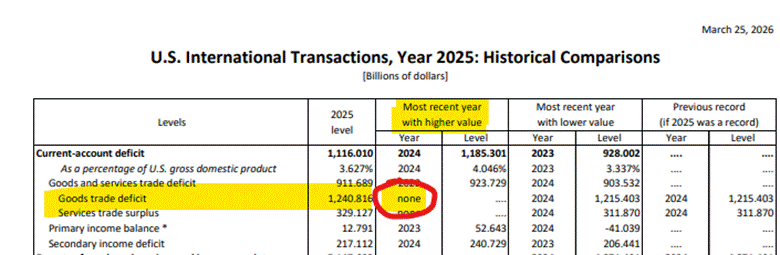
➡️The trade deficit increased. The goal of Trump’s tariffs was spelled out in the title: Regulating Imports with a Reciprocal Tariff to Rectify Trade Practices that Contribute to Large and Persistent Annual United States Goods Trade Deficits. Trump’s executive order asserted that persistent goods trade deficits are a national emergency, and the Administration’s cure was to hike tariffs to the highest level since the 1930s.

The result? On March 25, the Bureau of Economic Analysis reported that the U.S. goods deficit increased to an all-time high in 2025.


➡️The manufacturing sector suffered. According to Trump’s Liberation Day executive order, “The decline of U.S. manufacturing capacity threatens the U.S. economy in other ways, including through the loss of manufacturing jobs.” Here’s what happened next:

Figure 2: Manufacturing Employment

➡️Farmers paid dearly. According to President Trump’s Liberation Day Fact Sheet, President Biden’s policies generated an all-time high agricultural trade deficit.  But data from the Foreign Agriculture Service show the ag trade deficit increased from $37 billion in 2024 to $41 billion in 2025.

  • Tariffs hit farmers and ranchers with a double-whammy of lower exports and higher input prices. Under Liberation Day tariffs, U.S. agricultural exports declined and the 2025 agricultural trade deficit increased by 10.8%. From February to October 2025 alone, tariffs increased the cost of goods like farm machinery and agricultural chemicals by $958 million. 
  • The failure of this tariff policy is reflected in a recent letter from the country’s leading farm organizations, which warns: “America’s farmers, ranchers, and growers are facing extreme economic pressures that threaten the long-term viability of the U.S. agriculture sector. An alarming number of farmers are financially underwater, farm bankruptcies continue to climb, and many farmers may have difficulty securing financing to grow their next crop.”

These results were entirely predictable. 

  • There was no reason to expect Liberation Day tariffs to reduce the trade deficit. Tariffs reduce the growth of both imports and exports, with no definitive impact on the overall trade balance.
  • Over half of U.S. imports in 2025 were industrial supplies or capital goods used to make things in the United States. Tariffs on those goods made it harder for U.S. manufacturers to afford the goods they need to survive and grow.
  • During President Trump’s first term, the Department of Agriculture created the Market Facilitation Program to bail out farmers affected by the ramifications of Trump’s Section 301 tariffs—tariffs that were much smaller than Liberation Day tariffs. Now the government is considering even larger farm bailouts.

Federal officials should learn from their tariff mistakes.

Many factors other than tariffs influence the U.S. economy, and it would be a mistake to assign blame or credit to tariffs for everything that happened in 2025. However, the data should demonstrate to the Trump Administration that its measures of success are inherently flawed.

History shows that it’s easy to reduce the trade deficit: simply engineer a wealth-destroying recession. Trade deficits are not a cause for concern when they are driven by the desire of our trading partners to invest in a thriving U.S. economy or our ability to afford more imports. The Trump Administration and Congress should continue to focus on tax and regulatory reforms that strengthen our economy, regardless of their impact on the trade deficit.

History also shows that manufacturing job losses as a share of total employment should not be a cause for concern when they are driven by productivity improvements that create better jobs and boost manufacturing growth, as opposed to when they result from destructive federal economic polices—like taxing steel, aluminum, and other needed inputs.

One year after Liberation Day, the evidence is in: tariffs failed even by the Trump Administration’s own terms. They did not shrink the trade deficit, did not revitalize manufacturing, and did not help farmers. It would be a mistake to replace one set of failed tariffs with another.

Free Training

Source link

Toyota Invests $1 Billion to Expand U.S. Manufacturing Capacity


GEORGETOWN, Ky. — Toyota is investing $1 billion across its Kentucky and Indiana manufacturing operations to expand production capacity and support electrification, as the company marks 40 years of vehicle assembly in Kentucky.

The investment includes $800 million at Toyota’s Georgetown, Kentucky plant to prepare the facility for a second battery electric vehicle and increase assembly capacity for the Camry and RAV4. An additional $200 million will go to Toyota’s Indiana plant to expand production of the Grand Highlander SUV.

Toyota said the investment is part of a previously announced plan to invest up to $10 billion in U.S. manufacturing over the next five years, aimed at meeting customer demand and supporting a broader vehicle lineup.

The Georgetown facility, Toyota’s largest manufacturing plant globally, has produced more than 14 million vehicles since opening in 1986. The site remains a key hub for vehicle assembly and is central to the company’s strategy to expand production in North America.

In Indiana, the investment will increase output of the Grand Highlander, which will be assembled alongside the Sienna minivan in the plant’s East facility while continuing production with the Lexus TX in the West facility.

“Today’s announcement reflects the company’s commitment to meeting customer demand and the belief in our team to get it done,” said Jason Puckett, president of Toyota Indiana.

Toyota said the investments are designed to increase throughput and support production of both traditional and electrified vehicles as demand shifts across the automotive market.

]]>


Looking for quick answers on assembly and manufacturing topics?


Try Ask ASM, our new smart AI search tool.

Ask ASM

In addition to manufacturing expansion, the company is investing in workforce development programs tied to its production operations. Toyota Kentucky announced $4 million in funding for STEM education initiatives in local school systems and $400,000 to support manufacturing engineering programs at Eastern Kentucky University.

The company said the efforts are intended to support workforce readiness and ensure a pipeline of skilled workers for future production needs.

Toyota’s Kentucky plant employs approximately 10,000 workers, while its Indiana facility employs more than 7,000. The company said continued investment in facilities and workforce development is essential to maintaining production capacity and supporting long-term manufacturing growth in the United States.

Free Training

Source link

United States Dallas Fed Manufacturing Business Index declined to -0.2 in March from previous 0.2


Information on these pages contains forward-looking statements that involve risks and uncertainties. Markets and instruments profiled on this page are for informational purposes only and should not in any way come across as a recommendation to buy or sell in these assets. You should do your own thorough research before making any investment decisions. FXStreet does not in any way guarantee that this information is free from mistakes, errors, or material misstatements. It also does not guarantee that this information is of a timely nature. Investing in Open Markets involves a great deal of risk, including the loss of all or a portion of your investment, as well as emotional distress. All risks, losses and costs associated with investing, including total loss of principal, are your responsibility. The views and opinions expressed in this article are those of the authors and do not necessarily reflect the official policy or position of FXStreet nor its advertisers. The author will not be held responsible for information that is found at the end of links posted on this page.

If not otherwise explicitly mentioned in the body of the article, at the time of writing, the author has no position in any stock mentioned in this article and no business relationship with any company mentioned. The author has not received compensation for writing this article, other than from FXStreet.

FXStreet and the author do not provide personalized recommendations. The author makes no representations as to the accuracy, completeness, or suitability of this information. FXStreet and the author will not be liable for any errors, omissions or any losses, injuries or damages arising from this information and its display or use. Errors and omissions excepted.

The author and FXStreet are not registered investment advisors and nothing in this article is intended to be investment advice.

Source: https://www.fxstreet.com/news/united-states-dallas-fed-manufacturing-business-index-declined-to-02-in-march-from-previous-02-202603301430

Free Training

Source link

Manufacturing has struggled since ‘Liberation Day’


“April 2, 2025, will forever be remembered as the day American industry was reborn, the day America’s destiny was reclaimed, and the day that we began to make America wealthy again.”

President Donald Trump spoke those words as he imposed historic tariffs on countries all over the world. One year on, the tariffs have led to massive changes in international relations, disruptions in global trade, a momentous Supreme Court ruling, and many other far-reaching effects. The full legacy of the tariffs is yet to be known, but this Washington Examiner series will take stock of the first year. The first installment looks at the manufacturing sector and how employment has not lived up to Trump’s promises.

Manufacturing employment has fallen in the year since President Donald Trump imposed his “Liberation Day” tariffs, meaning that a chief goal of the aggressive trade agenda has not been fulfilled.

Trump and his team have touted the tariffs as a way to reshore manufacturing and increase employment in the sector. But job growth has not materialized, in part because manufacturers are paying more for inputs as a result of the tariffs.

ELIZABETH WARREN PROPOSES WEALTH TAX ON FAMILIES WITH OVER $50 MILLION

Trump announced the major new tariffs on April 2, 2025. Since that month, the United States has lost 89,000 manufacturing jobs, according to the Bureau of Labor Statistics. For all of Trump’s time in office, the number is 100,000.

“I think there’s a lot of uncertainty with the tariffs itself … companies putting capital investments on hold, especially if they source a lot of product internationally,” said Dean Burrows, president and CEO of Gear Motions, an upstate New York-based precision gear and gearbox manufacturing company.

It’s clearly not Trump’s fault that manufacturing employment has contracted. The U.S. has been losing manufacturing jobs for decades, a long-running trend that economists have generally attributed to automation and globalization.
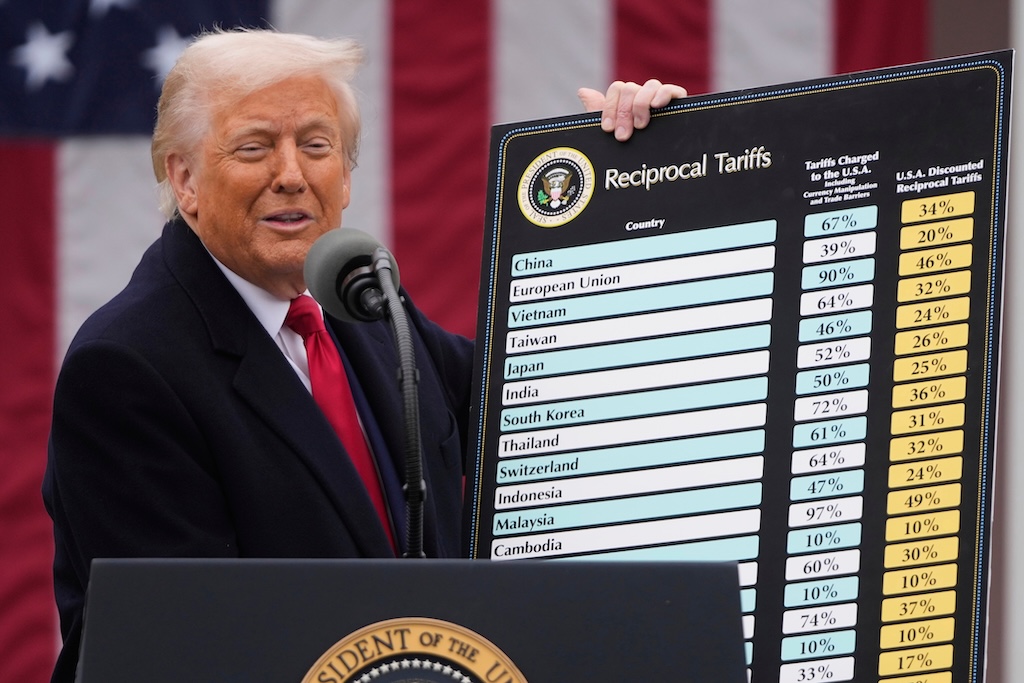
President Donald Trump speaks during an event to announce new tariffs.President Donald Trump speaks during an event to announce new tariffs in the Rose Garden at the White House, April 2, 2025, in Washington. (AP Photo/Mark Schiefelbein, File)

But Trump promised to reverse the trend, and the stakes are high. Surveys show that higher tariffs aren’t popular with voters.

“Jobs and factories will come roaring back into our country,” Trump said when announcing tariffs last year. “And ultimately, more production at home will mean stronger competition and lower prices for consumers.”

At least part of the pro-tariff logic is that raising the cost of goods from outside the country would give domestic manufacturers an advantage and thus encourage investment in factories.

But Trump’s tariffs have also raised the costs of inputs, paradoxically making things more challenging for manufacturing.

“I think the main thing is manufacturing is suffering from the fact that the cost of inputs has gone up, in other words, raw materials — and that’s a function of the trade wars,” Sean Higgins, a research fellow at the Competitive Enterprise Institute, told the Washington Examiner.

In perhaps the most significant example, Trump has imposed major tariffs on steel, aluminum, copper, and lumber, which are important materials in a wide range of manufactured products. So, for example, a domestic furniture maker might benefit from tariffs on imported furniture, but at the same time see that advantage disappear when higher material costs are taken into account.

Rep. Blake Moore (R-UT), a member of the House Ways and Means Committee, said that, while tariffs have allowed Trump to reach some advantageous trade deals and pursue other goals, they have raised input costs.

“Input costs are more now, input costs are higher, it’s more difficult to reshore in that situation,” Moore told the Washington Examiner. “So, that’s a factor that can hurt the ability to increase manufacturing in the U.S., and hopefully those trends can reverse themselves.”

Trump has also hurt investment by creating uncertainty about tariffs, making it difficult for businesses to plan. At times, he’s shocked markets by imposing massive tariffs, only to lower them later on. His Liberation Day tariffs were struck down by the Supreme Court, but he immediately moved to reimplement them by other means.

“Because the tariffs sort of jump or jump around, a lot of businesses don’t really know what they can charge for their products quite so much, because they don’t know what the prices are going to be six months to a year from now,” Higgins said.

The case for tariffs

The case for tariffs is that they will take time to work.

“It’s true that there’s been a slide in manufacturing numbers over the last 15 months, [but] it’s worth noting that that’s been the case for the last couple of years,” Scott Paul, president of the Alliance for American Manufacturing, told the Washington Examiner. “It also predated some of the tariff increases coming in last year.”

Paul, whose trade group includes the United Steelworkers union, said several factors might be contributing to the job declines. He said that none of the policies aimed at boosting manufacturing, whether the tariffs or the 2022 CHIPS and Science Act that provided major incentives for domestic computer chip factories, is “happening in a vacuum.”

Nick Iacovella, executive vice president at the pro-tariff Coalition for a Prosperous America, told the Washington Examiner that it is a “flawed assumption” that Trump’s tariffs alone are enough to reshore industry in the U.S.

“The last year from the Trump administration has been arguably the greatest effort by any administration in recent history to use trade policy to reshore domestic production, especially in critical sectors,” Iacovella said.

Iacovella said that it has been a “massive” effort across “very complicated industrial sectors.”

“And for anyone to be so quick to judge that they’re not doing a good job, that things haven’t happened yet, just ignores reality of how long these things take,” he said. “These new factories don’t just pop up overnight. You’re not going to open a semiconductor [fabrication plant] in a matter of months.”

Early signs of life for manufacturing?

The defenders of Trump’s tariffs also cite a few statistics that could be early signs of a manufacturing turnaround.

One is that job openings in the manufacturing sector have risen in the past few months. In other words, hiring may not yet have increased, but more vacancies are being advertised.

From just November 2025 to January, job openings in manufacturing increased by over 100,000, according to the BLS’s Job Openings and Labor Turnover Survey.

Trump defenders also argue that the pace of job losses has slowed.

Acting Council of Economic Advisers Chairman Pierre Yared said in an email that more than 200,000 manufacturing jobs were lost during former President Joe Biden’s last two years in office alone.

Yared said that the effort to revitalize manufacturing is a three-pillar approach. The first pillar is tariffs, but tax cuts and deregulation are also key to the effort, he said. Yared also pointed out that manufacturing productivity grew at its fastest rate in two decades last year under Trump.

Another sign of life for the sector is that indices of factory activity have perked up in recent months.

The Institute for Supply Management’s monthly Purchasing Managers’ Index reports, which measure whether the U.S. manufacturing sector is expanding or contracting, have also shown expansion in January and February of this year.

Nicole Wolter is the president and CEO of HM Manufacturing, a company founded in 1979 that primarily makes gears and power transmission components for aerospace, defense, and other markets.

Wolter said that part of the mismatch between openings and declining employment is that, as manufacturing evolves, there is less need for “button pushers” and greater demand for more skilled roles.

“We need real skilled, talented, labor force,” she said. “So I need someone that can program, set up machines, understands fixtures … and I think that’s where we have so many openings right now, is there’s not a lot of people with that skill set out there, and so we’re kind of crying for that type of help.”

Wolter said there was a noticeable uptick in purchase orders after Trump won reelection.

“People were purchasing machinery like there was that excitement that, OK, manufacturing is back,” she said.

DEMOCRATIC PRESIDENTIAL CONTENDERS EYE TAX CUTS TO WOO GOP VOTERS

Burrows, the New York-based manufacturer, said that while his company has been stable on staffing, it is hiring right now. He also said that one problem has been that demand for higher wages has been a hindrance in filling that gap in manufacturing job openings.

“We are finding upward pressure on wages right now, so it’s becoming more challenging to hire,” Burrows said. “We’re back kind of where we were a few years ago, where wages just continue to increase.”

Free Training

Source link

John Deere’s U.S. Manufacturing Highlighted at White House Agriculture Celebration, Company Applauds New Announcements That Support Farmers


John Deere’s U.S. Manufacturing Highlighted at White House Agriculture Celebration, Company Applauds New Announcements That Support Farmers | American Ag Network

Mozilla/5.0 (Macintosh; Intel Mac OS X 10_15_7) AppleWebKit/537.36 (KHTML, like Gecko) Chrome/120.0.0.0 Safari/537.36

7e7c9b3a15fceea9d0bef0fbd26cf78db8f81ab5

1

Free Training

Source link

The Export-Import Bank Levels the Playing Field for US Businesses  | The Well News


Exports are critical to the American economy. 

The U.S. Chamber of Commerce estimates that more than 41 million American jobs depend on trade. Of those jobs, approximately 11 million are directly impacted by exports. Manufacturing is particularly dependent on international trade. An estimated 45% of all goods produced in American factories will be exported to international markets.

Companies that export their products and services are incredibly valuable to the American economy. The International Trade Administration reported that, on average, these businesses “pay 18% more than non-exporting businesses,” are “70% more productive than non-exporting manufacturers,” and are “more resilient” during times of economic instability. 

The ability for U.S. businesses to export opens new channels of commerce and creates increased financial opportunities, business growth, and the ability to hire and expand. International exporting also enhances risk and creates financial hurdles that small-to-medium sized companies struggle to overcome, particularly as they attempt to break into new markets. 

That’s where the Export-Import Bank steps in. 

EXIM is an independent federal agency that offers several financial services to American businesses that are unable to secure the financing they need from private banks. These services include export credit insurance, working capital guarantees and loan guarantees for foreign buyers. 

These offerings are necessary for all businesses to succeed in global markets, but particularly for small-and-medium-sized businesses that don’t have the same level of fluid assets or insurance to support the high risks associated with operating internationally. 

EXIM is often criticized for supporting “big business” or giant corporations, but that’s simply not the case. The majority of EXIM’s financial services — more than 95% — support small businesses and manufacturers. While EXIM certainly supports large American businesses and manufacturers, what is often overlooked is the vast supply chains that feed into those large companies. Each tier of suppliers that produce parts, systems and technologies for large-scale products benefits from the financial assistance EXIM provides to those large companies. 

During my career, I oversaw the manufacturing of aerospace parts that were assembled into commercial and military aircraft destined for international sales. Parts were manufactured from all over the United States by manufacturers that ranged from strong-but-mighty mom and pop shops with 10 employees or fewer to medium-sized companies that employed anywhere between 100 and 200 workers. The financial assistance provided by EXIM leveled the playing field for the large American company to sell final products internationally. In turn, the profits were reinvested into the supply chain, helping to sustain existing jobs, create new jobs, and ensure long-term work for employees throughout the system. 

The concept of EXIM isn’t new. In fact, most foreign companies receive financial support from their governments through programs like EXIM. It happens on a large scale across the globe. Without EXIM, American businesses simply can’t compete. 

In 2023, the Office of Inspector General Export-Import Bank of the United States produced a report that analyzed and compared the effectiveness of EXIM against foreign export credit agencies. It found that overall, foreign ECAs were consistently more effective in providing financial support for their country’s businesses. A significant reason for this is because of the constant uncertainty of EXIM’s congressional authorization as well as “long-standing statutory and policy limitation.” 

Despite its challenges, EXIM has been able to provide nearly $70 billion in support for more than 5,000 U.S. businesses and manufacturers. Data also shows that thanks to EXIM’s support, American companies have achieved more than $100 billion in total export sales. 

Here in Oregon, nearly 90 state-based businesses have benefited from EXIM, 70 of which are small businesses. That investment translates to approximately $932 million in total export value. Imagine how much greater these statistics could be if Congress reauthorized EXIM and provided assurance that the bank’s future was secure.

A bill was recently introduced in the Senate that, if passed, would reauthorize EXIM for the next 10 years. This straight-forward decision would empower American businesses to compete and win in the international marketplace.

It would also strengthen the U.S. manufacturing sector, supply chains and our overall economic competitiveness globally. 

Congress should consider this important piece of legislation as soon as possible to provide more certainty for small businesses that rely on overseas markets to grow.

If Congress wants to keep America winning, it needs to reauthorize the Export-Import Bank early this year. 

Dave Hyem served as vice president for Boeing Fabrication and held leadership roles in engineering, operations and supply chains during his career. He can be found on LinkedIn.


TWN

We’re proud to make our journalism accessible to everyone, but producing high-quality
journalism comes at a cost. That’s why we need your help. By making a contribution today,
you’ll be supporting TWN and ensuring that we can keep providing our journalism for free to
the public.

Donate now and help us continue to publish TWN’s distinctive journalism. Thank you for your
support!

Support TWN Journalism

Free Training

Source link

Apple Expands U.S. Manufacturing Partners


Apple announced new members of its American Manufacturing Program (AMP), expanding the company’s commitment to bring more advanced manufacturing and component production to the United States. Apple is working with Bosch, Cirrus Logic, TDK, and Qnity Electronics to manufacture essential materials and components in the U.S. for Apple products sold around the world, creating jobs and strengthening America’s manufacturing capabilities.

Why it matters

This expansion of Apple’s U.S. supply chain through the AMP program is part of the company’s broader $600 billion, four-year commitment to U.S. manufacturing and innovation. It demonstrates Apple’s belief in the power of American ingenuity and manufacturing, and will help create jobs while bolstering domestic production of critical components.

The details

The new collaborations will enable key technologies for Apple products, including sensor hardware for features like Crash Detection and Face ID systems. Apple is also working with partners to establish new semiconductor process technologies and cutting-edge materials production in the U.S. for the first time.

  • Apple announced the new AMP members on March 27, 2026.
  • The company plans to spend $400 million on these new programs through 2030.

The players

Apple

An American technology company that designs, develops, and sells consumer electronics, computer software, and online services.

Tim Cook

The CEO of Apple.

Bosch

A German multinational engineering and technology company.

Cirrus Logic

An American semiconductor company that designs and manufactures integrated circuits for audio and energy applications.

TDK

A Japanese electronics company that manufactures electronic materials, electronic components, and recording and data-storage media.

Qnity Electronics

A company that provides cutting-edge materials and technologies essential for semiconductor manufacturing and advanced electronics.

Got photos? Submit your photos here. ›

What they’re saying

“At Apple, we believe in the power of American innovation and manufacturing, and we’re proud to partner with even more companies to produce critical components and cutting-edge materials for our products right here in the U.S.”

— Tim Cook, Apple’s CEO

What’s next

Apple’s American Manufacturing Academy will host its first Spring Forum from April 30 to May 1 at Michigan State University in East Lansing, Michigan, bringing together students, educators, industry leaders, and businesses to discuss how AI is transforming the manufacturing industry.

The takeaway

This expansion of Apple’s U.S. supply chain demonstrates the company’s commitment to American innovation and manufacturing, and will help create jobs while strengthening domestic production of critical components for Apple products.

Free Training

Source link

Apple adds US manufacturing partners with $400M expansion


Listen to the article

This audio is auto-generated. Please let us know if you have feedback.

Dive Brief:

  • Apple recently added four semiconductor companies to its American Manufacturing Program, including Bosch, Cirrus Logic, TDK and Qnity Electronics.
  • The Cupertino, California-based company on Thursday said it plans to spend $400 million through 2030 in support of its new partners as they produce materials and components in the United States for Apple products sold around the world.
  • As part of the expansion, longtime Apple supplier TDK has agreed to make iPhone sensors in the U.S. for the first time. The advanced sensors support camera stabilization, among other features. Apple is also working with Bosch on producing circuits that support crash detection, activity tracking and elevation.

Dive Insight:

Apple’s expansion is part of a larger $600 billion commitment to U.S. manufacturing and innovation. It adds to a growing number of companies participating in Apple’s American Manufacturing Program as uncertainty fueled by tariffs and international conflict spur domestic investments.

Initial members such as Amkor, GlobalWafers and Corning are already starting to implement their plans with Apple. The technology giant has redirected all of its iPhone and Apple Watch cover glass production to Corning’s Harrodsburg, Kentucky, facility. It also recently announced plans to bring Mac mini production to Houston later this year.

GlobalWafers has begun wafer production at its Sherman, Texas, factory. Meanwhile, Amkor has broken ground on its advanced packaging and test facility in Peoria, Arizona, where Apple is set to be its first and largest customer.

“We’re proud to partner with even more companies to produce critical components and cutting-edge materials for our products right here in the U.S,” Apple CEO Tim Cook said in a statement.

In addition to new partnerships with TDK and Bosch, Apple is working with Cirrus Logic to establish new semiconductor process technologies at GlobalFoundries’ facility in Malta, New York. Apple said this collaboration will enable Cirrus Logic to develop “mixed-signal solutions” for its applications, including advanced integrated circuits for Face ID systems.

Qnity Electronics and HD Microsystems have also agreed to provide materials and technologies that enhance semiconductor manufacturing through artificial intelligence and high-performance computing. Qnity, a Dupont spinoff, recently formed in November and opened a 385,000-square-foot chips facility in Newark, Delaware, to meet rising AI demand.

Apple also said it has served nearly 150 businesses through dozens of free, in-person training sessions and virtual programming. It is scheduled to host its first Spring Forum from April 30 to May 1 at Michigan State University in East Lansing, Michigan.

Free Training

Source link

Inside Rivian’s US$5bn Investment in US Manufacturing


Manufacturing leaders won’t want to miss Sustainability LIVE: The US Summit, taking place at Navy Pier, Chicago, on April 21–22.

Co-located with Procurement & Supply Chain LIVE, the event unites senior decision-makers at a time when supply chains, sustainability and business performance are more interdependent than ever.

Secure your place now for The US Summit – group booking discounts available.

“But the people that work at this plant and the community we’re in are truly the most important story. 

“Technology is important, and we are using our robotics and AI capabilities extensively. We have high levels of automation, but everything starts with our team members: they’re the experts at what they do.”

Hiring in Georgia

In addition to the 7,500 direct jobs expected to be created by this multibillion dollar-investment, an additional nearly 8,000 indirect jobs will result from the Rivian’s Georgia plant, according to analysis conducted by IMPLAN. 

Collectively, these 15,000+ jobs are expected to generate over US$1bn in labour income annually, supporting suppliers, vendors and small businesses.

Free Training

Source link

Apple to Expand American Manufacturing Programme by US$400m


“We are very proud to be working with Apple to accelerate US manufacturing. We share their commitment to do more in the US, and our teams are working side-by-side with theirs in the US.”

TDK’s US facility will supply TMR sensors in devices shipped all over the world, and will increase the volume of chips that Apple will source from US silicon supply chains.

Expanded with other partners

As part of this new investment in Apple’s AMP, Cirrus Logic and GlobalFoundries will establish new semiconductor process technologies at GlobalFoundries’ facility in New York that will enable Apple to develop mixed-signal solutions for a number of applications, including advanced ICs to power Face ID systems.

Tim Cook, Apple’s CEO, says: “At Apple, we believe in the power of American innovation and manufacturing, and we’re proud to partner with even more companies to produce critical components and cutting-edge materials for our products right here in the US.

“Today, we’re joining with world-class partners like Bosch, Cirrus Logic, TDK, and Qnity Electronics to further expand Apple’s US supply chain through our American Manufacturing Program. This is another powerful example of what is possible when we invest in American ingenuity, and we’re excited to build the future together.”

Free Training

Source link