Fed Leaders Highlight Growth, U.S. Manufacturing at ENC


Transit Bus Manufacturer ENC welcomed the Federal Reserve Bank of San Francisco (SF Fed) for a tour of the Company’s 227,000-square-foot manufacturing facility in Jurupa Valley, California.

The visit is part of the SF Fed’s ongoing engagement with major employers and industries across Southern California and, more broadly, the western U.S. to better understand regional economic conditions and business outlooks.

A Look at American Manufacturing

Hosted by company executives, the tour provided a firsthand look at how federal transit investments translate into skilled jobs, domestic manufacturing capacity, and economic activity in the Inland Empire.

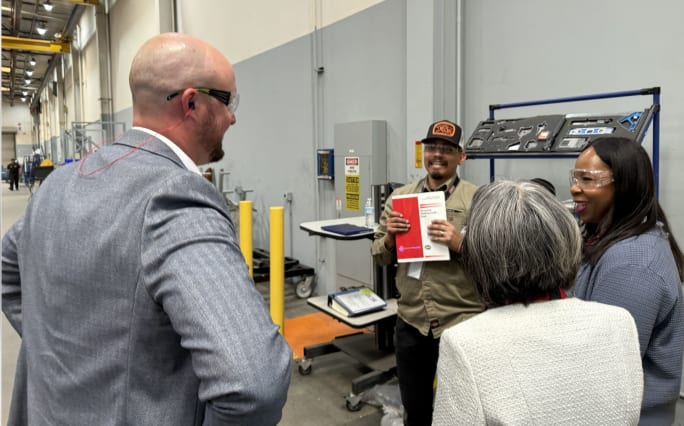
Visitors from the SF Fed toured ENC’s production floor, observing the end-to-end bus manufacturing process, from welding and painting to final assembly and testing.

According to the American Public Transportation Association (APTA), 77% of federal public transportation investment flows directly to American businesses, supporting manufacturers, small suppliers, and job creation in communities across the country. Federal transit funding reaches more than 3,000 suppliers in 50 states and Washington, D.C.

ENC officials said, with suppliers in more than 30 U.S. states, the company is a direct example of how those investments strengthen domestic supply chains and create family-wage jobs.

Since assuming ownership of ENC in 2024, Rivaz has invested more than $50 million in facility upgrades, workforce development and upskilling, and planned expansions. The company currently employs approximately 230 people at its Jurupa Valley facility, with a pathway to approximately 500 jobs at full production capacity.

“Our investments in expanded capacity and workforce training are about more than building buses – they are about building long-term economic strength in this region,” said John Obert, VP of transit sales at ENC. “The SF Fed’s visit reflects the growing recognition that American transit manufacturing is essential infrastructure, and ENC is proud to be leading that effort from right here in the Inland Empire.”

ENC up-close shot of Federal Reserve Bank visit.

Visitors from the SF Fed toured ENC’s production floor, observing the end-to-end bus manufacturing process, from welding and painting to final assembly and testing.

ENC’s Facility

ENC’s Jurupa Valley campus spans 17 acres and operates as an ISO 9001-certified manufacturing facility. Every vehicle produced is designed to meet federal Buy America requirements, ensuring that transit agency investments support California workers and California manufacturing, said officials.

All models are Altoona-tested and FTA-approved.

Free Training

Source link

Iran war disrupts oil exports, US manufacturing costs surge


## Market Snapshot

The “Fed Rate Cuts Predictions for 2026” market is examining the likelihood of rate cuts, currently showing uncertainty due to inflation pressures. Meanwhile, the “Bitcoin Above on April 30” market indicates a 100% YES resolution, though underlying sentiment may be shifting. The “WTI Crude Oil Prices in May 2026” market lacks current pricing data but is closely tied to geopolitical developments.

## Key Takeaways

– Rising input costs due to the Iran war appear to suggest inflationary pressures, which could impact Fed rate cut expectations for 2026. – Current market pricing suggests Bitcoin remains above $86,000, though broader economic conditions may influence future sentiment. – The ongoing Iran conflict and its effect on oil supply routes are consistent with scenarios where WTI crude oil prices remain high, potentially exceeding $150.

## Article Body

The United States’ manufacturing sector continues its expansion into April 2026 despite challenges posed by the Iran war, which has led to a significant increase in input prices. The conflict, which began with US-Israel military strikes on Iranian facilities, has disrupted oil exports and critical shipping routes, notably the Strait of Hormuz. Oil prices have surged to wartime highs, impacting US manufacturing costs. Nevertheless, the defense sector has seen increased demand, with companies like RTX and Northrop Grumman reporting higher orders. The European Central Bank has cautioned that prolonged conflict could trigger stagflation and recession risks in the EU.

## Market Interpretation

The impact of rising input costs and geopolitical tensions appears consistent with a scenario where the Federal Reserve may hold off on rate cuts in 2026, suggesting a moderate impact on rate cut predictions. The Bitcoin market, despite showing a 100% YES for April 30, may face indirect pressures from a risk-off environment due to inflationary concerns. The WTI crude oil market reflects a high impact, with the potential for prices to reach $150, consistent with ongoing supply constraints from the Iran war.

## What to Watch

Observers should monitor upcoming Federal Reserve statements and inflation reports for indications of policy adjustments. Key developments in the Iran conflict, particularly around the Strait of Hormuz, will be crucial for WTI crude oil pricing. Additionally, any significant changes in Bitcoin’s sentiment or speculative asset trends could influence market dynamics, particularly if broader economic conditions shift.

Get prediction market intelligence as a structured API feed. Early access waitlist.

Free Training

Source link

Whirlpool Expands U.S. Manufacturing as Ohio Plants Anchor Past, Present and Future Growth


PERRYSBURG, Ohio—Whirlpool Corp. is expanding its U.S. manufacturing footprint with new investment in Ohio, building on decades of production history and positioning its operations for future growth.

The company announced plans to invest $300 million in its laundry manufacturing facilities in Clyde and Marion, Ohio, adding capacity for next-generation washers and dryers and creating 400 to 600 jobs. The investment is part of a broader strategy to strengthen domestic production and support supply chain resilience.

The expansion comes as Whirlpool marks a milestone at its Marion facility, which has produced clothes dryers since 1955. The plant, which began with 235 employees and an output of 300 units per day, now employs nearly 2,000 workers and can produce up to 22,000 dryers daily, reflecting decades of investment in manufacturing technology and workforce development.

“My father was an engineer at the Marion plant, and my grandfather worked here in the 1950s – I am following in their footsteps,” said Jason Ebert, Whirlpool Corporation senior vice president for North America manufacturing. “There is no other factory like it in the world, and what makes it truly special are the people who work here. This facility represents decades of American hard work and ingenuity to make clothes dryers millions of homes rely on every day.”

Company officials said the Ohio operations remain central to Whirlpool’s U.S. manufacturing strategy, with the Clyde facility serving as the world’s largest washing machine plant and the Marion site continuing to evolve through new equipment, processes and product introductions.

“Whirlpool Corporation’s unwavering commitment to American manufacturing is a cornerstone of our identity,” said Marc Bitzer, chairman and CEO. “This $300 million investment in our Clyde and Marion facilities underscores our dedication to creating jobs, fostering innovation and delivering high-quality, American-made appliances.”

Whirlpool manufactures approximately 80% of its major appliances sold in the United States domestically and has invested billions of dollars in U.S. operations over the past decade. The company said its approach combines large-scale production with ongoing upgrades to automation, product design and workforce capabilities.

Recent investments are focused on increasing flexibility and throughput, while supporting the transition to new product platforms and evolving consumer demand. Company officials said the strategy is designed to ensure long-term competitiveness as manufacturing shifts toward more advanced and connected production systems.


Looking for quick answers on assembly and manufacturing topics?


Try Ask ASM, our new smart AI search tool.


Ask ASM

“Across our U.S. operations, from the factory floor to design labs to distribution centers, our people are the foundation of everything we build,” said Kristin Day, vice president of U.S. manufacturing. “This investment builds on that legacy and ensures we can continue producing world-class appliances in the United States.”

Whirlpool said it plans to continue investing in its U.S. manufacturing network as it expands capacity, modernizes facilities and strengthens its position in the global appliance market.

Free Training

Source link

GM just boosted its U.S. manufacturing spend to $6 billion in one year


General Motors has now committed more than $6 billion to U.S. manufacturing in just 12 months—and the latest installment, an $830 million infusion across three propulsion plants announced Wednesday, is starting to look less like a spending spree and more like a strategic homecoming.

The new funding includes flows to Romulus Propulsion Systems in Michigan ($300 million, its second such investment after an identical commitment last year) to expand 10-speed transmission capacity for full-size trucks and SUVs; Toledo Propulsion Systems in Ohio ($40 million, also a second tranche) for light-duty truck transmissions; and Saginaw Metal Casting in Michigan ($150 million) to boost production of heads for sixth-generation V-8 engines destined for next-generation pickups and Corvettes.

In an interview with Fortune, GM’s manufacturing chief Mike Trevorrow said the company made sure the workers heard about it first. UAW representatives joined plant managers on the floor at all three facilities to deliver the news in person. “We were fortunate enough to have them at a couple of our plants today to help with the rollout to the employees,” said Trevorrow, senior vice president of global manufacturing. “It’s fun.”

A century-old idea, quietly revived

The shape of GM’s current manufacturing portfolio—full-size trucks, sixth-generation V-8s, 10-speed transmissions, a broad EV lineup maintained even as battery capacity was trimmed—bears a striking resemblance to a strategy that is literally over 100 years old.

Alfred P. Sloan built GM into the world’s largest automaker in the 1920s through the 1950s on a single organizing idea: offer a vehicle for every person, at every price point, under a stable of distinct brands. He immortalized this with the 1925 advertising slogan, “A car for every purse and purpose.”

When Fortune raised the comparison, Trevorrow paused. “I think it’s always been in our DNA, but I‘ve never heard it referenced specifically.” Then, almost as an aside, he noted: “We have a wide variety of vehicles for everyone.”

The fact that it was Fortune’s question may be the most revealing thing about how GM is operating right now—not as a company consciously invoking its storied past, but as one that has quietly re-internalized it.

‘Fast, flexible, and frugal’

The modern translation of Sloan’s philosophy, in Trevorrow’s telling, is three words: “Fast, flexible, and frugal.” It’s GM’s internal manufacturing mantra, part of CEO Mary Barra’s broader embrace of agility. In an environment where trade policy, consumer demand, and technology are all shifting at once, the ability to pivot is worth more than any single strategic conviction.

That flexibility is why, when EV demand grew more slowly than expected, GM didn’t dismantle its electric vehicle lineup. “We didn’t cut any vehicles,” Trevorrow clarified to Fortune when asked about how this investment reflects the EV focus. “We just cut a little bit of the battery capacity.” The company currently offers more than a dozen EV models and ranks second in U.S. EV sales—while simultaneously pouring hundreds of millions into sixth-generation V-8 infrastructure. Both things coexist, by design.

Trevorrow was careful not to let tariffs take full credit for the investment wave. “Tariffs might be involved only because of the timing,” he said. “When you know the rules, you know the guidelines—how you play that to the benefit of … the country, the consumer, and your company is key.”

What $6 billion looks like on the ground

The roughly 3,000 workers across Romulus, Toledo, and Saginaw are the most concrete expression of what this strategy looks like in practice, and Trevorrow said he thinks GM is in a good place with its workers right now. When asked what changed, he said it’s simple: a lot of surveys.

“We survey our employees,” he said. “In fact, they’ll say we survey too much, and I always say, ‘Remember the time when we didn’t ask?’” Sharing that it’s been in place for a little over five years, and that GM is now in the top quartile of all companies worldwide as a workplace of choice, Trevorrow said, “People like working here. We get that feedback, and we make changes according to it.”

Trevorrow noted this data drives real changes: shift-hour adjustments, lighting improvements on the plant floor, tools designed or 3D-printed based on worker suggestions. “The more we communicate,” he said, “the better we can problem-solve and root-cause things together. That’s the joy, I would say, every day of manufacturing.” GM’s view on continuous improvement, he said, is that everything can be improved.

The manufacturing chief allowed that he’s aware of anxiety, even angst, across the workforce over automation, especially when it comes to artificial intelligence. On AI specifically, he takes the long view. GM has invested more than $250 million over the past five years to upskill workers alongside new technology—setting aside a percentage of every new launch budget to bring plant floor employees up to speed before new automation goes live.

“What I emphasize is we’ve always led in implementation of automation, and we continue to do it,” he said, adding that GM believes in its people. “The investment in bringing our people along on this journey is key. Automation doesn’t work without people … Nothing’s worse than having new automation that sits because nobody knows what to do with it.” The goal isn’t replacement, in his telling. It’s fluency: “We’ll find out how to use our people best, and how to use automation best, and continue to drive both for safety, quality, and efficiency.”

Trevorrow said he sees AI himself daily and describes his own adoption curve in terms that plant workers might recognize. “It takes some getting used to,” he said. “But doesn’t everything? My cell phone took some getting used to. Now, if somebody was to take it away, I would think I’m missing an arm.”

Trevorrow reframed the debate around geopolitical uncertainty, shifting trade patterns, and employee anxiety: “Uncertainty is opportunity, too.”

Free Training

Source link

Novartis finalizes US manufacturing and R&D expansion plan with seventh new facility


Real-time Estimate


Cboe Europe


07:06:01 2026-04-30 am EDT

5-day change

1st Jan Change

115.28 CHF

+1.71%

Intraday chart for Novartis AG

-1.12%

+4.91%

Published on 04/30/2026
at 07:00 am EDT

Dow Jones

(MORE TO FOLLOW) Dow Jones Newswires

April 30, 2026 07:00 ET (11:00 GMT)

Dow Jones logo
© Dow Jones –
2026

DurationAuto.2 months3 months6 months9 months1 year2 years5 years10 yearsMax.

PeriodDayWeek

Chart Novartis AGLogo Novartis AG
Novartis AG is one of the world’s leaders in the design, manufacturing, and marketing of pharmaceutical products. Net sales break down by therapeutic area as follows:

– oncology (30.9%);

– immunology (18.9%);

– cardiovascular, renal and metabolic diseases (16.4%);

– neuroscience (11%).

The remaining net sales (22.8%) are from contract manufacturing of pharmaceutical products.

At the end of 2025, Novartis AG had over 31 production sites worldwide.

Net sales are distributed geographically as follows: Switzerland (2.6%), Europe (28.1%), the United States (42.8%), Asia/Africa/Australasia (19.8%), Canada and Latin America (6.7%).

Trader

Trader

This super rating is the result of a weighted average of the rankings based on the following ratings: Valuation (Composite), EPS Revisions (4 months), and Visibility (Composite). We recommend that you carefully review the associated descriptions.

Investor

Investor

This super composite rating is the result of a weighted average of the rankings based on the following ratings: Fundamentals (Composite), Valuation (Composite), EPS Revisions (1 year), and Visibility (Composite). We recommend that you carefully review the associated descriptions.

Global

Global

This composite rating is the result of an average of the rankings based on the following ratings: Fundamentals (Composite), Valuation (Composite), Financial Estimates Revisions (Composite), Consensus (Composite) and Visibility (Composite). The company must be covered by at least 4 of these 5 ratings for the calculation to be carried out. We recommend that you carefully review the associated descriptions.

Quality

Quality

This composite rating is the result of an average of rankings based on the following ratings: Returns (Composite), Profitability (Composite) and Quality of Financial Reporting (Composite), and Financial Health (Composite). The company must be covered by at least 2 of these 3 ratings for the calculation to be performed. We recommend that you carefully read the associated descriptions.

ESG MSCI

ESG MSCI

The MSCI ESG score assesses a company’s environmental, social, and governance practices relative to its industry peers. Companies are rated from CCC (laggard) to AAA (leader). This rating helps investors incorporate sustainability risks and opportunities into their investment decisions.

SellConsensusBuy

Last Close Price

143.45USD

Average target price

153.80USD

Spread / Average Target

+7.21%

Quarterly revenue – Rate of surprise

Indices
Europe

America

Asia

Download from Apple Store

OUR EXPERTS ARE HERE FOR YOU

Monday – Friday 9am-12pm / 2pm-6pm GMT + 1

MarketScreener, Stock Market Live
Legal information
|
Cookie settings
|
MarketScreener Blog
|
About us
|
Copyright © 2026 Surperformance SAS. All rights reserved.

Stock quotes are provided by Factset, Morningstar and S&P Capital IQ

Select your edition

All financial news and data tailored to specific country editions

Free Training

Source link

General Motors invests $6 billion into U.S. manufacturing


DETROIT, Mich. — General Motors has invested over $6 billion into its U.S. manufacturing footprint over the past year, with hundreds of millions dedicated towards projects in Michigan.

The company recently announced $830 million in investments towards projects that will support the launch of GM’s next generation full-size trucks and SUVs.

The sites benefiting from the total investment include:

  • Romulus Propulsion Systems, receiving $300 million to increase the facility’s capacity to produce 10-speed transmissions, which are used in GM’s next-generation full-size trucks and SUVs. This is a further capacity increase for production at Romulus, which initially received $300 million late last year to support this work. Romulus has about 1,000 employees.
  • Saginaw Metal Casting Operations (Michigan) recently announced to its approximately 350 employees a $150 million investment to increase head casting volume for Gen 6 engines, supporting next-generation full-size pickup trucks and Corvettes.

Comment with Bubbles

BE THE FIRST TO COMMENT

The company says these investments show the strength of GM’s current operations and its focus on positioning its U.S. manufacturing base for continued leadership in full-size truck and SUVs segments.

Free Training

Source link

Aurelius Systems Opens U.S. Manufacturing Line for High-Power Fiber Lasers


Autonomous laser defense company launches domestic production of high-power laser sources

SAN FRANCISCO, April 29, 2026–(BUSINESS WIRE)–Aurelius Systems, the autonomous laser defense company behind the Archimedes counter-UAS system, today announced Aurelius Manufacturing, a new division that will build high-power fiber laser source modules in the United States.

The U.S. defense laser supply chain has a gap. Demand for high-power fiber lasers is growing across military and industrial applications. A small number of established domestic manufacturers produce laser sources, but the market is shifting. Chinese laser companies have taken majority share in Asia Pacific, a region that accounts for nearly half the global fiber laser market, and are expanding into the U.S. through new automation products and service networks. For defense programs that need ITAR-compliant components from a supplier they can trace end to end, the pool of qualified domestic options is small and getting smaller relative to demand.

Aurelius set out to build Archimedes, its autonomous counter-UAS system, to give American forces scalable defense against drone threats. In doing so, the team found that domestic production of high-power fiber lasers has been shrinking for over a decade, with most remaining suppliers no longer American-owned. Aurelius Manufacturing is the company’s response: a U.S. production line for the same fiber laser source modules and components that sit at the heart of any directed-energy system, and that American manufacturers have had to import for years.

The launch comes as the Pentagon pushes to field laser weapons at scale within 36 months, backed by $250 million in directed energy R&D funding from the One Big Beautiful Bill. The Department of Defense’s fiscal year 2027 budget requested more than quadruples that figure, proposing over $2 billion in directed energy RDT&E. The Army’s Enduring High Energy Laser program is moving toward its first production contract, with plans to acquire up to 24 systems. Navy leadership has called for lasers on every ship in the surface fleet. As these programs move from prototyping into production, the number of domestic suppliers building defense-grade laser sources has not kept pace. Lead times from qualified vendors are long, and the industrial base needs more capacity.

Aurelius Manufacturing’s first product is a compact, rack-integrated fiber laser source module rated at multi-kilowatt output. Units will be available from prototype quantities through full-rate production, with configurations tailored to directed-energy and industrial manufacturing applications.

Aurelius’s laser sources are designed to be ITAR-compliant with full domestic traceability and no dependency on foreign allocation schedules. For industrial customers running laser welding, metal cutting, surface treatment, or additive manufacturing lines, domestic production will mean shorter lead times and direct access to the engineers building the hardware.

“It’s clear the domestic production of high-power lasers in the US is significantly lower than necessary to support both our directed energy and defense needs. Laser system production has been continually offshored outside of our lands. In order to support our customers, the directed energy industry at large and the growing material processing industry in the US, we’ll be vertically integrating and producing lasers here in the homeland,” said Michael Laframboise, CEO of Aurelius Systems.

Production capacity reservations for Q1 2027 are open. Customers can reach Aurelius at aureliusmanufacturing.com.

About Aurelius Systems

Aurelius Systems is a San Francisco-based defense technology company building autonomous laser systems. Its first product, Archimedes, is a counter-drone system designed to defeat Group 1 and 2 UAS threats. Through Aurelius Manufacturing, the company is building domestic production of high-power fiber laser sources for defense and industrial customers. All products are designed and built in the United States. For more information, visit aureliussystems.com.

View source version on businesswire.com: https://www.businesswire.com/news/home/20260429408874/en/

Contacts

Media Contacts:
Wilson Wiangchanok
marketing@aureliussystems.us

Free Training

Source link

Nexans Acquires Republic Wire To Establish U.S. Manufacturing Platform In Low-Voltage Cable Market


Nexans, a Paris-based global electrification company, has signed an agreement to acquire 100% of Republic Wire, a family-owned American manufacturer of low-voltage copper and aluminum wire products headquartered in Cincinnati, Ohio. The deal, valued at approximately 680 million euros with a potential earn-out of up to 43 million euros, establishes Nexans’ first significant manufacturing and distribution platform in the United States and complements its recent acquisition of Electro Cables in Canada.

Founded in 1982, Republic Wire serves electrical wholesale distributors, utilities, and municipalities across the United States and Canada. The company operates a 32,500-square-meter manufacturing facility and a newly completed 30,000-square-meter warehouse and distribution center, employing more than 200 people. A recently completed expansion program is expected to be fully online by the end of 2026, increasing production capacity by approximately 30%. Republic Wire generated approximately 520 million euros in revenue over the twelve months through February 2026.

The U.S. low-voltage cable segment is estimated at approximately 12 billion euros and is driven by sustained demand across residential, commercial, and data center construction. Nexans projects approximately 23 million euros in run-rate synergies over three years, driven by commercial cross-selling, manufacturing technology deployment, and purchasing scale.

The transaction is expected to be immediately earnings-per-share accretive before synergies and is anticipated to close in the early third quarter of 2026, subject to regulatory approval. Republic Wire’s current management team, led by Ron and Jeremy Rosenbeck, will remain in place.

KEY QUOTES:

“The acquisition of Republic Wire marks a transformative moment in Nexans’ journey to become a reference pure player in electrification. The United States represents the single largest growth opportunity in low- and medium-voltage cable. Republic Wire gives us the expanded platform, the customer relationships and the operational credibility we need to compete in this highly dynamic market.”

Julien Hueber, Chief Executive Officer, Nexans

“Republic Wire has always been more than a business to our family — it is a legacy built on hard work, loyalty, and a deep responsibility to our customers and the people who chose to build their careers here. In Nexans, I found a partner who shares those values, not just a buyer.”

Ron Rosenbeck, CEO, Republic Wire

“The acquisition of Republic Wire represents an important strategic milestone, meaningfully strengthening our position in the North American market. As a highly respected brand with a proven track record of exceptional quality and customer centricity, Republic Wire brings deep market relationships and an extensive commercial network.”

Tim King, Managing Director North America, Nexans


Free Training

Source link

Teknor Apex Joins OSS Ventures €75M Fund to Scale Industrial Software Across U.S. Manufacturing


Teknor Apex Joins OSS Ventures €75M Fund to Scale Industrial Software Across U.S. Manufacturing

Teknor Apex Joins OSS Ventures €75M Fund to Scale Industrial Software Across U.S. Manufacturing

PR Newswire

BOSTON, April 28, 2026


BOSTON, April 28, 2026 /PRNewswire/ — Teknor Apex Company, a global leader in material science solutions, today announced it has joined as a founding partner in OSS Ventures’ new investment fund, targeting €75M million to scale proven industrial software companies across North America and Europe.


Building Software Where It Matters: On the Manufacturing Floor

Founded in 2019 by Renan Devillieres, OSS Ventures is a venture studio building next-generation industrial software that operates at the intersection of software development and manufacturing operations. The firm’s thesis is straightforward: industrial software only drives lasting change when it’s built from the manufacturing floor up – alongside the operators, supervisors, and engineers who use it daily.

With OSS Ventures now expanding operations beyond Europe to its new office in Boston, MA, Teknor Apex will serve as the regional industrial anchor partner, becoming the first U.S. manufacturer to both invest in and operate OSS portfolio software at scale.

“This partnership reflects a shared view that the future advancements in industry will be innovated by people and technology working in tandem to create measurable impacts” said Donald Wiseman, CEO, Teknor Apex.

Teknor Apex: From Co-Builder to Co-Investor

This partnership started on the factory floor. Teknor Apex deployed three of OSS Ventures’ portfolio companies in their Rhode Island and Tennessee sites. The impact was immediate:

  • Oplit allows Teknor Apex to set their plants up for success through a reduction in changeovers, improved yield, and a stronger foundation for more automated planning over time.
  • Fabriq helps to strengthen a culture of continuous improvement, with problem-solving embedded at every level of the manufacturing organization.
  • Mercateam supports operators, mechanics, and lab technicians in building critical skills and advancing their careers – helping Teknor Apex better invest in its most valuable resource: its people.

Teknor Apex and OSS Ventures are aligned as both core business partners and venture partners, with Teknor Apex joining as a founding partner in the €75M amplification fund alongside DECATHLON PULSE, the investment and innovation arm of global sports company DECATHLON, and Peugeot Family Group.

“As we shape our next 100 years of manufacturing, digital transformation is the sole viable path to not only short-term efficiency, but long-term competitiveness,” said Michael Roberts, CIO, Teknor Apex.

Contact: 
Faustine Ladeiro Levent, Head of Marketing
faustine@oss.ventures

Photo – https://mma.prnewswire.com/media/2965406/OSS_Ventures_x_Teknor_Apex.jpg

View original content to download multimedia:https://www.prnewswire.com/news-releases/teknor-apex-joins-oss-ventures-75m-fund-to-scale-industrial-software-across-us-manufacturing-302754013.html

SOURCE OSS Ventures; Teknor Apex

Free Training

Source link

Crazy Beanies Tests Domestic Manufacturing Model in a US


"We kept seeing the same pattern -- people were looking for something beyond mass-produced basics, but the market wasn't giving them many options that were actually made here. We handle everything from the initial sketch to the finished product in our o

“We kept seeing the same pattern — people were looking for something beyond mass-produced basics, but the market wasn’t giving them many options that were actually made here. We handle everything from the initial sketch to the finished product in our o

As the U.S. headwear market continues to grow and consumer surveys show sustained interest in domestically made goods, a small manufacturer based in Washington state is testing whether in-house production and a rapid release cycle can compete in a category overwhelmingly supplied by overseas factories. Crazy Beanies designs and produces beanies at its own facility, releasing new styles on a weekly basis, according to the company.
The vast majority of headwear sold in the United States is manufactured abroad. In 2023, U.S. apparel imports totaled $79.3 billion, with the bulk sourced from China, Vietnam, Bangladesh, and India, according to U.S. International Trade Commission data analyzed by the FASH455 Global Apparel & Textile Trade program at the University of Delaware. Domestic apparel and textile production, while holding steady, remains a fraction of what American consumers purchase, and more than 74 percent of U.S. apparel manufacturers operate as micro-factories with fewer than 50 employees, according to data compiled by the U.S. Fashion Industry Association.

At the same time, consumer interest in domestically manufactured goods has remained elevated. A 2023 survey by Morning Consult found that 65 percent of U.S. consumers said they routinely look for products made in America. A separate 2024 poll, conducted by Morning Consult for the Alliance for American Manufacturing, found that 77 percent of respondents said they prefer to buy Made in America items when purchasing gifts.

It is within that gap – strong stated consumer preference for domestic goods alongside limited domestic supply – that a small number of manufacturers are attempting to build businesses in categories historically ceded to overseas producers. The headwear market is one such category. The U.S. headwear market is projected to reach approximately $11.6 billion by 2030, growing at an estimated 6.6 percent annually from 2023, according to Grand View Research. Industry market reports have noted growing consumer demand for beanies in particular as everyday fashion accessories, with interest rising among younger consumers drawn to streetwear and athleisure styling.

Crazy Beanies, an e-commerce brand based in Washington state according to the company, is one business operating in that space. The company says it designs, manufactures, and fulfills orders for its beanie line entirely from its own facility, without importing finished goods or outsourcing production to third-party factories. It says it introduces new designs on a weekly basis – a pace it attributes to the speed advantages of controlling every stage of production in-house.

Many small headwear brands purchase decorated blanks from wholesale suppliers or import finished products from contract manufacturers overseas. The fully in-house model that Crazy Beanies describes – where design, production, and fulfillment all occur at a single facility – is a less common approach at a small-business scale, though the company’s claims about its manufacturing process have not been independently verified.

Whether the approach is commercially sustainable is an open question. Domestic manufacturing carries higher labor and material costs than overseas sourcing, and the company competes for consumer attention in a crowded online accessories market where price sensitivity is a significant factor. The brand must also build recognition without the distribution advantages that established headwear companies hold through wholesale and retail partnerships.

The broader context, however, suggests that the market conditions the company is attempting to leverage are real and measurable. Consumer preference for domestically produced goods has persisted across multiple years of survey data from independent polling firms, the headwear category is growing, and the expansion of direct-to-consumer e-commerce has lowered some of the barriers that once made it difficult for small manufacturers to reach buyers without wholesale intermediaries.

MEDIA CONTACT: https://crazybeanies.com

Media Contact
Company Name: Crazy Beanies
Contact Person: Deanna Duncan
Email:Send Email [https://www.abnewswire.com/email_contact_us.php?pr=crazy-beanies-tests-domestic-manufacturing-model-in-a-us-headwear-market-dominated-by-imports]
Country: United States
Website: https://CrazyBeanies.com

Legal Disclaimer: Information contained on this page is provided by an independent third-party content provider. ABNewswire makes no warranties or responsibility or liability for the accuracy, content, images, videos, licenses, completeness, legality, or reliability of the information contained in this article. If you are affiliated with this article or have any complaints or copyright issues related to this article and would like it to be removed, please contact retract@swscontact.com

This release was published on openPR.

Free Training

Source link