Apple Expands U.S. Manufacturing Partners


Apple announced new members of its American Manufacturing Program (AMP), expanding the company’s commitment to bring more advanced manufacturing and component production to the United States. Apple is working with Bosch, Cirrus Logic, TDK, and Qnity Electronics to manufacture essential materials and components in the U.S. for Apple products sold around the world, creating jobs and strengthening America’s manufacturing capabilities.

Why it matters

This expansion of Apple’s U.S. supply chain through the AMP program is part of the company’s broader $600 billion, four-year commitment to U.S. manufacturing and innovation. It demonstrates Apple’s belief in the power of American ingenuity and manufacturing, and will help create jobs while bolstering domestic production of critical components.

The details

The new collaborations will enable key technologies for Apple products, including sensor hardware for features like Crash Detection and Face ID systems. Apple is also working with partners to establish new semiconductor process technologies and cutting-edge materials production in the U.S. for the first time.

  • Apple announced the new AMP members on March 27, 2026.
  • The company plans to spend $400 million on these new programs through 2030.

The players

Apple

An American technology company that designs, develops, and sells consumer electronics, computer software, and online services.

Tim Cook

The CEO of Apple.

Bosch

A German multinational engineering and technology company.

Cirrus Logic

An American semiconductor company that designs and manufactures integrated circuits for audio and energy applications.

TDK

A Japanese electronics company that manufactures electronic materials, electronic components, and recording and data-storage media.

Qnity Electronics

A company that provides cutting-edge materials and technologies essential for semiconductor manufacturing and advanced electronics.

Got photos? Submit your photos here. ›

What they’re saying

“At Apple, we believe in the power of American innovation and manufacturing, and we’re proud to partner with even more companies to produce critical components and cutting-edge materials for our products right here in the U.S.”

— Tim Cook, Apple’s CEO

What’s next

Apple’s American Manufacturing Academy will host its first Spring Forum from April 30 to May 1 at Michigan State University in East Lansing, Michigan, bringing together students, educators, industry leaders, and businesses to discuss how AI is transforming the manufacturing industry.

The takeaway

This expansion of Apple’s U.S. supply chain demonstrates the company’s commitment to American innovation and manufacturing, and will help create jobs while strengthening domestic production of critical components for Apple products.

Free Training

Source link

Apple adds US manufacturing partners with $400M expansion


Listen to the article

This audio is auto-generated. Please let us know if you have feedback.

Dive Brief:

  • Apple recently added four semiconductor companies to its American Manufacturing Program, including Bosch, Cirrus Logic, TDK and Qnity Electronics.
  • The Cupertino, California-based company on Thursday said it plans to spend $400 million through 2030 in support of its new partners as they produce materials and components in the United States for Apple products sold around the world.
  • As part of the expansion, longtime Apple supplier TDK has agreed to make iPhone sensors in the U.S. for the first time. The advanced sensors support camera stabilization, among other features. Apple is also working with Bosch on producing circuits that support crash detection, activity tracking and elevation.

Dive Insight:

Apple’s expansion is part of a larger $600 billion commitment to U.S. manufacturing and innovation. It adds to a growing number of companies participating in Apple’s American Manufacturing Program as uncertainty fueled by tariffs and international conflict spur domestic investments.

Initial members such as Amkor, GlobalWafers and Corning are already starting to implement their plans with Apple. The technology giant has redirected all of its iPhone and Apple Watch cover glass production to Corning’s Harrodsburg, Kentucky, facility. It also recently announced plans to bring Mac mini production to Houston later this year.

GlobalWafers has begun wafer production at its Sherman, Texas, factory. Meanwhile, Amkor has broken ground on its advanced packaging and test facility in Peoria, Arizona, where Apple is set to be its first and largest customer.

“We’re proud to partner with even more companies to produce critical components and cutting-edge materials for our products right here in the U.S,” Apple CEO Tim Cook said in a statement.

In addition to new partnerships with TDK and Bosch, Apple is working with Cirrus Logic to establish new semiconductor process technologies at GlobalFoundries’ facility in Malta, New York. Apple said this collaboration will enable Cirrus Logic to develop “mixed-signal solutions” for its applications, including advanced integrated circuits for Face ID systems.

Qnity Electronics and HD Microsystems have also agreed to provide materials and technologies that enhance semiconductor manufacturing through artificial intelligence and high-performance computing. Qnity, a Dupont spinoff, recently formed in November and opened a 385,000-square-foot chips facility in Newark, Delaware, to meet rising AI demand.

Apple also said it has served nearly 150 businesses through dozens of free, in-person training sessions and virtual programming. It is scheduled to host its first Spring Forum from April 30 to May 1 at Michigan State University in East Lansing, Michigan.

Free Training

Source link

Inside Rivian’s US$5bn Investment in US Manufacturing


Manufacturing leaders won’t want to miss Sustainability LIVE: The US Summit, taking place at Navy Pier, Chicago, on April 21–22.

Co-located with Procurement & Supply Chain LIVE, the event unites senior decision-makers at a time when supply chains, sustainability and business performance are more interdependent than ever.

Secure your place now for The US Summit – group booking discounts available.

“But the people that work at this plant and the community we’re in are truly the most important story. 

“Technology is important, and we are using our robotics and AI capabilities extensively. We have high levels of automation, but everything starts with our team members: they’re the experts at what they do.”

Hiring in Georgia

In addition to the 7,500 direct jobs expected to be created by this multibillion dollar-investment, an additional nearly 8,000 indirect jobs will result from the Rivian’s Georgia plant, according to analysis conducted by IMPLAN. 

Collectively, these 15,000+ jobs are expected to generate over US$1bn in labour income annually, supporting suppliers, vendors and small businesses.

Free Training

Source link

Apple to Expand American Manufacturing Programme by US$400m


“We are very proud to be working with Apple to accelerate US manufacturing. We share their commitment to do more in the US, and our teams are working side-by-side with theirs in the US.”

TDK’s US facility will supply TMR sensors in devices shipped all over the world, and will increase the volume of chips that Apple will source from US silicon supply chains.

Expanded with other partners

As part of this new investment in Apple’s AMP, Cirrus Logic and GlobalFoundries will establish new semiconductor process technologies at GlobalFoundries’ facility in New York that will enable Apple to develop mixed-signal solutions for a number of applications, including advanced ICs to power Face ID systems.

Tim Cook, Apple’s CEO, says: “At Apple, we believe in the power of American innovation and manufacturing, and we’re proud to partner with even more companies to produce critical components and cutting-edge materials for our products right here in the US.

“Today, we’re joining with world-class partners like Bosch, Cirrus Logic, TDK, and Qnity Electronics to further expand Apple’s US supply chain through our American Manufacturing Program. This is another powerful example of what is possible when we invest in American ingenuity, and we’re excited to build the future together.”

Free Training

Source link

How Demand Forecasting became Critical to American Manufacturing


State

AlabamaAlaskaArizonaArkansasCaliforniaColoradoConnecticutDelawareFloridaGeorgiaHawaiiIdahoIllinoisIndianaIowaKansasKentuckyLouisianaMaineMarylandMassachusettsMichiganMinnesotaMississippiMissouriMontanaNebraskaNevadaNew HampshireNew JerseyNew MexicoNew YorkNorth CarolinaNorth DakotaOhioOklahomaOregonPennsylvaniaRhode IslandSouth CarolinaSouth DakotaTennesseeTexasUtahVermontVirginiaWashingtonWashington D.C.West VirginiaWisconsinWyomingPuerto RicoUS Virgin IslandsArmed Forces AmericasArmed Forces PacificArmed Forces EuropeNorthern Mariana IslandsMarshall IslandsAmerican SamoaFederated States of MicronesiaGuamPalauAlberta, CanadaBritish Columbia, CanadaManitoba, CanadaNew Brunswick, CanadaNewfoundland, CanadaNova Scotia, CanadaNorthwest Territories, CanadaNunavut, CanadaOntario, CanadaPrince Edward Island, CanadaQuebec, CanadaSaskatchewan, CanadaYukon Territory, Canada

Zip Code

Country

United States of AmericaUS Virgin IslandsUnited States Minor Outlying IslandsCanadaMexico, United Mexican StatesBahamas, Commonwealth of theCuba, Republic ofDominican RepublicHaiti, Republic ofJamaicaAfghanistanAlbania, People’s Socialist Republic ofAlgeria, People’s Democratic Republic ofAmerican SamoaAndorra, Principality ofAngola, Republic ofAnguillaAntarctica (the territory South of 60 deg S)Antigua and BarbudaArgentina, Argentine RepublicArmeniaArubaAustralia, Commonwealth ofAustria, Republic ofAzerbaijan, Republic ofBahrain, Kingdom ofBangladesh, People’s Republic ofBarbadosBelarusBelgium, Kingdom ofBelizeBenin, People’s Republic ofBermudaBhutan, Kingdom ofBolivia, Republic ofBosnia and HerzegovinaBotswana, Republic ofBouvet Island (Bouvetoya)Brazil, Federative Republic ofBritish Indian Ocean Territory (Chagos Archipelago)British Virgin IslandsBrunei DarussalamBulgaria, People’s Republic ofBurkina FasoBurundi, Republic ofCambodia, Kingdom ofCameroon, United Republic ofCape Verde, Republic ofCayman IslandsCentral African RepublicChad, Republic ofChile, Republic ofChina, People’s Republic ofChristmas IslandCocos (Keeling) IslandsColombia, Republic ofComoros, Union of theCongo, Democratic Republic ofCongo, People’s Republic ofCook IslandsCosta Rica, Republic ofCote D’Ivoire, Ivory Coast, Republic of theCyprus, Republic ofCzech RepublicDenmark, Kingdom ofDjibouti, Republic ofDominica, Commonwealth ofEcuador, Republic ofEgypt, Arab Republic ofEl Salvador, Republic ofEquatorial Guinea, Republic ofEritreaEstoniaEthiopiaFaeroe IslandsFalkland Islands (Malvinas)Fiji, Republic of the Fiji IslandsFinland, Republic ofFrance, French RepublicFrench GuianaFrench PolynesiaFrench Southern TerritoriesGabon, Gabonese RepublicGambia, Republic of theGeorgiaGermanyGhana, Republic ofGibraltarGreece, Hellenic RepublicGreenlandGrenadaGuadaloupeGuamGuatemala, Republic ofGuinea, Revolutionary
People’s Rep’c ofGuinea-Bissau, Republic ofGuyana, Republic ofHeard and McDonald IslandsHoly See (Vatican City State)Honduras, Republic ofHong Kong, Special Administrative Region of ChinaHrvatska (Croatia)Hungary, Hungarian People’s RepublicIceland, Republic ofIndia, Republic ofIndonesia, Republic ofIran, Islamic Republic ofIraq, Republic ofIrelandIsrael, State ofItaly, Italian RepublicJapanJordan, Hashemite Kingdom ofKazakhstan, Republic ofKenya, Republic ofKiribati, Republic ofKorea, Democratic People’s Republic ofKorea, Republic ofKuwait, State ofKyrgyz RepublicLao People’s Democratic RepublicLatviaLebanon, Lebanese RepublicLesotho, Kingdom ofLiberia, Republic ofLibyan Arab JamahiriyaLiechtenstein, Principality ofLithuaniaLuxembourg, Grand Duchy ofMacao, Special Administrative Region of ChinaMacedonia, the former Yugoslav Republic ofMadagascar, Republic ofMalawi, Republic ofMalaysiaMaldives, Republic ofMali, Republic ofMalta, Republic ofMarshall IslandsMartiniqueMauritania, Islamic Republic ofMauritiusMayotteMicronesia, Federated States ofMoldova, Republic ofMonaco, Principality ofMongolia, Mongolian People’s RepublicMontserratMorocco, Kingdom ofMozambique, People’s Republic ofMyanmarNamibiaNauru, Republic ofNepal, Kingdom ofNetherlands AntillesNetherlands, Kingdom of theNew CaledoniaNew ZealandNicaragua, Republic ofNiger, Republic of theNigeria, Federal Republic ofNiue, Republic ofNorfolk IslandNorthern Mariana IslandsNorway, Kingdom ofOman, Sultanate ofPakistan, Islamic Republic ofPalauPalestinian Territory, OccupiedPanama, Republic ofPapua New GuineaParaguay, Republic ofPeru, Republic ofPhilippines, Republic of thePitcairn IslandPoland, Polish People’s RepublicPortugal, Portuguese RepublicPuerto RicoQatar, State ofReunionRomania, Socialist Republic ofRussian FederationRwanda, Rwandese RepublicSamoa, Independent State ofSan Marino, Republic ofSao Tome and Principe, Democratic Republic ofSaudi Arabia, Kingdom ofSenegal, Republic ofSerbia and MontenegroSeychelles, Republic ofSierra Leone, Republic ofSingapore, Republic ofSlovakia (Slovak Republic)SloveniaSolomon IslandsSomalia, Somali RepublicSouth Africa, Republic ofSouth Georgia and the South Sandwich IslandsSpain, Spanish StateSri Lanka, Democratic Socialist Republic ofSt. HelenaSt. Kitts and NevisSt. LuciaSt. Pierre and MiquelonSt. Vincent and the GrenadinesSudan, Democratic Republic of theSuriname, Republic ofSvalbard & Jan Mayen IslandsSwaziland, Kingdom ofSweden, Kingdom ofSwitzerland, Swiss ConfederationSyrian Arab RepublicTaiwan, Province of ChinaTajikistanTanzania, United Republic ofThailand, Kingdom ofTimor-Leste, Democratic Republic ofTogo, Togolese RepublicTokelau (Tokelau Islands)Tonga, Kingdom ofTrinidad and Tobago, Republic ofTunisia, Republic ofTurkey, Republic ofTurkmenistanTurks and Caicos IslandsTuvaluUganda, Republic ofUkraineUnited Arab EmiratesUnited Kingdom of Great Britain & N. IrelandUruguay, Eastern Republic ofUzbekistanVanuatuVenezuela, Bolivarian Republic ofViet Nam, Socialist Republic ofWallis and Futuna IslandsWestern SaharaYemenZambia, Republic ofZimbabwe

Free Training

Source link

Hyundai Plans 36 New Models for N.A. & Expand U.S. Manufacturing


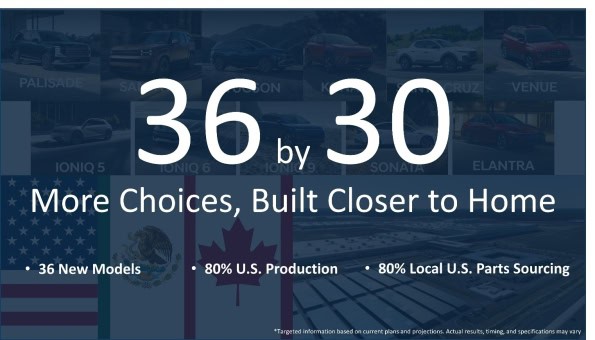
Hyundai Motor Company laid out an ambitious product and manufacturing strategy on Wednesday, announcing plans to introduce 36 new or substantially updated vehicles across North America by 2030 as part of a sweeping effort to deepen its footprint in the United States and cement its standing as one of the industry’s most aggressive growth stories.

The announcement, made by President and Chief Executive José Muñoz at the company’s annual shareholder meeting, signals Hyundai’s determination to compete aggressively in a market that has become central to its global ambitions — even as the broader auto industry navigates economic uncertainty, shifting consumer preferences and an uneven transition to electric vehicles.

The planned vehicles — spanning passenger cars, sport utility vehicles, trucks and commercial models — will be offered with a range of powertrains, including traditional combustion engines, hybrids, fully electric and extended-range electric options. The lineup will also include expanded trim levels, among them the rugged XRT variants and high-performance N derivatives that have cultivated a devoted following among driving enthusiasts. The rollout will cover the United States, Canada and Mexico.

“Hyundai is accelerating across North America,” Mr. Muñoz said at the meeting. “By expanding our product portfolio and offering a wider range of powertrains in North America, we’re giving customers more choice while continuing to strengthen our long-term investment in U.S. manufacturing, jobs, and the broader automotive ecosystem.”

The product push is closely tied to a $26 billion investment in the United States previously announced by Hyundai Motor Group. That commitment, which extends well beyond vehicle development, also encompasses a new state-of-the-art steel mill in Louisiana and a robotics research and innovation hub — investments the company says will strengthen its manufacturing capabilities and technology infrastructure across the region for decades to come.

On the production side, Hyundai said it aims to have more than 80 percent of the vehicles it sells in the United States assembled domestically by 2030, a significant increase from current levels. Simultaneously, the company is targeting a rise in American-made components within its supply chain, pushing that figure from roughly 60 percent today to approximately 80 percent. Together, those goals are designed to reduce the company’s exposure to global supply chain disruptions and improve operational efficiency through more localized sourcing.

The strategy reflects a broader industrywide pressure on automakers to bring production closer to home — a trend sharply accelerated by pandemic-era supply chain upheaval, evolving trade policy and growing political and consumer interest in domestic manufacturing. For Hyundai, the push also represents a calculated bet that committing deeply to American production and American workers will pay long-term dividends in both brand loyalty and market resilience across the United States, Canada and Mexico.

Free Training

Source link

Apple adds new partners to its American Manufacturing Programme


Apple adds new partners to its American Manufacturing Programme

New Delhi, March 26 (SocialNews.XYZ) Apple on Thursday announced new members of its American Manufacturing Programme (AMP), expanding the company’s long-standing commitment to bring even more advanced manufacturing and critical component production to the United States.

Apple is working with Bosch, Cirrus Logic, TDK, and Qnity Electronics to manufacture essential materials and components in the U.S. for Apple products sold around the world, creating jobs and strengthening America’s manufacturing capabilities. Apple is planning to spend $400 million for these new programs through 2030.

“At Apple, we believe in the power of American innovation and manufacturing, and we’re proud to partner with even more companies to produce critical components and cutting-edge materials for our products right here in the U.S.,” said Tim Cook, Apple’s CEO.

“Today, we’re joining with world-class partners like Bosch, Cirrus Logic, TDK, and Qnity Electronics to further expand Apple’s U.S. supply chain through our American Manufacturing Program. This is another powerful example of what is possible when we invest in American ingenuity, and we’re excited to build the future together,” Cook added.

Today’s expansion accelerates the momentum of AMP, a key part of Apple’s $600 billion, four-year commitment to US manufacturing and innovation.

The programme’s initial partners, including Amkor, Applied Materials, Broadcom, Coherent, Corning, GlobalFoundries, GlobalWafers America, MP Materials, Samsung, and Texas Instruments, are already achieving major milestones to expand advanced manufacturing in America and strengthen Apple’s domestic supply chain.

Longtime Apple supplier TDK will manufacture sensors for Apple in the U.S. for the very first time.

The two companies have collaborated for over 30 years on various technologies, including advanced tunnel magnetoresistance (TMR) sensors that support key iPhone features like camera stabilisation.

TDK’s US facility will supply TMR sensors in devices shipped all over the world, and will increase the volume of chips that Apple will source from U.S. silicon supply chains.

Apple, Bosch, and TSMC will work together to produce integrated circuits (ICs) for Bosch’s new sensing hardware at TSMC Washington in Camas, Washington. These ICs are essential for features like Crash Detection, Activity tracking, and elevation in Apple products.

Apple is also working with Cirrus Logic and GlobalFoundries to establish new semiconductor process technologies at GlobalFoundries’ facility in Malta, New York. GlobalFoundries’ newest silicon process will be available in the U.S. for the first time to enable key technologies for Apple products. This collaboration enables Cirrus Logic to develop mixed-signal solutions for a number of Apple applications, including advanced ICs to power Face ID systems.

Qnity Electronics and HD MicroSystems will provide cutting-edge materials and technologies essential for semiconductor manufacturing and advanced electronics. This collaboration will pioneer innovations for high-performance computing and AI, bolstering the domestic production of critical components and strengthening America’s leadership in advanced technology.

Apple’s commitment to supporting American jobs and manufacturing includes the Apple Manufacturing Academy, launched last fall in Detroit to provide small- and medium-sized manufacturers hands-on training in AI, automation, and smart manufacturing. The academy has already supported nearly 150 businesses through dozens of free in-person training sessions and virtual programming.

Source: IANS

Apple adds new partners to its American Manufacturing Programme

About Gopi

Gopi Adusumilli is a Programmer. He is the editor of SocialNews.XYZ and President of AGK Fire Inc.

He enjoys designing websites, developing mobile applications and publishing news articles on current events from various authenticated news sources.

When it comes to writing he likes to write about current world politics and Indian Movies. His future plans include developing SocialNews.XYZ into a News website that has no bias or judgment towards any.

He can be reached at gopi@socialnews.xyz

Like this:

Like Loading…

Free Training

Source link

Clarity advances US manufacturing strategy with major copper 64 supply agreement


Clarity Pharmaceuticals (ASX:CU6) has announced a large-scale manufacturing supply agreement for copper-64 with US-based Theragenics.

The company said the deal signals a clear move from late-stage clinical development toward building the infrastructure required for a potential commercial launch of its lead diagnostic candidate, 64Cu SAR bisPSMA.

At the centre of the agreement is Theragenics’ expansive production facility near Atlanta, Georgia, a strategically located transport hub equipped with 14 cyclotrons.

The site is designed to enable centralised, high-volume production of copper-64, a radioisotope that plays a critical role in next-generation cancer imaging. This capacity is expected to support Clarity’s anticipated commercial rollout, contingent on the successful completion of its Phase 3 trials and regulatory approval in the United States.

Theragenics brings decades of radiometal production expertise to the partnership, alongside the ability to generate substantial daily output. A single cyclotron at the facility can produce enough copper-64 to support approximately 2,000 patient doses per day, highlighting the scalability of the arrangement. Clarity said this agreement complements existing supply deals and strengthens a geographically diverse manufacturing network designed to ensure reliability and redundancy across the US market.

Clarity said the agreement represents a shift toward a more scalable, economically efficient model for radiodiagnostics, one that could expand patient access while improving operational viability for providers.

Free Training

Source link

About Those Manufacturing Employment Numbers…


Last month, the Wall Street Journal published a story straightforwardly titled “U.S. Manufacturing Is in Retreat and Trump’s Tariffs Aren’t Helping.” Exhibit A, meant to indicate as self-evident that tariffs are killing U.S. manufacturing and thus failing in their stated purpose: the fact that American “[m]anufacturers shed workers in each of the eight months after Trump unveiled ‘Liberation Day’ tariffs.”

The piece is a classic of the genre. News outlets, elected officials, think tanks, and other assorted members of the D.C. “policy community” keep asking the same question: What about these manufacturing employment numbers? Don’t they mean tariffs aren’t working?

The numbers are true enough. U.S. manufacturing lost 93,000 jobs between March 2025 and February 2026. It is also true that a decline in manufacturing jobs certainly can indicate something seriously amiss. For example, after the United States normalized trade relations with China in 2000, the American manufacturing sector shed three million jobs in three years.

This did indeed portend a sector in crisis. Manufacturing output, measured appropriately, stagnated, a fact that people living in the affected communities did not miss even if economists did. Eventually, manufacturing productivity flatlined and began a long decline, meaning America got worse at making things efficiently. Fair enough, then, to ask whether manufacturing job loss suggests something wrong with American economic policy now as well.

The problem with the argument the WSJ and others are making, however, is that it misunderstands the logic of reindustrialization. The rebuilding of an atrophied American economy is a slow process that must proceed in stages; tariffs are a vital part of a toolkit intended to prompt that slow, staged process. The real question is whether this logic holds in the face of reality. A reasonable evaluator, rather than a partisan polemicist, would therefore ask several questions.

For example: How was the sector performing before these tariffs? How quickly should we expect manufacturing jobs to increase after one year, if this were working? Are there any signs that indicate something positive happening in manufacturing? The answers (which are, in order: even worse; not at all; yes) suggest that the state of manufacturing employment does not undermine the logic of reindustrialization at all. Working through each question in turn helps clarify why.

First up: past jobs numbers. The argument that declining employment after tariffs demonstrates harm to American industry rests on the implied premise that manufacturing jobs were in a better state before. This was manifestly not the case.

As explained by analyst Alan Tonelson, the Bureau of Labor Statistic (BLS)’s annual benchmark revision, released with its January 2026 jobs report, contains a telling story. American manufacturing lost 81,000 jobs in the first 11 months of Trump’s second term—but lost 179,000 jobs in the preceding 11 months. Breitbart economics editor John Carney, in a direct rebuttal to the WSJ’s February story (helpfully titled “Why the Wall Street Journal Missed the Trump Manufacturing Boom”), explains the point: “Manufacturing employment losses during the Trump tariff period were less than half those recorded during the comparable pre-tariff Biden period. The trajectory improved, not deteriorated.”

This improvement happened despite countervailing pressures from the Trump administration’s severe immigration enforcement efforts, which would reasonably be expected to worsen the manufacturing employment situation. Estimates of how much of the unauthorized labor force works in manufacturing vary; a 2025 analysis from the Center for Migration Studies suggests around 11%. The Dallas Fed reports that unauthorized migration has turned net negative since February 2025, and estimates a “net loss of about 49,000 unauthorized immigrant workers in July [2025] alone,” while the Pew Research Center estimates that 1.2 million immigrants (including both those in the U.S. legally and illegally) had left the workforce by July.

As Carney points out, net negative migration also results in new pressures within the workforce still in the United States, as manufacturing employers compete for workers from a smaller labor pool. Manufacturing job loss has slowed even under these conditions.

American manufacturers also want to hire. Monthly job openings in the manufacturing sector spiked by over 100,000 from a low of 389,000 in April 2025 to a high of 495,000 in January 2026. This does not suggest a sector eager to shed its workers. Quite the opposite: the sector is desperate to grow its workforce. Its difficulty in doing so holds many implications for what policymakers could do better when it comes to workforce development and education, among other things. But skyrocketing demand for manufacturing labor, combined with slowing job loss despite significant enforcement pressure on a meaningful part of the manufacturing workforce, does not suggest a sector in freefall.

Share

Second: How quickly should manufacturing jobs be expected to increase? The answer requires thinking in stages. The first step on the reindustrialization road is to create demand and induce investment; tariffs contribute to this effect by raising the cost of reliance on imports relative to investment in domestic industry. Reindustrialization prompted by tariff pressure therefore necessarily entails short-term pain.

Meeting this increased demand requires increased capacity utilization. In the immediate term, we should expect it to be hard for an atrophied manufacturing labor market to swiftly respond to that need. Manufacturers could be expected instead to increase hours (which they are doing) and boost productivity (which they are also doing).

In the longer term, we should expect growth in employment as new investments pay off and new capacity comes online. A revitalized manufacturing sector should be expected to create jobs—but not in the first year. The example of recent industrial policy (another vital tool of reindustrialization) is instructive. The CHIPS and Science Act was enacted in 2022; asking in early 2023 where all the chip-making jobs were would have been nonsensical. Almost four years later, however, one academic study estimates the policy had “national direct employment effects of approximately 15,000-16,000 jobs in the core semiconductor sector and indirect effects of 15,000-30,000 jobs in related sectors.” No one can build (and then man) a factory overnight.

Third and most important: Are there any signs of a manufacturing sector gradually reorienting itself towards increased production? The answer here is encouraging: yes.

The ISM Manufacturing PMI measures growth or contraction in the sector based on surveys of purchase managers; a PMI above 50 indicates growth. After 12 months of sub-50 readings, the manufacturing index hit 52.6 in January 2026 and 52.4 in February. These are the highest readings since August 2022. They did remain negative through 2025, a point much noted by tariff critics, who now seem strangely silent on the potential import of such a positive turn. S&P Global’s U.S. Manufacturing PMI, for its part, was consistently positive in both 2025 and early 2026 after trending negative in 2024, and seems to have therefore been ignored by the pundits.

Furthermore, the industrial production index is at its highest level since 2019, and has been on an upward trend since November 2024. Manufacturing output has been on an upward trend since 2025 as well, versus a downward trend in the preceding years. The counter-trend spike in demand for manufacturing labor indicates a sector eager to grow. The sector is responding to that pressure with a counter-trend spike in productivity. Manufacturing productivity increased 2 points in 2025—the largest annual increase since 2010, as the BLS helpfully highlights in its March 2026 report. This is healthy; increasing pressure to get better at making things is a key element of a sensible reindustrialization agenda.

None of this compares favorably with the shallow argument that tariffs are destroying American manufacturing. They clearly are not. What seems more likely is that, upon discovering that American manufacturing is not in the unambiguous freefall they predicted, critics have cottoned to a bad argument instead.

There are many quite reasonable criticisms to make about the current trade regime’s relationship to manufacturing. Some we at American Compass have made ourselves. One is that tariffs are insufficient on their own to achieve the desired scale of revitalization, and that when imposed without a comprehensive suite of other policy measures (public-private financing for critical industry and real workforce development solutions, to name just two), they create more pain than needed for less upside than intended. Another is that tariffs implemented in a haphazard, opaque, and unpredictable manner make it harder for manufacturers to invest than necessary, thus offsetting some of the potential gains tariff pressures produce. But these criticisms come from within the frame that tariffs can work, as the data is indicating they can.

Those opposed to tariffs in principle, on the other hand, are stuck grasping at any data that might uphold their narrative that tariffs cause nothing but harm. The real irony, of course, is that when a massive and precipitous decline in American manufacturing jobs really did indicate a crisis in the sector, the free trade absolutists were the first to remind the public that economic transformation takes time, and that painful tradeoffs would be worth it in the long run.

They were wrong; their version of the long run was even worse. Here, however, we seem headed in the right direction. And at the very least, the economists who lectured the American people about the wisdom of achieving general equilibrium over multiple generations through free trade, despite the pain along the way, should refrain from judging an alternative policy a failure because a negative job trend didn’t turn positive overnight.

Leave a comment

Free Training

Source link

Kanthal expands US manufacturing footprint with North Carolina service centre to meet electrification demand


Kanthal has strengthened its position in advanced manufacturing with the inauguration of a new service centre in Concord, North Carolina, aimed at scaling production and deployment of high-temperature electric heating technologies.

The investment reflects growing demand from sectors including electronics, glass and steel, where manufacturers are seeking to electrify heat-intensive processes and reduce reliance on fossil fuels. At the centre of this shift is Kanthal’s Globar® silicon carbide heating element technology, which enables industrial heating applications of up to 2,950°F.

By replacing combustion-based systems, these electric heating elements offer manufacturers a pathway to lower emissions, improved energy efficiency and tighter process control, factors that are becoming increasingly critical as industry faces mounting pressure to decarbonise.

According to the Congressional Budget Office, combustion emissions account for 573 million metric tonnes, or 75% of total emissions in the manufacturing sector. Electrification of industrial heat is therefore seen as a key lever in reducing the sector’s carbon footprint.

The Concord facility will play a dual role in both manufacturing and service delivery. In addition to producing a range of heating solutions—including metallic and Fibrothal® elements—the site now supports local supply of Globar® components, which were previously manufactured and shipped exclusively from Kanthal’s production hub in Perth, Scotland.

Robert Stål, President of Kanthal, said the move builds on the company’s long-standing presence in the U.S. market.

“We have served the U.S. market since the 1930s.  We are already supporting our customers from Concord with a broad portfolio, and adding Globar® to the mix allows us to leverage existing infrastructure. The opening of our Concord service center is the next step in strengthening our local presence in the region which is experiencing a surge in advanced manufacturing.”

– Robert Stål, President of Kanthal.

The new centre is part of a broader $11m investment programme, which also includes a significant expansion of the Perth facility. Upgrades there include an additional 19,000 square feet of manufacturing space, new equipment and an optimised production layout. Together, the two sites are expected to increase overall production capacity by around 40%.

Beyond capacity gains, the Concord site introduces new manufacturing flexibility. Enhanced production technologies enable the facility to tailor heating element configurations to specific furnace designs and customer order cycles, improving responsiveness across quoting, production and delivery.

Simon Lile, President of Kanthal’s Heating Systems business unit, said the upgraded operation is designed to align more closely with U.S. customer requirements, reducing lead times and enabling more agile manufacturing support.

The expansion follows Kanthal’s 2022 consolidation of its U.S. operations into the Concord site, creating a centralised, state-of-the-art manufacturing and distribution hub. With the addition of Globar® production capabilities, the facility now serves as a critical node in the company’s global manufacturing network, supporting both regional demand and the broader shift toward electrified industrial processes.

Free Training

Source link