Aurelius Systems Opens U.S. Manufacturing Line for High-Power Fiber Lasers


Autonomous laser defense company launches domestic production of high-power laser sources

SAN FRANCISCO, April 29, 2026–(BUSINESS WIRE)–Aurelius Systems, the autonomous laser defense company behind the Archimedes counter-UAS system, today announced Aurelius Manufacturing, a new division that will build high-power fiber laser source modules in the United States.

The U.S. defense laser supply chain has a gap. Demand for high-power fiber lasers is growing across military and industrial applications. A small number of established domestic manufacturers produce laser sources, but the market is shifting. Chinese laser companies have taken majority share in Asia Pacific, a region that accounts for nearly half the global fiber laser market, and are expanding into the U.S. through new automation products and service networks. For defense programs that need ITAR-compliant components from a supplier they can trace end to end, the pool of qualified domestic options is small and getting smaller relative to demand.

Aurelius set out to build Archimedes, its autonomous counter-UAS system, to give American forces scalable defense against drone threats. In doing so, the team found that domestic production of high-power fiber lasers has been shrinking for over a decade, with most remaining suppliers no longer American-owned. Aurelius Manufacturing is the company’s response: a U.S. production line for the same fiber laser source modules and components that sit at the heart of any directed-energy system, and that American manufacturers have had to import for years.

The launch comes as the Pentagon pushes to field laser weapons at scale within 36 months, backed by $250 million in directed energy R&D funding from the One Big Beautiful Bill. The Department of Defense’s fiscal year 2027 budget requested more than quadruples that figure, proposing over $2 billion in directed energy RDT&E. The Army’s Enduring High Energy Laser program is moving toward its first production contract, with plans to acquire up to 24 systems. Navy leadership has called for lasers on every ship in the surface fleet. As these programs move from prototyping into production, the number of domestic suppliers building defense-grade laser sources has not kept pace. Lead times from qualified vendors are long, and the industrial base needs more capacity.

Aurelius Manufacturing’s first product is a compact, rack-integrated fiber laser source module rated at multi-kilowatt output. Units will be available from prototype quantities through full-rate production, with configurations tailored to directed-energy and industrial manufacturing applications.

Aurelius’s laser sources are designed to be ITAR-compliant with full domestic traceability and no dependency on foreign allocation schedules. For industrial customers running laser welding, metal cutting, surface treatment, or additive manufacturing lines, domestic production will mean shorter lead times and direct access to the engineers building the hardware.

“It’s clear the domestic production of high-power lasers in the US is significantly lower than necessary to support both our directed energy and defense needs. Laser system production has been continually offshored outside of our lands. In order to support our customers, the directed energy industry at large and the growing material processing industry in the US, we’ll be vertically integrating and producing lasers here in the homeland,” said Michael Laframboise, CEO of Aurelius Systems.

Production capacity reservations for Q1 2027 are open. Customers can reach Aurelius at aureliusmanufacturing.com.

About Aurelius Systems

Aurelius Systems is a San Francisco-based defense technology company building autonomous laser systems. Its first product, Archimedes, is a counter-drone system designed to defeat Group 1 and 2 UAS threats. Through Aurelius Manufacturing, the company is building domestic production of high-power fiber laser sources for defense and industrial customers. All products are designed and built in the United States. For more information, visit aureliussystems.com.

View source version on businesswire.com: https://www.businesswire.com/news/home/20260429408874/en/

Contacts

Media Contacts:
Wilson Wiangchanok
marketing@aureliussystems.us

Free Training

Source link

AMF Bruns Opens New Ohio Headquarters, Expands U.S. Manufacturing Footprint


More than double the size. State-of-the-art manufacturing and office space. Enhanced customer support and an eye on future growth.  

Last May, AMF Bruns of America broke ground on brand-new office and manufacturing space in Stow, Ohio, as the company grows in both staff and customer and product demand. Now, less than one year later, the building is complete, and METRO was on the scene to check out their new digs during their April 14, 2026, ribbon-cutting and open house.

A Story of Growth and Opportunity Leads to Expansion

Relocating from a former facility in Hudson, the new AMF Bruns building boasts 41,000 square feet, offering the company expanded production capacity and room to grow.

Speaking of growth, several of AMF Bruns’ owners and executives from Germany flew in to celebrate the new U.S. hub. Their shared passion for the North American market and pride in their presence in Ohio was impossible to ignore. Each leader made a point to show their gratitude for the on-site team, partners, and supporters. They recognized the collaborative work of the AMF staff, the dedication of customers, and the community’s support, especially thanking the city of Stow for the warm welcome.

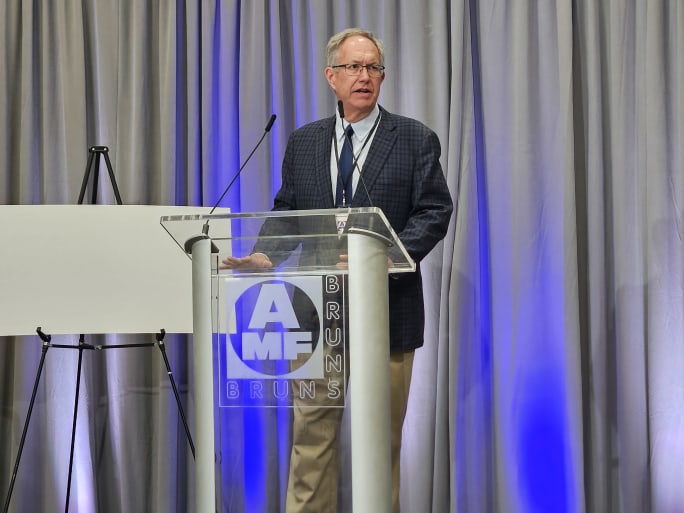
took the 90-some open house attendees on a tour through the new facility, pointing out the rows of raw materials that easily fit inside and several stations and machines that turn those materials into finished products ready for vehicle use, AMF Bruns’ CEO, took a moment to reflect on what led to this exciting new step. “It seems only yesterday, in 2013, when we took our first steps and established physical operations in Ohio,” he said. “Since that time, we’ve grown the company from three 40-foot containers, a one-man show, and three employees starting in Hudson, and now here in this new facility with 33 employees today. It’s a beautiful new facility, and we hope to grow another 20% next year.”

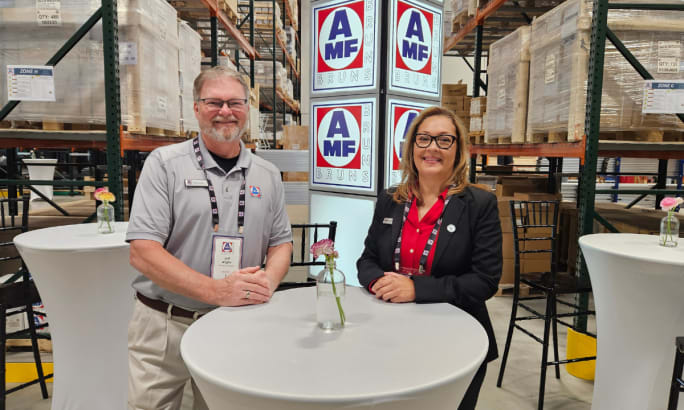
AMF Bruns national account managers Maritza Valentin and Jeff Allgire stand in the new building’s manufacturing space.

AMF Bruns national account managers Maritza Valentin and Jeff Allgire stand in the new building’s manufacturing space.

Of course, familiar faces were there as well, including national account managers Maritza Valentin and Jeff Algire.

Joe Esteireiro, operations manager, and other key staff took the 90-some open house attendees on a tour through the new facility, pointing out the rows of raw materials that easily fit inside and several stations and machines that turn those materials into finished products ready for vehicle use.

How Does AMF Bruns Support Its Communities as a Global Company?

“AMF Bruns always wanted to be a global player,” said Gerit Bruns, one of the company’s owners. “Years ago, we could work out of Germany and export products to foreign countries. I must admit, the world has changed. The economy is still global, but it needs far more diversification for each market. It is necessary to be local in the global market.”

To demonstrate the company’s support of local communities, they presented a $10,000 check to the Stow-Monroe Falls Community Foundation. “This donation is not just a gesture; it’s a promise that we’re not only here to do business, but to be a responsible partner and a positive force in the region,” Jan Woltermann, board of trustees member, said.

Stow's mayor, John Pribonic, was happy to welcome AMF Bruns to town.

Stow’s mayor, John Pribonic, was happy to welcome AMF Bruns to town.

Stow Mayor John Pribonic shared that through the donation, the foundation plans to establish the AMF Bruns Mobility and Accessibility Fund. Grants from this fund will help both private and public accessibility needs and projects in the community.  

What Else Sets AMF Bruns Apart in the Mobility and Securement Space?

AMF Bruns’ products are Buy America compliant; all its restraints are manufactured in the U.S., and its flooring materials are sourced internationally and assembled in Ohio.

Additionally, AMF prides itself on being ISO 9001 registered and certified, meaning its products have been extensively tested and documented and have passed an external audit for safety and quality.

Looking Back: AMF Bruns Enters Paratransit Vehicle Modification Market

Free Training

Source link

Missouri S&T – News and Events – S&T opens Missouri Protoplex for advanced manufacturing


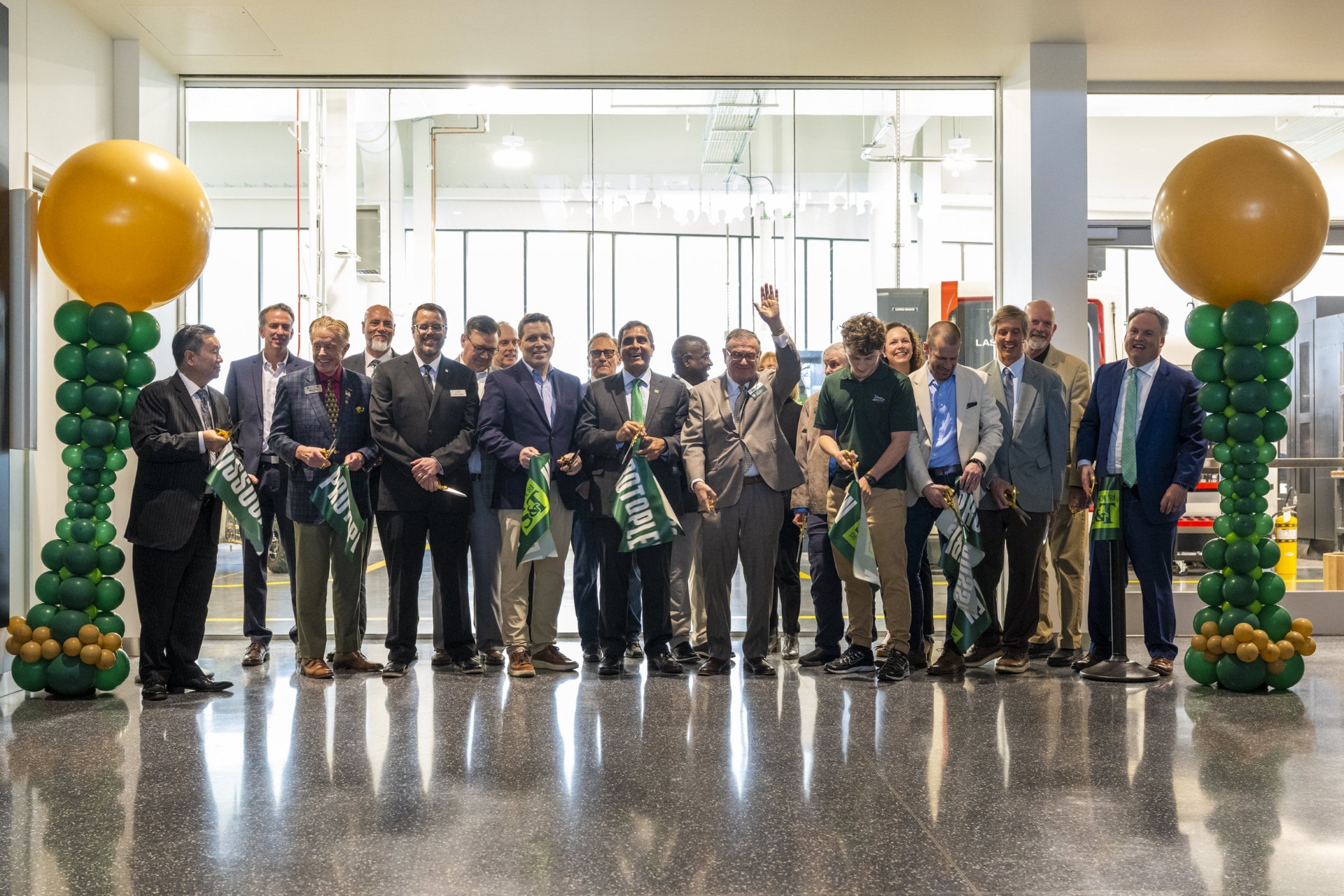
Nearly 500 people celebrated the opening of the Missouri Protoplex on April 15 at the new facility, located at 1700 White Columns Drive in Rolla. The 117,000-square-foot advanced manufacturing facility is the first building in Missouri S&T’s Manufacturing Technology and Innovation Campus.

Group of leaders after ribbon is cutLeaders celebrate after cutting the ribbon to mark the opening of the Missouri Protoplex on April 15. Photo by Michael Pierce/ Missouri S&T
“On behalf of the Board of Curators, I’m excited today to join in the dedication of the Missouri Protoplex, one of the most comprehensive university-based manufacturing facilities in the nation,” said Todd Graves, chair of the University of Missouri Board of Curators. “With the Protoplex, Missouri S&T is taking the lead to ensure our state’s manufacturing innovators and industry partners have access to the latest research technology and equipment, along with enhanced space to design and test their new products and processes.”

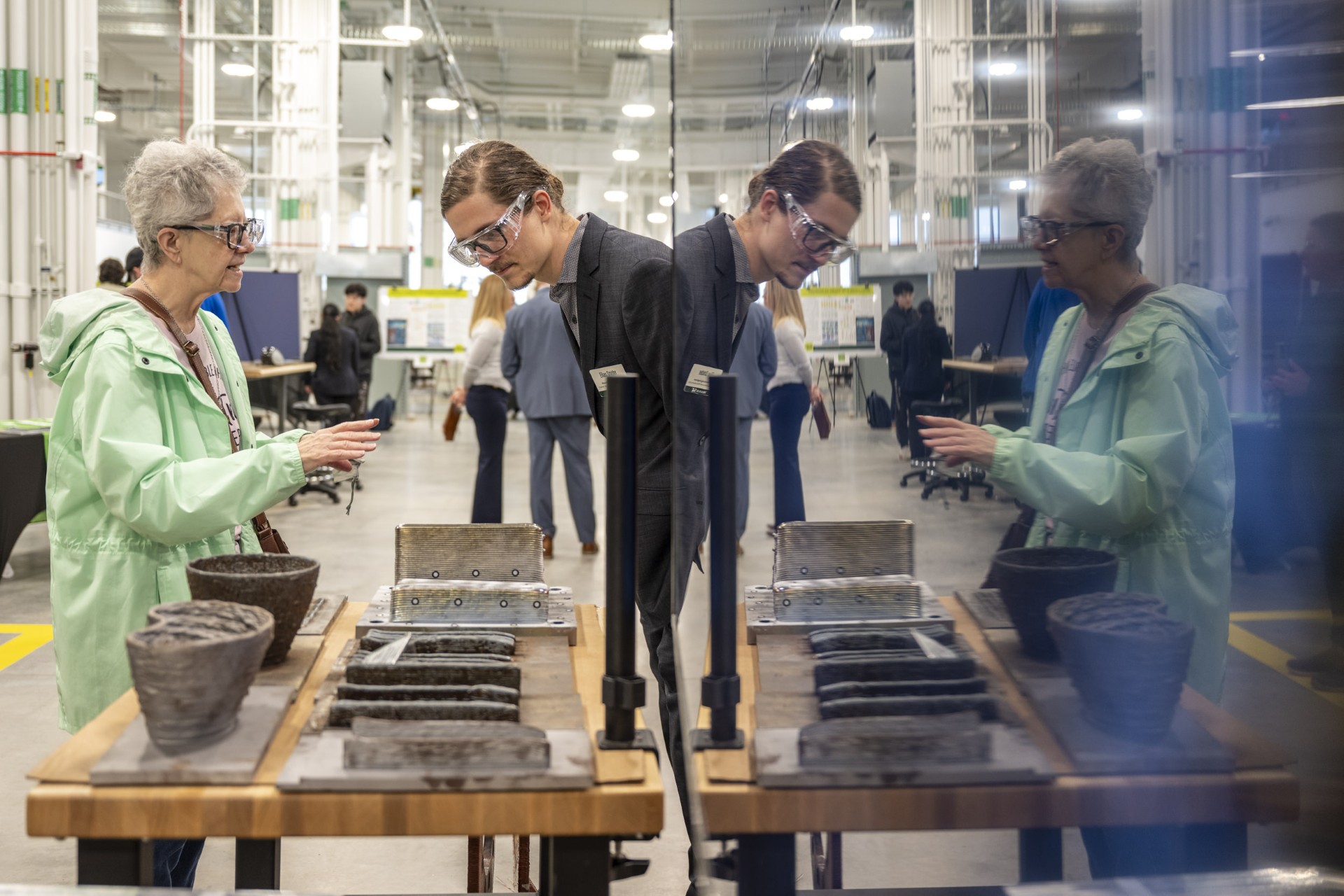
Engineer shows guest manufacturing equipment. Students and engineers gave demonstrations and answered questions during the April 15 Protoplex open house. Photo by Michael Pierce/Missouri S&T
The facility includes 40,000 square feet of high-bay manufacturing space and more than 60 industrial-scale pieces of equipment and manufacturing systems. S&T has already secured more than $22 million to support collaborations with its industry and research partners.

“Our previous governor, Mike Parson, our current governor, Mike Kehoe, and elected leaders have made it a strategic point to invest in higher education, infrastructure and workforce development, and this is another testament to that investment that’s happening here,” said Dr. Mun Choi, president of the University of Missouri.

Gov. Kehoe was unable to attend but shared his congratulations in a video message played during the ceremony.

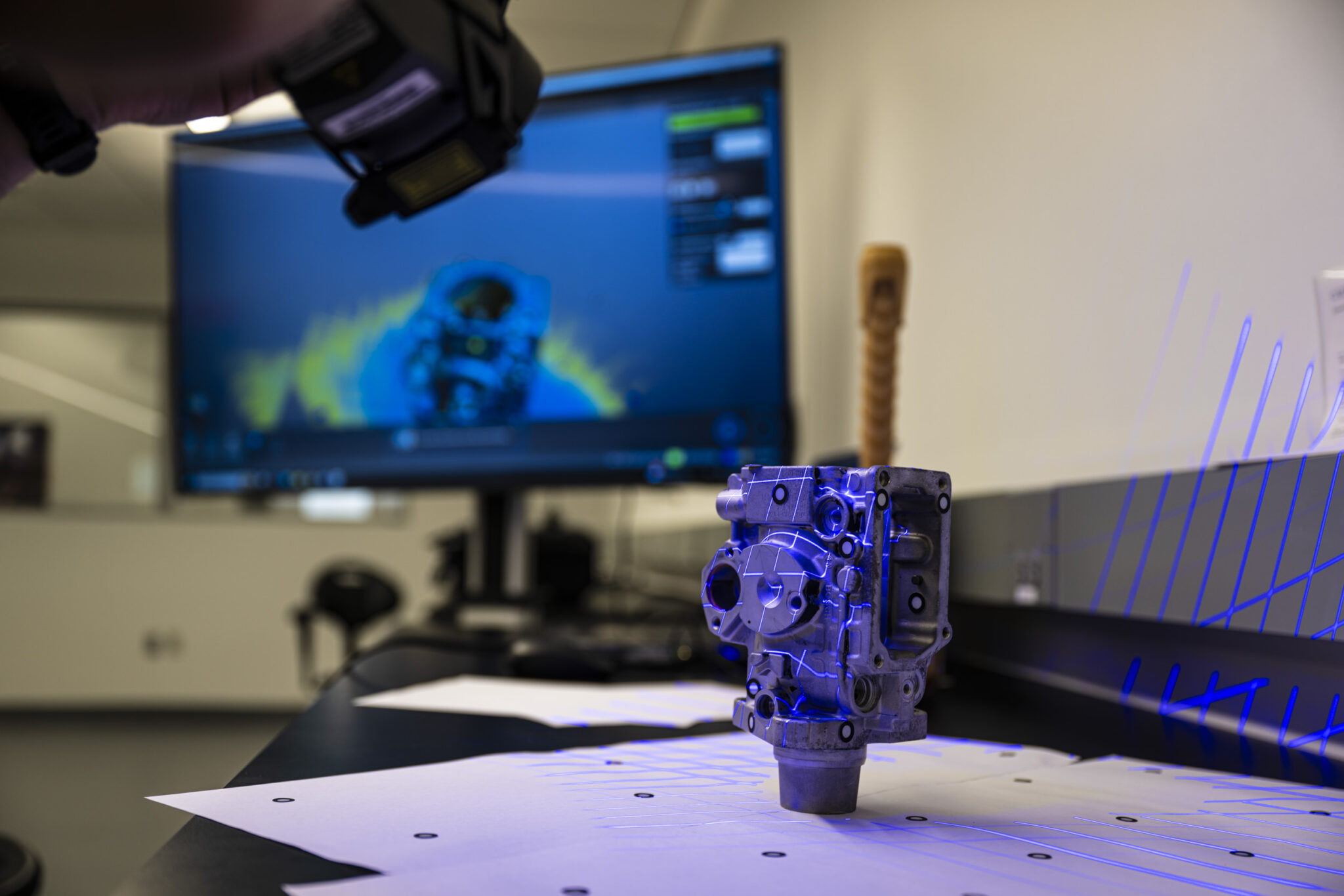
A 3D scanning system projects patterned blue light onto a metal part to capture precise measurements. A 3D scanning system projects patterned blue light onto a metal part to capture precise measurements. Photo by Michael Pierce/Missouri S&T

“When we broke ground for the Missouri Protoplex three years ago, I spoke about the need for such a facility to support our engineering education and technological workforce needs,” said Dr. Mo Dehghani, chancellor of Missouri S&T. “Now, more than ever, this facility is needed to strengthen U.S. manufacturing, drive economic development and build the talent pipeline for tomorrow’s workforce. The Missouri Protoplex will support a broad range of manufacturers, from established companies to startups to entrepreneurs. As the United States aspires to onshore manufacturing, technological universities like Missouri S&T can help.”

Dr. Richard Billo, director of the Protoplex and Distinguished Professor of mechanical and aerospace engineering, spoke about the current state of U.S. manufacturing.

Busy lobby area during eventGuests check out the new Protoplex facility on April 15. Photo by Michael Pierce/Missouri S&T

“There are few domains in the United States where the impact of technology has been more acutely felt than manufacturing,” Billo said. “The Missouri Protoplex is where the innovations in manufacturing supported by the research we conduct and the technical assistance we provide will be put in the hands of manufacturers. Our goal is to support them in their endeavors and to adopt the advanced manufacturing methods that will help them become and remain as competitive as possible in an increasingly complex marketplace. The work undertaken at the Protoplex will help keep our manufacturers where they belong — at the forefront of American innovation.”

A reception and open house followed the remarks and ribbon-cutting ceremony. Guests toured the Protoplex and visited with students and engineers on hand to demonstrate equipment, discuss their research and answer questions.

Free Training

Source link

Hadrian opens ‘Factory of the Future’ in Alabama


Hadrian has opened a new advanced manufacturing facility in Cherokee, Alabama to support U.S. Navy Columbia- and Virginia-class submarine programs. The site, known as Factory 4, is designed to mass-produce critical components and help accelerate submarine construction.


The 2.2 million square foot facility will operate as a highly automated “factory of the future,” producing parts, assemblies and finished products identified as key drivers of submarine production timelines. Increased output is expected to reduce bottlenecks and enable faster delivery of submarines.

The project is funded through a public-private partnership combining $900 million in U.S. Navy investment with more than $1.5 billion in private capital. The total investment of over $2.4 billion reflects efforts to strengthen the maritime industrial base and expand production capacity.

The facility is also expected to create up to 1,000 high-paying jobs, supporting regional economic growth while addressing workforce shortages in the defence sector. Hadrian said its automated manufacturing platform will enable faster workforce training and improve production efficiency.


The opening comes as the Navy seeks to address long-standing capacity constraints in submarine construction. By shifting component manufacturing to dedicated facilities, shipyards can focus more resources on assembling submarine modules.

“Both chambers of Congress delivered the generational investment required to rebuild our shipbuilding capacity, bring those jobs back to Alabama and put American skilled laborers back at the center of American strength,” said Secretary of the Navy John C. Phelan. “I look forward to building on this progress together in the months ahead, because we are just getting started. This factory is the first of three facilities designed to address the most critical bottlenecks in the maritime industrial base.”

Officials described the approach as part of a broader strategy to increase production rates through distributed manufacturing. “We call this distributed shipbuilding, and it’s a key tenet of our plan to achieve required shipbuilding production rates,” said Jason Potter, performing the duties of Assistant Secretary of the Navy for Research, Development and Acquisition.

“These factories of the future might be several states away from the yards where the ships are ultimately built, but by taking on this work they reduce bottlenecks, having a profound effect on the speed of delivery,” he added.


Hadrian said the facility will reach full production capacity within 18 to 24 months, following qualification processes and initial production phases. By the third year, the site is expected to sustain operations through regular delivery of submarine components.

Company leadership said the project reflects a coordinated effort between government and industry to expand manufacturing capacity. “The Administration has set the strategy, Congress has cleared a path, the Navy has set the requirement, and Secretary Phelan has been unambiguous that private-sector partnership is foundational, not optional, to deter threats to national security. Industry has to answer that call with real execution, and the window to do it is now. We are proud to be part of the coalition building that capacity, and this factory is Hadrian’s commitment to meeting this moment,” said Chris Power, founder and CEO of Hadrian.

Lawmakers attending the opening highlighted the strategic and economic impact of the investment. “This investment marks a major step forward in strengthening our nation’s defense industrial base while bringing high-quality jobs and economic growth to Northwest Alabama,” said Representative Robert Aderholt.

Officials said the facility is part of a wider effort to modernise U.S. manufacturing and strengthen long-term defence readiness. The project is expected to play a key role in increasing submarine production capacity and supporting national security objectives.


Free Training

Source link

US manufacturing access opens new Alpha-GPC format options as cognitive health market matures


According to market insights firms SPINS, U.S. cognitive health vitamin, mineral and supplement sales reached approximately $499 million over the latest 52-week period, with unit sales exceeding 19.5 million. While the category remains one of the industry’s largest condition-specific segments, dollar sales declined slightly year over year, underscoring the difficulty of sustaining growth in a mature market.

Within that landscape, CHEMI Nutra says expanded U.S. manufacturing access to its choline-rich Alpha-GPC ingredients is enabling shorter formulation timelines while preserving Italian pharma-level purity and stability. CHEMI Nutra, incorporated in 2001, manufacturers Alphasize at CHEMI S.p.A.’s pharmaceutical-grade facilities in Milan and Patrica, Italy.

Alpha-GPC (Alpha-glycerylphosphorylcholine) is used across a wide range of cognitive health products, particularly in blended formulations positioned for focus, memory and mental performance. Its use, however, has largely remained concentrated in powders and capsules.

Accessing the AlphaSizeLiquid-Science Platform

Mike Petteruti, president & general manager of CHEMI Nutra highlighted that delivery format innovation continues to shape future development strategies for choline ingredients.

“Future development will focus on delivery systems that improve bioavailability, format flexibility and consumer compliance, including liquids, softgels and hybrid systems,” he told NutraIngredients. “The biggest opportunity lies in integrating choline solutions into multi-benefit formulations without compromising stability or sensory experience.”

Efforts to expand Alpha-GPC into liquid and softgel formats have historically faced stability challenges, and the “main barriers were limited access to suitable liquid Alpha-GPC and a lack of confidence and know-how around softgel applications,” according to Petteruti.

“Alpha-GPC’s sensitivity to moisture and interaction with lipid systems made long-term stability difficult without system-level expertise,” he noted.

Those issues have limited how quickly brands could pursue alternative delivery formats, but Petteruti said those challenges can now be addressed via CHEMI Nutra’s AlphaSize Liquid-Science Platform.

Introduced in 2025, this platform allows for the use of “Liquid 85L” Alpha-GPC in applications such as shots, ready-to-drink (RTD) beverages, gummies, drops and softgels, while maintaining the stability and efficacy of the ingredient.

Moving forward, Petteruti added, regulatory clarity and scientific substantiation will continue to influence how quickly new formats reach the market.

Added value of U.S. manufacturing and regulatory clarity

As competition heats up, regulatory positioning is also playing a more substantial role in ingredient selection. Alphasize is the only New Dietary Ingredient (NDI)-cleared Alpha-GPC in the U.S. market.

“Expanded U.S. manufacturing access to an NDI-supported Alpha-GPC increases regulatory confidence and commercial clarity for brands,” Petteruti said. “NDI support provides a well-documented safety and quality foundation, while domestic production improves traceability, continuity and alignment with FDA expectations.”

He added that those factors shorten supply chains and allow brands to plan innovation cycles with greater certainty in cognitive health and brain-mood formulations.

US-based manufacturing is also becoming more closely tied to transparency and documentation expectations.

“The AlphaSize Liquid-Science platform combines U.S.-based manufacturing with the same transparency and quality standards applied across CHEMI Nutra’s global operations,” Petteruti said. “Domestic production enables clearer documentation, tighter quality oversight and closer collaboration around formulation, stability and delivery formats.”

On-shoring can also make technical or regulatory decision-making processes less complex, as it “provides more direct access to this know-how and more consistent answers around regulatory confidence and performance expectations,” he added.

Free Training

Source link