American manufacturing is a nonnegotiable 


While the ceasefire holds in Lebanon, the Strait of Hormuz is back open. The disruption caused by its prolonged closure and the increased cost of critical goods have made the importance of domestic manufacturing more clear than ever. In times of crisis, we must be able to manufacture products vital for national security, including steel and aluminum, here in the United States.

Fortunately, President Donald Trump’s Section 232 tariffs are finally bringing manufacturing back home after years of foreign cheating. With renegotiation of the U.S.-Mexico-Canada Agreement on the horizon, it is important for the Trump administration to continue putting America first, even as left-wingers push for handouts to foreign countries at the expense of American jobs. 

A flood of imported metals, often subsidized by the socialist policies of foreign governments, have cheated American steel and aluminum workers out of business for years. During my time in Congress, I witnessed the consequences of this dynamic firsthand when fighting for my constituents within the U.S.’s manufacturing community. Mexico is particularly notorious, using Chinese aluminum to cheaply manufacture products they ship across our borders tariff-free under the USMCA. 

To make matters worse, when the USMCA replaced the North American Free Trade Agreement during the first Trump Administration, Mexico and Canada tied the agreement’s ratification to tariff relief. While some tariff relief was granted, the newly minted USMCA should have prevented the unfair trade practices that necessitate these tariffs. Unfortunately, when the Biden Administration took office shortly after the USMCA took effect, vital aspects of the USMCA went unenforced, including mechanisms intended to prevent import surges. Tariff exemptions were handed out left and right by the autopen. Once again, American jobs were shipped over the border. 

The entire aluminum supply chain was devastated, including extruders, who represent the vast majority of American aluminum workers. Extruders produce the essential aluminum parts used in everything from building materials to cars. Biden’s failures accelerated the trend of offshoring that began with NAFTA: thousands of aluminum extrusion jobs were wiped out across the country and American businesses were forced to shut down as operations moved to Mexico and the imports came flooding in. 

Now that he is back in the Oval Office, Trump wants to stop the bleeding caused by Biden’s reckless negligence, and he has made great progress through the reinstatement of his Section 232 tariffs on steel and aluminum. 

If we want to keep manufacturing at home and extend the benefits of an “America First” trade agenda to aluminum extruders, we can’t afford to repeat past mistakes. Mexico and Canada want Trump to fold under globalist pressure and hand out Section 232 tariff exemptions tied to the USMCA renegotiation. It’s the same play they made last time, and as we learned from Biden, any preferential treatment or signs of weakness turn free and fair trade into a rigged game.

And guess what? The worker always loses. We must firmly maintain the Section 232 tariffs on steel and aluminum at all stages of the supply chain, so that U.S. manufacturers can compete on a level playing field. 

At the same time, the USMCA renegotiation represents an opportunity to rebalance the agreement and correct NAFTA’s original flaw, made worse by China’s cheating. Rather than protect North American manufacturers, this agreement has become an outlet for foreign adversaries, namely communist China, to use Mexico as a back door to cheap U.S. market access. Now we have Chinese aluminum being fabricated into “Mexican” auto parts that are shipped into the U.S. fully processed. 

This means a product made with entirely Chinese aluminum can receive the benefits of USMCA that are meant to be exclusive to North America. As a result, Automakers are assembling these 100% foreign parts in the U.S. and calling the cars American made so they can cash in on lucrative rebates funded by taxpayers. 

USMCA’s rules of origin must be strengthened to discourage companies who assemble aluminum parts from moving their operations to Mexico, where they use Chinese metal to cheat the system. It is no accident that our trade deficit with Mexico is the largest it has ever been, even larger now than the trade deficit with China. By imposing stronger rules of origin and specific U.S. content requirements for aluminum, the USMCA can become the tool for fair North American trade it was meant to be. 

HEY SOCIALISTS, WE’VE ALREADY FIGURED OUT THE SUPERMARKET

As the master negotiator, it is up to Trump and his trade team to fight for us. If we maintain the Section 232 tariffs on steel and aluminum, without exceptions and exemptions, while taking these steps to strengthen the USMCA, millions of U.S. workers will benefit. Let’s keep fighting for the forgotten men and women of the U.S. and truly make our country great again! 

Rep. Jason Chaffetz served as chairman of the House Oversight and Government Reform Committee. He is a contributor for Fox News networks and the author of They’re Coming for You.

Free Training

Source link

Strategic Metals & Supply Chains


The global semiconductor revolution has fundamentally transformed how nations approach strategic resource security. As electronic systems become increasingly sophisticated, the rare earth elements that enable cutting-edge technology have emerged as critical bottlenecks in manufacturing supply chains. Among these materials, gallium represents perhaps the most acute vulnerability for advanced economies seeking to maintain technological sovereignty through critical minerals energy transition initiatives.

This silvery metal, essential for high-frequency semiconductors and defence applications, has become a focal point for geopolitical competition. The production of gallium in the United States represents more than an industrial policy objective; it constitutes a strategic imperative for maintaining competitiveness in defence systems, telecommunications infrastructure, and renewable energy technologies.

Strategic Vulnerabilities in Critical Mineral Supply Chains

The United States faces an unprecedented level of import dependency for gallium, with 100% of domestic consumption sourced from foreign suppliers. This complete reliance on external sources represents a significant departure from historical precedent, as domestic production ceased entirely in 1987 after nearly four decades of operation.

China currently controls approximately 98% of global gallium production, creating a near-monopolistic position in this critical market. This concentration has enabled Beijing to implement increasingly restrictive export policies, beginning with a licensing system introduced in 2023, followed by a complete export ban to the United States in December 2024, and subsequent restrictions on processing technology transfers in 2025.

Defence and Aerospace Applications

Gallium compounds serve as fundamental building blocks for military radar systems, secure communications networks, and missile guidance technologies. The element’s unique semiconductor properties enable high-frequency operations essential for defence critical minerals applications across multiple sectors:

  • Advanced radar systems requiring precise signal processing capabilities
  • Satellite communication equipment operating in challenging electromagnetic environments
  • Electronic warfare systems designed for spectrum dominance operations
  • Precision munitions guidance requiring reliable electronic components under extreme conditions

Industry leaders have characterised gallium availability as representing strategic bottlenecks for defence and aerospace manufacturing capabilities. The vulnerability extends beyond raw material access to encompass technological expertise in processing and purification methods.

Economic Impact of Supply Chain Disruptions

Recent export restrictions demonstrate the immediate market volatility created by geopolitical tensions. The December 2024 export ban resulted in significant price fluctuations and forced manufacturers to seek alternative suppliers or redesign products to reduce gallium content.

The semiconductor industry projects 15-20% annual demand growth through 2030, driven by artificial intelligence applications, 5G infrastructure deployment, and autonomous vehicle systems. Defence modernisation programmes contribute steady 8-12% growth in military applications, while clean energy initiatives could expand demand by 25-30% as solar panel efficiency improvements require higher-performance gallium compounds.

When big ASX news breaks, our subscribers know first

Industrial Waste Stream Recovery Pathways

The production of gallium in the United States depends heavily on developing economically viable extraction methods from existing industrial waste streams. Unlike primary mining operations, these approaches leverage existing infrastructure whilst addressing environmental remediation objectives through mining industry innovation principles.

Red Mud Processing Innovation

Columbia University’s “Mud to Metal” research programme represents a comprehensive approach to extracting multiple strategic elements from aluminium refining byproducts. This two-year initiative, conducted in partnership with US Critical Materials, targets gallium recovery alongside scandium, titanium, and rare earth elements from red mud samples sourced from various industrial operations.

The research programme utilises samples from facilities associated with major aluminium producers, providing access to substantial feedstock volumes. Professor Greeshma Gadikota leads the technical development, focusing on optimising extraction efficiency whilst maintaining economic viability for commercial implementation.

Direct Bayer Extraction methodology offers significant advantages for existing aluminium refineries. This continuous electrochemical process operates on dilute Bayer solutions without requiring modifications to established alumina production circuits, enabling rapid implementation across multiple facilities.

Counter-current ion exchange processing combined with electrochemical finishing stages provides high-temperature continuous operation capabilities. This approach integrates seamlessly with existing aluminium refinery infrastructure, reducing capital investment requirements whilst leveraging operational expertise.

Industrial waste stream processing targets residual materials incompatible with traditional extraction methods. The technology generates valuable co-products including alumina, ammonium sulfate, and cementitious materials, improving overall process economics through multiple revenue streams.

Recovery Source
Gallium Content Range
Processing Advantage

Aluminium refinery waste
50-100 ppm
Existing infrastructure integration

Coal fly ash
30-80 ppm
High-volume feedstock availability

Zinc processing residues
100-300 ppm
Concentrated gallium content

Technology Development Companies and Capabilities

The Department of Energy allocated $5.4 million across five companies in April 2026 to advance gallium recovery technologies. This funding represents the federal government’s commitment to reestablishing domestic production capabilities after nearly four decades of import dependence.

California-Based Innovation Leaders

PHNX Materials focuses on processing waste streams that traditional methods cannot economically handle. Their technology targets pilot-scale validation by 2027, with commercial demonstration following successful performance verification. The approach generates multiple co-products, improving project economics through diversified revenue streams.

Aluminium Industry Integration

Atlantic Alumina, operating as a subsidiary of New Day Aluminum in Louisiana, leverages existing refinery infrastructure for gallium recovery. Their high-temperature ion exchange system operates continuously, integrating electrochemical processing stages to achieve commercial-grade purity standards.

Found Energy operates facilities in Massachusetts and Tennessee, developing Direct Bayer Extraction technology specifically designed for aluminium refinery implementation. The system’s key advantage lies in avoiding circuit modifications, enabling rapid deployment across existing facilities whilst maintaining alumina production efficiency.

Specialised Processing Approaches

Kunin Technologies, based in Tennessee, targets high-concentration gallium streams with production capacity designed for approximately 12 metric tons annually. This direct processing approach focuses on metal streams containing elevated gallium concentrations, achieving efficient recovery rates through specialised metallurgical techniques.

Indium Corporation, leveraging advanced materials expertise from New York operations, develops combined metallurgical processes for gallium recovery from recycled feedstock materials. This circular economy approach addresses both supply security and environmental sustainability objectives.

Primary Mining Development

US Critical Materials advances the Sheep Creek project in Montana, characterised as containing some of the highest-grade rare earth concentrations in the United States. The deposit also contains significant gallium and other strategic minerals, providing integrated recovery opportunities for multiple critical elements alongside strategic antimony projects.

Economic Factors Driving Production Viability

Market dynamics strongly favour domestic gallium production development, particularly given recent supply chain disruptions and projected demand growth. The production of gallium in the United States benefits from several economic advantages compared to import-dependent alternatives.

Cost Structure Benefits

Waste stream recovery approaches offer substantial advantages over primary mining operations:

  • Lower feedstock acquisition costs through industrial waste utilisation
  • Reduced capital requirements via existing infrastructure integration
  • Operational expertise leverage within established aluminium and zinc refining sectors
  • Multi-product revenue streams from co-product generation and sales

Supply Chain Risk Premium

Recent Chinese export restrictions demonstrate the immediate economic impact of geopolitical tensions on critical material availability. The December 2024 export ban created significant price volatility, whilst 2025 processing technology restrictions extended vulnerability beyond raw materials to manufacturing capabilities.

Furthermore, domestic production commands premium pricing through:

  • Geopolitical risk elimination providing supply certainty for defence contractors
  • Reduced transportation costs and shorter delivery timelines
  • Quality assurance advantages through direct supplier relationships
  • Strategic stockpile integration supporting national security objectives

Demand Growth Projections

The convergence of artificial intelligence expansion, defence modernisation, and clean energy deployment creates unprecedented gallium demand growth across multiple sectors simultaneously.

Semiconductor applications drive the largest consumption increases, with AI chip manufacturing requiring higher-performance gallium arsenide components. Defence modernisation programmes contribute steady growth through radar system upgrades and secure communications infrastructure development.

Clean energy applications represent the fastest-growing segment, as solar panel efficiency improvements and LED manufacturing expansion require increasing gallium compound quantities. Electric vehicle adoption accelerates demand through power electronics and charging infrastructure requirements.

Federal Policy and Funding Support Mechanisms

Government involvement in production of gallium in the United States extends beyond direct funding to encompass strategic planning, regulatory frameworks, and international trade policy coordination. The April 2026 Department of Energy announcement represents coordinated federal commitment to reestablishing domestic capabilities through comprehensive critical minerals policy initiatives.

Technology Development Funding

The $5.4 million allocation distributed among five companies demonstrates targeted investment in proven technologies with clear commercialisation pathways. Recipients include established manufacturers with existing infrastructure capabilities and innovative startups developing breakthrough processing methods.

Department of Energy leadership emphasised the initiative’s focus on reactivating primary domestic production through novel and innovative extraction approaches. This strategic direction acknowledges that traditional mining methods may prove insufficient for achieving production targets within required timelines.

Defence Production Act Implementation

ElementUSA Minerals received $29.9 million under Defence Production Act authorities, demonstrating government willingness to utilise emergency powers for critical mineral development. This funding mechanism enables accelerated project timelines and prioritised resource allocation for strategic materials.

Research Collaboration Infrastructure

The Columbia University partnership with US Critical Materials exemplifies federal support for academic-industry collaboration. The “Mud to Metal” programme creates knowledge transfer opportunities whilst developing intellectual property for commercial application.

University-based research provides:

  • Fundamental science advancement in extraction methodology
  • Skilled workforce development through graduate student training
  • Technology validation prior to commercial implementation
  • International competitiveness through innovation leadership

Regulatory Framework Considerations

Environmental review requirements balance rapid deployment needs with ecological protection mandates. The National Environmental Policy Act compliance framework provides structured evaluation processes whilst maintaining development timeline feasibility.

Mining permit streamlining initiatives prioritise critical mineral projects through fast-track processing procedures. These mechanisms reduce regulatory uncertainty whilst maintaining environmental and safety standards essential for community acceptance.

Manufacturing Competitiveness and Innovation Ecosystem

The development of domestic gallium production capabilities creates cascading benefits throughout the U.S. manufacturing ecosystem. Beyond immediate supply security advantages, production of gallium in the United States enables technological innovation and competitive positioning in global markets.

Technology Transfer Opportunities

Gallium processing expertise developed through government-funded programmes creates opportunities for equipment manufacturing and engineering services export. American companies developing extraction technologies can licence methodologies to international partners whilst maintaining domestic production advantages.

Research partnerships between universities and private companies accelerate innovation timelines whilst building intellectual property portfolios. Columbia University’s collaboration with industry partners exemplifies knowledge transfer mechanisms that benefit both academic research and commercial development.

Workforce Development Impact

Critical mineral processing requires specialised technical skills in metallurgy, electrochemistry, and advanced manufacturing. The production of gallium in the United States creates high-value employment opportunities in regions with existing industrial infrastructure.

Key workforce development areas include:

  • Metallurgical engineering specialising in rare earth element processing
  • Electrochemical systems design and operation for continuous extraction
  • Quality control analysis ensuring semiconductor-grade purity standards
  • Process optimisation maximising recovery efficiency and cost-effectiveness

Regional Economic Development

Gallium production facilities concentrate in regions with existing aluminium and zinc refining infrastructure, leveraging established industrial ecosystems. Louisiana, Tennessee, and Montana emerge as primary development centres, building on existing metallurgical expertise and transportation networks.

The integrated approach creates synergies between traditional metal production and advanced material recovery, strengthening regional industrial competitiveness whilst generating new revenue streams from previously waste materials.

The next major ASX story will hit our subscribers first

Technical Challenges and Infrastructure Requirements

Achieving commercial-scale production of gallium in the United States requires overcoming significant technical obstacles whilst building specialised infrastructure capabilities. These challenges encompass both technological limitations and capital investment requirements.

Purity and Quality Control Standards

Semiconductor applications demand gallium purity levels exceeding 99.99%, requiring sophisticated purification techniques and quality control systems. Defence and aerospace applications impose additional specifications for consistency and reliability under extreme operating conditions.

Critical quality parameters include:

  • Metallic impurity concentrations below 10 parts per million
  • Crystal structure consistency for semiconductor substrate applications
  • Thermal stability under high-temperature processing conditions
  • Corrosion resistance in harsh environmental applications

Energy and Environmental Considerations

High-temperature processing demands significant energy inputs, requiring careful optimisation to maintain economic viability. Environmental considerations include waste stream management and air emissions control for regulatory compliance.

Processing efficiency improvements focus on:

  • Heat recovery systems reducing overall energy consumption
  • Closed-loop water usage minimising environmental impact
  • Byproduct utilisation creating additional revenue streams
  • Emission control technology ensuring regulatory compliance

Infrastructure Development Needs

Specialised equipment requirements include high-temperature furnaces, electrochemical processing systems, and analytical laboratories capable of verifying purity specifications. Transportation and storage infrastructure must accommodate reactive metal handling and preservation requirements.

Quality assurance laboratories require sophisticated analytical capabilities for real-time process monitoring and final product verification. These facilities demand significant capital investment whilst supporting multiple production operations within regional processing clusters.

Strategic Scenarios for Accelerated Development

Multiple pathways could accelerate the timeline for achieving meaningful production of gallium in the United States. These scenarios reflect different combinations of government support, private investment, and market conditions that influence development speed and scale.

Emergency Response Acceleration

A severe supply crisis triggering national security concerns could activate emergency authorities under the Defence Production Act. This scenario enables expedited permitting processes, priority resource allocation, and accelerated construction timelines.

Emergency response capabilities include:

  • 18-24 month facility construction through priority supplier networks
  • Streamlined environmental review under national security exemptions
  • Public-private partnerships combining government funding with industry expertise
  • Strategic stockpile integration ensuring immediate market impact

Market-Driven Development

Sustained high gallium prices resulting from continued Chinese export restrictions could attract significant private investment without requiring government funding. This scenario depends on market fundamentals supporting long-term profitability for domestic producers according to USGS gallium data.

Private sector development offers advantages through:

  • Rapid decision-making without bureaucratic approval processes
  • Technology optimisation driven by competitive market pressures
  • Scalable expansion based on demonstrated commercial success
  • Innovation incentives encouraging efficiency improvements

Integrated Critical Minerals Strategy

Coordinated development across multiple critical materials creates economies of scale and shared infrastructure advantages. Regional processing hubs handling gallium, rare earth elements, and other strategic minerals optimise capital utilisation whilst building comprehensive supply chain capabilities.

This integrated approach enables:

  • Shared processing equipment reducing individual project capital requirements
  • Combined research programmes accelerating technological advancement
  • Regional expertise clustering attracting specialised workforce and suppliers
  • Supply chain resilience through diversified production capabilities

Performance Metrics and Success Indicators

Measuring progress toward production of gallium in the United States requires comprehensive metrics encompassing production volumes, supply chain penetration, technological advancement, and economic impact. These indicators provide benchmarks for policy effectiveness and industry development.

Production Volume Targets

Initial production objectives focus on establishing viable commercial operations rather than immediately displacing imports. Target production levels of 50-100 tons annually by 2030 represent meaningful progress toward supply chain diversification whilst enabling technology refinement and market development.

Successful technology demonstration projects validate scalability assumptions and provide operational experience essential for larger facility development. Pilot operations create proof-of-concept data supporting private investment and additional government funding decisions.

Market Penetration Indicators

Supply chain penetration targeting 25-40% of domestic demand through U.S. sources by 2030 provides measurable progress indicators whilst maintaining realistic expectations given current production capacity limitations.

Technology commercialisation success requires 3-5 proven extraction technologies operating at commercial scale, demonstrating multiple viable pathways for expanded production. This diversity ensures resilience against technical failures whilst encouraging continued innovation.

Long-term Strategic Objectives

Import dependency reduction below 75% by 2035 represents substantial progress toward supply security whilst acknowledging continued international trade benefits. This target balances domestic production development with economic efficiency considerations.

Economic impact measurements include direct employment creation, regional economic development, and technology export opportunities. The $500 million+ domestic gallium industry value creation target encompasses direct production, equipment manufacturing, and engineering services development as highlighted in Department of Energy announcements.

Gallium recycling and circular economy systems development creates sustainable long-term supply augmentation whilst reducing environmental impact. These initiatives complement primary production whilst addressing end-of-life electronics and manufacturing waste streams.

The strategic imperative for production of gallium in the United States extends beyond immediate supply security to encompass technological sovereignty, economic competitiveness, and innovation leadership. Success requires coordinated efforts across government, industry, and academia whilst maintaining focus on commercial viability and environmental sustainability.

This analysis incorporates information from government announcements and industry sources current as of April 2026. Projections and timelines reflect stated objectives rather than guaranteed outcomes, and actual development may vary based on market conditions, technological advancement, and policy changes.

Looking to invest in critical minerals opportunities?

Discovery Alert’s proprietary Discovery IQ model delivers real-time alerts on significant mineral discoveries across the ASX, instantly empowering subscribers to identify actionable opportunities in critical minerals and strategic materials ahead of the broader market. Understand why major mineral discoveries can lead to substantial market returns by exploring Discovery Alert’s dedicated discoveries page, showcasing historic examples of exceptional outcomes, then begin your 14-day free trial today to position yourself ahead of the market.

Free Training

Source link

Tariffs alone won’t save American manufacturing — here’s what actually will


As this year’s State of the Union made clear, President Trump places manufacturing — and tariffs — at the center of his economic agenda. Even with the Supreme Court striking down the IEEPA tariffs, other tariffs, including Section 232 tariffs on steel and aluminum, are here to stay. In fact, last week the United States Trade Representative announced the initiation of its first investigation under Section 301 of the Trade Act of 1974 with the stated aim of replacing the IEEPA tariff regime.

President Trump’s goal of ushering in the greatest manufacturing era in American history remains intact, but the fatal flaw of the administration’s current tariff strategy is that it is making it more expensive to manufacture in America.

Trump allies, including Oren Cass at American Compass, argue that tariffs and reshoring are essential to securing supply chains and rebuilding America’s manufacturing base. Cass recently told the Financial Times that tariffs are strategic levers to restore industrial capacity. Michael Lind, in his essay “So What If Tariffs Are Taxes?”, portrays tariffs as a public good that can reassert national control over markets. Robert Lighthizer, Trump’s former trade representative, defends tariffs as central to safeguarding U.S. manufacturing. These arguments carry populist appeal, but they falter when confronted with the economics of manufacturing and the realities of global supply chains.

Cass and Lind suggest that reshoring can be accomplished swiftly. But the equipment manufacturing industry, which I advocate on behalf of, demonstrates otherwise. Supply chains are vast, intricate, and global. Companies operate on multi-year investment cycles, and suppliers cannot be uprooted overnight. Attempting to force rapid reshoring risks bottlenecks, shortages, and inefficiencies that weaken U.S. equipment manufacturers rather than strengthen them. The Trump administration has wisely provided glide paths for industries facing regulatory changes; reshoring requires similar patience, not blunt instruments.

Tariffs, meanwhile, raise the cost of U.S. manufacturing. Steel and aluminum tariffs, along with levies on derivative components, have already inflated input costs for American equipment manufacturers. The United States is already the highest-cost producer of heavy equipment globally, and additional tariffs only exacerbate this disadvantage. Cass and Lind argue that tariffs level the playing field, but in practice they make U.S.-made equipment less competitive both at home and abroad. Lighthizer’s defense of tariffs as a bulwark against globalization ignores a fundamental reality: higher costs erode competitiveness.

Export competitiveness suffers as well. Higher input costs make U.S. goods less attractive in foreign markets, forcing manufacturers to either absorb losses or relocate production abroad to remain competitive. This dynamic undermines the President’s vision of global manufacturing leadership and his claim to be the “Affordability President.” Cass, Lind, and Lighthizer frame tariffs as tools to reduce deficits, but in practice they risk expanding them by driving production offshore.

Even if reshoring could be swiftly accomplished through tariffs — a premise many economists dispute — expanding domestic manufacturing capacity runs into a more fundamental constraint: the nation’s workforce. The U.S. manufacturing sector is already struggling to fill open positions. As of late 2025, between 394,000 and 449,000 manufacturing jobs remain unfilled nationwide, according to U.S. Department of Labor and Federal Reserve data. In equipment manufacturing specifically, vacancies remain high, with more than 85,000 job openings. A Deloitte study forecasts a shortfall of 2.1 million manufacturing workers by 2030 — a gap large enough to cost the U.S. economy as much as $1 trillion in lost output.

This looming deficit is driven in part by accelerating retirements among Baby Boomers and Generation X, who make up a disproportionate share of today’s skilled industrial workforce. Compounding the challenge, current and anticipated immigration policies are shrinking the pool of available workers at precisely the moment labor demand is rising. With immigration now the primary driver of growth in the working-age population, these declines significantly constrain labor supply across industrial sectors. It will take far more than tariffs to rebuild domestic manufacturing. Meaningful increases in workforce availability — through training, retention, workforce participation strategies, and immigration reforms — are essential before the U.S. can fill today’s job openings, let alone the additional labor required to support large-scale reshoring.

President Trump’s vision of industrial strength can be realized through investment in innovation, workforce development, and critical new infrastructure. Advanced manufacturing technologies, automation, and national energy dominance can give U.S. equipment manufacturers a decisive edge. Expanding apprenticeships, vocational training, and STEM education will ensure a skilled and growing workforce ready for modern industry. Modernizing ports, rail, and digital infrastructure will reduce logistical costs and enhance supply chain efficiency. Strategic partnerships with allies can diversify supply chains without resorting to blunt tariffs. These measures align with President Trump’s goals while avoiding the pitfalls of Cass, Lind, and Lighthizer’s protectionism.

President Trump is right to champion manufacturing as the backbone of American strength. But tariffs and forced reshoring are costly detours. Global supply chains cannot be redirected overnight. Tariffs raise input costs, and higher costs erode American competitiveness domestically and abroad. Cass, Lind, and Lighthizer offer patriotic rhetoric, but their solutions undermine the very industries they seek to protect. To truly make American manufacturing great again, the administration should double down on building strength through competitiveness, not barriers.

The opinions expressed in Fortune.com commentary pieces are solely the views of their authors and do not necessarily reflect the opinions and beliefs of Fortune.

Free Training

Source link

US are planning for an industrial hub in the Philippines. What does this mean?


– The US and the Philippines’ planned 1,620ha industrial hub to shore up supply chains for critical industries marks Manila’s most concrete step in alignment with Washington’s efforts to rewire global production networks.

The proposed site, on the main island of Luzon, will support manufacturing in sectors such as semiconductors, electronics and critical minerals, the US Department of State said in a statement on April 16.

The Wall Street Journal (WSJ) reported that the deal is expected to offer US companies access to essential inputs such as critical minerals that bypass Beijing’s control. It said the hub will have diplomatic immunity and operate under US common law, the first such arrangement in the world.

Undersecretary of State for Economic Affairs Jacob Helberg told WSJ that the US would use the land rent-free for two years and administer it as a special economic zone.

Analysts broadly welcomed the move as a long-overdue economic dimension to an alliance historically dominated by defence, but cautioned that the hub’s unusual legal status and the Philippines’ traditional role as a raw materials supplier could limit its upside.

The project will be designated as an economic security zone within the Luzon Economic Corridor, a US-backed initiative linking industrial hubs north of Manila such as Clark and Subic to the capital’s ports and markets.

Details about the economic zone have yet to be publicised, including which US companies will participate and whether the area would be exclusive to US companies.

The Straits Times has contacted the office of President Ferdinand Marcos Jr for comment.

The US State Department said the Luzon hub would serve as a pilot for a wider network of industrial zones across partner countries, aimed at fast-tracking investments and using AI to better coordinate production and supply chains.

“The zone can leverage the Philippines’ geographic centrality in the Indo-Pacific, its young and technically skilled workforce, and its deepening alliance with the United States,” it added.

The announcement came as the Philippines became the 13th signatory to formally join Pax Silica, a US-led initiative that seeks to secure the full technology supply chain, from raw materials to advanced manufacturing and data infrastructure.

The State Department said the initiative is a key pillar of the US’ economic statecraft strategy, aimed at reducing dependence on rival economies and deepening industrial cooperation among allies.

“This is a good development… It adds on to the very hard security-dominant cooperation between the US and the Philippines,” said Dr Aries Arugay, a political scientist at the ISEAS – Yusof Ishak Institute in Singapore, noting that economic resilience is increasingly being treated as a national security concern.

He said that by anchoring investments, manufacturing and jobs in the Philippines, the initiative could help “lock in” long-term commitment on both sides, reducing the risk of fluctuating political priorities that have at times complicated bilateral ties.

“What’s good here is that we’re going to be part of the supply chain. This increases our relevance (to the US). We won’t be accused by the Trump administration of benefiting more than contributing to our alliance,” said Dr Arugay.

Still, he said the hub having diplomatic immunity under US common law could potentially be challenged before the Philippine Supreme Court over constitutionality concerns. “The Philippines should negotiate well and not compromise national interests because this is exactly the criticism with the US alliance,” he said.

Geopolitical analyst Dindo Manhit, who is president of Manila-based think-tank Stratbase Institute, said the hub would still have to operate within the Philippines’ existing legal framework for investment zones.

“At most, this can be structured as a special economic zone under the PEZA law,” he said, referring to the Philippine Economic Zone Authority, which governs eco-zones and allows fiscal incentives and streamlined regulations but keeps them under Philippine jurisdiction.

The economic upside could be significant. The Philippines has long sought to revive its manufacturing base and move up global value chains, but has struggled to compete with regional peers such as Vietnam and Thailand.

The development reflects a broader shift towards what Mr Manhit described as “geo-economics”, where economic partnerships increasingly reinforce strategic alignments.

“This is very important… We’re seeing defence cooperation now crossing into the economic side,” he said, pointing to the involvement of major economies and traditional security partners in Pax Silica.

He added that the hub could bring job-generating investments and help drive growth anchored on manufacturing – an area where the Philippines has historically lagged behind but which remains critical for long-term development.

Assistant Professor J.C. Punongbayan of the University of the Philippines-Diliman School of Economics said the project could generate jobs, particularly if it succeeds in attracting electronics and advanced manufacturing firms with strong linkages to the local economy.

“But the benefits will depend on execution. It will not automatically translate into broad-based employment,” he said.

Dr Punongbayan said that while the Philippines has a “decent base” in engineering, IT and manufacturing, gaps remain in more specialised areas such as AI and advanced production.

“Some foreign talent may be needed at first, but that can still be positive if it helps train Filipino workers and build local capability,” he said, adding that the key question is whether the hub becomes “a genuine driver of industrial upgrading or just a self-contained enclave”.

At the same time, the project sits squarely within intensifying US-China competition over access to critical minerals and advanced technologies.

China currently dominates several critical industries, such as rare earth processing and battery supply chains, leaving the US and its partners seeking to diversify sourcing and production.

The Philippines, with its reserves of nickel, copper and cobalt, has emerged as a natural candidate for such efforts, the US State Department said.

Mr Manhit downplayed the risk of potential pushback from Beijing, arguing that the Philippines’ economic fundamentals remain anchored in its ties with Western and like-minded economies.

“There’s no risk here,” he said, noting that key drivers of the Philippine economy such as remittances, business process outsourcing and manufacturing are largely tied to partners within the Pax Silica network.

Still, Dr Arugay cautioned that the benefits for the Philippines would depend on how far it can move beyond its traditional role as a supplier of raw materials. He stressed the need for policies that attract higher-value activities such as processing and manufacturing.

He noted there will also be environmental considerations for the Philippines, with the extraction and processing of critical minerals known to be resource-intensive and potentially polluting.

“If the role remains extractive, then we stay at the lower end of the supply chain,” he said.

Free Training

Source link

Is its manufacturing diversification strong enough to unloc


As Patrick Industries expands across key U.S. manufacturing sectors, you need to know if its strategy delivers reliable growth for investors in the United States and English-speaking markets worldwide. Here’s what drives the business and what to watch. ISIN: US7033951036

You rely on companies like Patrick Industries when building portfolios focused on resilient U.S. manufacturing. This stock offers exposure to recreational vehicles, marine, and housing markets through a diversified supplier model. Understanding its business model helps you assess if it’s positioned for steady gains amid economic shifts.

Updated: 17.04.2026

By Elena Vargas, Senior Markets Editor – Exploring how diversified manufacturers like Patrick Industries shape investor strategies in volatile sectors.

Patrick Industries’ Core Business Model

Patrick Industries operates as a leading supplier of components and materials to specialized markets in the United States. The company provides doors, furniture, axles, and other essentials primarily to the RV, marine, manufactured housing, and industrial sectors. This focus on niche, value-added distribution sets it apart from broad commodity producers.

You benefit from this model because it emphasizes consolidation in fragmented industries. Patrick acquires smaller distributors to expand its footprint, creating efficiencies that support margin growth. Over time, this strategy has built a network serving major OEMs like Winnebago and Thor Industries.

The approach reduces reliance on any single customer or product line. For investors in the United States, this means exposure to consumer-driven sectors without the full cyclical risks of pure-play manufacturers. The model’s strength lies in its ability to pass through pricing power during demand upswings.

Distribution centers across key regions ensure quick delivery and inventory management. This logistics edge helps Patrick maintain relationships with builders facing tight timelines. As you evaluate the stock, consider how this operational backbone supports performance in varied economic conditions.

Official source

All current information about Patrick Industries from the company’s official website.

Visit official website

Key Products and End Markets

Patrick Industries supplies a wide range of products tailored to its core markets. In the RV sector, it offers cabinetry, countertops, and chassis components that go into travel trailers and motorhomes. Marine products include docks, railings, and seating for boats and pontoons.

For manufactured housing, the company provides siding, roofing, and interior fixtures. Industrial offerings cover lawn and garden equipment plus powersports vehicles. This diversification across leisure and housing segments provides balance against sector-specific downturns.

You see value here because consumer spending on RVs and boats often rebounds strongly post-recession. Patrick captures this through its position as a one-stop supplier. The marine market, in particular, benefits from steady demand in coastal U.S. regions.

Housing components tie into broader affordability trends. As builders seek cost efficiencies, Patrick’s scale delivers competitive pricing. This product-market fit makes the stock relevant for you tracking U.S. consumer and construction cycles.

Market mood and reactions

Industry Drivers and Competitive Position

Several drivers shape Patrick Industries’ operating environment. RV shipments fluctuate with fuel prices and interest rates, but long-term camping trends support growth. Marine demand ties to disposable income and weather patterns in key states like Florida and Michigan.

Manufactured housing benefits from housing shortages in the United States. With traditional homebuilding slowed by labor and material costs, modular options gain traction. Patrick holds a strong competitive position through its acquisition-driven scale.

Smaller rivals lack the buying power and distribution network Patrick has built. This moat allows better negotiating with suppliers and customers. For you as an investor, this positioning means potential outperformance during industry recoveries.

Broader trends like outdoor recreation post-pandemic continue to lift demand. Patrick’s focus on these markets positions it ahead of general industrial suppliers. Watch how consolidation in OEMs further entrenches its role.

Why Patrick Industries Matters for U.S. Investors

For readers in the United States and across English-speaking markets worldwide, Patrick Industries provides targeted exposure to domestic manufacturing revival. Its markets align with American consumer preferences for RVs and boating. This makes the stock a play on leisure spending without international currency risks.

You can use it to diversify beyond tech-heavy portfolios. The company’s U.S.-centric operations shield it from global trade tensions. English-speaking markets benefit similarly through shared economic cycles in recreation.

Interest rate sensitivity affects housing and RV financing, but Patrick’s supplier role offers leverage to volume upticks. As U.S. housing affordability pressures persist, manufactured homes represent an accessible alternative. This relevance extends to investors seeking mid-cap stability.

The stock’s performance often tracks consumer confidence indicators. You gain insight into retail trends through its results. This domestic focus enhances its appeal for portfolios emphasizing U.S. growth stories.

Read more

More developments, headlines, and context on the stock can be explored quickly through the linked overview pages.

Current Analyst Views

Analysts from reputable firms view Patrick Industries as a solid pick in the specialty manufacturing space, citing its acquisition strategy and market positioning. Coverage emphasizes the company’s ability to navigate cyclical sectors through diversification. Recent assessments highlight resilience in RV and marine demand.

Firms like those tracking consumer goods note Patrick’s margin expansion potential. They point to operational efficiencies from integrations as key positives. For you, these views suggest watching earnings for acquisition updates.

Consensus leans toward holding or accumulating during dips, based on historical recovery patterns. Analysts stress the importance of housing market trends. This perspective helps you balance optimism with sector risks.

Risks and Open Questions

Key risks for Patrick Industries include economic slowdowns hitting discretionary spending. High interest rates could curb RV and boat purchases, pressuring volumes. Supply chain disruptions remain a concern in components sourcing.

Over-reliance on acquisitions poses integration risks if deals underperform. Customer concentration in top OEMs adds vulnerability to their decisions. You should monitor debt levels as leverage supports growth but amplifies downturns.

Open questions center on housing policy changes affecting manufactured homes. Will RV innovation drive premium products? Execution on new market entries will test management’s track record.

Competition from in-house OEM production could erode shares. Watch commodity price swings impacting costs. These factors make risk management central to your investment thesis.

Disclaimer: Not investment advice. Stocks are volatile financial instruments.

Free Training

Source link

US & Philippines to Create 4,000 Acre Manufacturing Zone


The manufacturing zone

The US State Department said in a statement that the hub is expected to serve as a purpose-built platform for allied manufacturing.

The currently conceptual site will serve as an “investment acceleration hub” where the specific industrial activities taking place will be shaped by market demand, host-country comparative advantages and the “evolving needs of the allied network”.

Situated within the Luzon Economic Corridor, the State Department said the Zone can leverage the Philippines’ geographic centrality in the Indo-Pacific as well as “its young and technically skilled workforce”.

This site, the first of its kind, is being designated by the Philippines as an Economic Security Zone, a new model for AI-native investment acceleration hubs being developed under the Pax Silica Initiative.

The Wall Street Journal reports that the administration will ask companies to put forward proposals to compete for a spot in building out the hub, giving priority to bids that will move critical minerals processing and manufacturing away from Chinese suppliers.

China and supply chains

Pax Silica is the Department of State’s effort on AI and supply chain security which spans advanced manufacturing and AI infrastructure with a goal to “reduce coercive dependencies”.

As the US ramps up manufacturing and production of these facilities in line with new technological developments, concerns have been raised about how dependent US supply chains and manufacturing is on China. 

Undersecretary of State for Economic Affairs Jacob Helberg told the Wall Street Journal: “The current geography of the global supply chain is completely unsustainable.” 

Free Training

Source link

Missouri S&T – News and Events – S&T opens Missouri Protoplex for advanced manufacturing


Nearly 500 people celebrated the opening of the Missouri Protoplex on April 15 at the new facility, located at 1700 White Columns Drive in Rolla. The 117,000-square-foot advanced manufacturing facility is the first building in Missouri S&T’s Manufacturing Technology and Innovation Campus.

Group of leaders after ribbon is cutLeaders celebrate after cutting the ribbon to mark the opening of the Missouri Protoplex on April 15. Photo by Michael Pierce/ Missouri S&T
“On behalf of the Board of Curators, I’m excited today to join in the dedication of the Missouri Protoplex, one of the most comprehensive university-based manufacturing facilities in the nation,” said Todd Graves, chair of the University of Missouri Board of Curators. “With the Protoplex, Missouri S&T is taking the lead to ensure our state’s manufacturing innovators and industry partners have access to the latest research technology and equipment, along with enhanced space to design and test their new products and processes.”

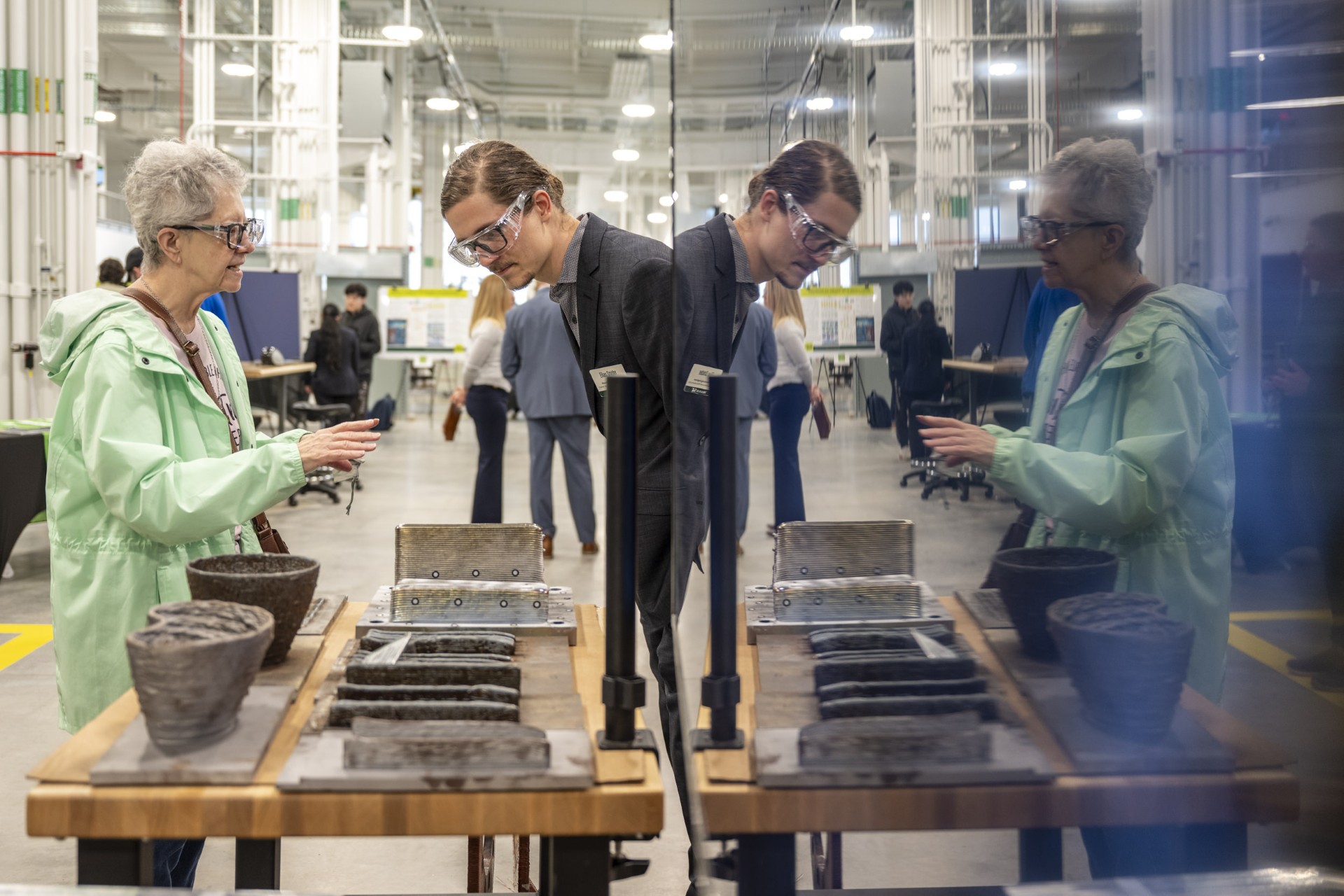
Engineer shows guest manufacturing equipment. Students and engineers gave demonstrations and answered questions during the April 15 Protoplex open house. Photo by Michael Pierce/Missouri S&T
The facility includes 40,000 square feet of high-bay manufacturing space and more than 60 industrial-scale pieces of equipment and manufacturing systems. S&T has already secured more than $22 million to support collaborations with its industry and research partners.

“Our previous governor, Mike Parson, our current governor, Mike Kehoe, and elected leaders have made it a strategic point to invest in higher education, infrastructure and workforce development, and this is another testament to that investment that’s happening here,” said Dr. Mun Choi, president of the University of Missouri.

Gov. Kehoe was unable to attend but shared his congratulations in a video message played during the ceremony.

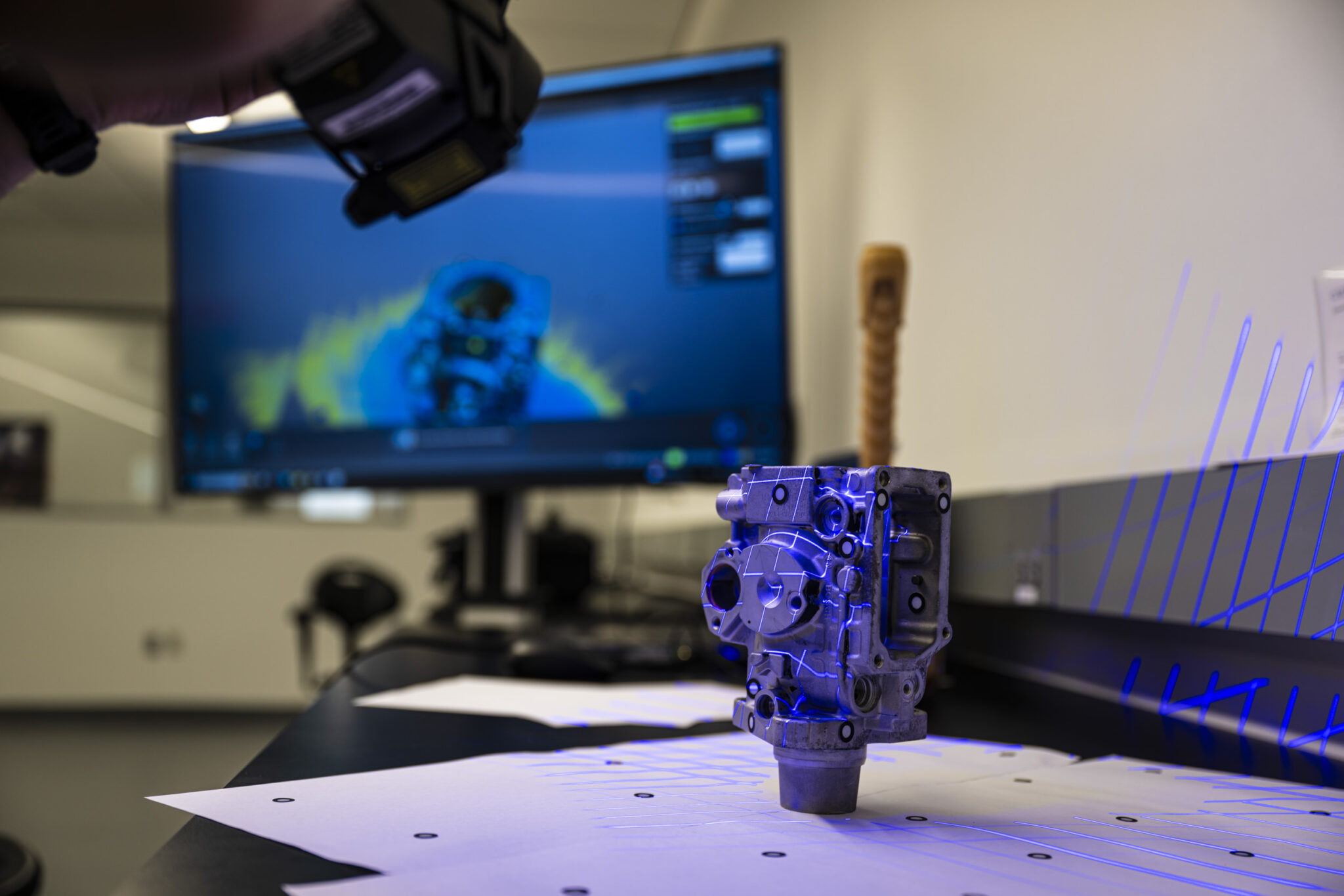
A 3D scanning system projects patterned blue light onto a metal part to capture precise measurements. A 3D scanning system projects patterned blue light onto a metal part to capture precise measurements. Photo by Michael Pierce/Missouri S&T

“When we broke ground for the Missouri Protoplex three years ago, I spoke about the need for such a facility to support our engineering education and technological workforce needs,” said Dr. Mo Dehghani, chancellor of Missouri S&T. “Now, more than ever, this facility is needed to strengthen U.S. manufacturing, drive economic development and build the talent pipeline for tomorrow’s workforce. The Missouri Protoplex will support a broad range of manufacturers, from established companies to startups to entrepreneurs. As the United States aspires to onshore manufacturing, technological universities like Missouri S&T can help.”

Dr. Richard Billo, director of the Protoplex and Distinguished Professor of mechanical and aerospace engineering, spoke about the current state of U.S. manufacturing.

Busy lobby area during eventGuests check out the new Protoplex facility on April 15. Photo by Michael Pierce/Missouri S&T

“There are few domains in the United States where the impact of technology has been more acutely felt than manufacturing,” Billo said. “The Missouri Protoplex is where the innovations in manufacturing supported by the research we conduct and the technical assistance we provide will be put in the hands of manufacturers. Our goal is to support them in their endeavors and to adopt the advanced manufacturing methods that will help them become and remain as competitive as possible in an increasingly complex marketplace. The work undertaken at the Protoplex will help keep our manufacturers where they belong — at the forefront of American innovation.”

A reception and open house followed the remarks and ribbon-cutting ceremony. Guests toured the Protoplex and visited with students and engineers on hand to demonstrate equipment, discuss their research and answer questions.

Free Training

Source link

US manufacturing output dips in March


Manufacturing output dipped 0.1% last month after an upwardly revised 0.4% increase in February

Published Thu, Apr 16, 2026 · 10:11 PM

[WASHINGTON] US factory production unexpectedly fell in March after two straight months of solid gains, weighed down by decreases in the output of motor vehicles and a range of other goods.

Manufacturing output dipped 0.1 per cent last month after an upwardly revised 0.4 per cent increase in February, the Federal Reserve said on Thursday (Apr 16). Economists polled by Reuters had forecast production at factories would gain 0.1 per cent after a previously reported 0.2 per cent rise in February.

Production at factories advanced 0.5 per cent on a year-over-year basis in March. It grew at a 3.0 per cent annualised rate in the first quarter, rebounding from the fourth quarter’s 3.2 per cent pace of decline.

Manufacturing, which accounts for 10.1 per cent of the economy, showed signs of recovery after being hammered by President Donald Trump’s import tariffs. But the US-Israeli war with Iran has sent oil prices surging by more than 35 per cent, which could stifle the recovery.

The Fed’s “Beige Book” report noted that the conflict “was cited as a major source of uncertainty that complicated decision-making around hiring, pricing and capital investment, with many firms adopting a wait-and-see posture.”

Motor vehicle production dropped 3.7 per cent after increasing 2.6 per cent in February. There were decreases in the output of primary metals, machinery as well as furniture and related products.

Navigate Asia in
a new global order

Get the insights delivered to your inbox.

The production of durable goods fell 0.2 per cent. Output of nondurable manufactured goods edged down 0.1 per cent, though production of petroleum and coal as well as plastics and rubber products rose.

Mining output declined 1.2 per cent after rebounding 2.1 per cent in February. Energy production fell 1.6 per cent, with oil and gas well drilling decreasing 2.4 per cent.

The Beige Book noted that though activity in the energy sector rose slightly in early April, “many producers remained cautious about increasing drilling due to uncertainty about the persistence of higher prices.”

SEE ALSO

While layoffs remain low, the oil price shock from the US-Israel war with Iran could be hindering hiring.The latest spending figures are consistent with a consumer who has grown more cautious over the last six months amid cost-of-living concerns and a sluggish job market.

Utilities production dropped 2.3 per cent as demand for heating declined. Utilities production increased 1.8 per cent in February. Overall industrial production dropped 0.5 per cent after an upwardly revised 0.7 per cent increase in February. Industrial output was previously reported to have gained 0.2 per cent.

It rose 0.7 per cent on a year-over-year basis in March and grew at a 2.4 per cent rate in the first quarter. Capacity utilisation for the industrial sector, a measure of how fully firms are using their resources, eased to 75.7 per cent from 76.1 per cent in February.

It is 3.7 percentage points below its 1972–2025 average. The operating rate for the manufacturing sector fell 0.2 percentage point to 75.3 per cent. It is 2.9 percentage points below its long-run average. REUTERS

Decoding Asia newsletter: your guide to navigating Asia in a new global order. Sign up here to get Decoding Asia newsletter. Delivered to your inbox. Free.

Free Training

Source link

Astellas manufacturing chief talks strategy 1 year into role


For Astellas’ chief manufacturing officer, Rao Mantri, Ph.D.—who entered the position a little over a year ago—production is not just about a reliable supply of a pharmaceutical product. Manufacturing serves as a crucial bridge that helps link promising research to patients in the real world, too. 

“Astellas manufacturing has tremendous strengths in multiple modalities as well as a strong focus on service to patients,” Mantri said during a recent meeting with Fierce at the American Biomanufacturing Summit in San Francisco. “So, when I started, it was about—how do we actually make the manufacturing organization as a strategic enabler to connect research innovation to access to patients even more.”

He described that ambition under his leadership as Astellas’ manufacturing “north star,” alongside always ensuring a reliable supply of its medicines.

When Mantri entered the role of manufacturing chief at the Tokyo-headquartered pharma last April, he came in with the goal of helping streamline new modalities for manufacturing and commercial supply and of embedding digital and artificial intelligence tools into Astellas’ network, he explained. 

Over the past few years, the company has made several strategic moves to help broaden its production base in advanced treatment fields such as cell therapy and antibody-drug conjugates.

On the balance between Astellas’ internal and external capacity, Mantri noted that it’s critical to weigh multiple factors, including speed to patients, modality complexity, development stage, regulatory readiness and cost competitiveness when drawing up a supply plan.

“But what’s most important is really about our ability to deliver the reliable supply,” he explained, adding that the company benefits from working with CDMOs and other partners whose capabilities may fall outside of Astellas’ core wheelhouse. 

“We also have platform approaches that we are ready to partner with the right strategic groups,” Mantri added, citing a recent pact with Yaskawa Electric Corporation.  

In the case of that Yaskawa joint venture, Astellas is wedding its regenerative medicine expertise and manufacturing base with its partner’s robotics and AI capabilities.

The purpose of the team-up is to develop a robotic automation platform that other companies can also use to produce medicines faster with superior quality and reliability, while also accelerating technical development, according to Mantri. 

Separately, Astellas last Halloween tied up with Ajinomoto to use the latter’s bespoke antibody-drug conjugate (ADC) development and manufacturing platform, AJICAP, which Mantri noted will help Astellas “design the next generation” of ADCs. 

“It’s really based on where do we want to go and what are the capabilities that we can leverage that are not internal to us,” Mantri said. “We are ready to partner, but if you have the maturity in our platforms that others can use, we are open to having those strategic collaborations as well.” 

With regard to internal capacity, one of Astellas’ most prominent expansions has taken the form of a new plant in Tralee, County Kerry, Ireland, which the company first unveiled designs for in 2023. 

External construction on the fill and finish facility—which will use advanced manufacturing and testing to deliver parenteral biologics—has wrapped up, with the site now expected to open in “early 2027,” per Mantri. 

Mantri also addressed geopolitical tensions—primarily in the form of U.S. import tariffs—that have complicated production decision-making in recent months. 

Astellas, in his estimation, is relatively well positioned given the company’s “geographically balanced global production network.” 

He also pointed to the company’s established manufacturing base in the U.S., where Astellas boasts a gene therapy production site in North Carolina and a unit for cell therapy manufacturing in Massachusetts, the latter of which has “strong capabilities for future regenerative medicines.” 

Looking at the role of Astellas’ manufacturing network, and the position production holds in the biopharma landscape more broadly, Mantri described the manufacturer’s charge as twofold: Production teams must both work to help streamline innovation coming out of research and “embrace and take into consideration uncertainties and complexities to serve patients” and provide reliable access to medicines. 

Free Training

Source link

Why Injection Molding Partnerships Are Becoming a Competitive Advantage in U.S. Manufacturing


The conversation around American manufacturing competitiveness has largely focused on automation, workforce development, and trade policy.

Less attention has been paid to a more granular but equally consequential factor: the quality and strategic alignment of the supplier relationships that underpin production. For companies whose products depend on custom plastic components, the choice of plastic injection molding partner has moved from a procurement decision to a strategic one, with direct implications for product quality, time to market, and supply chain resilience.

The Structural Shift in How Manufacturers Evaluate Suppliers

For much of the past two decades, cost minimization drove supplier selection in custom plastic manufacturing. The combination of offshore tooling costs, cheap ocean freight, and favorable currency differentials made it straightforward to justify moving production to low-cost regions. The total cost of that model, once accounting for lead times, quality escapes, engineering change delays, and the strategic exposure of depending on distant supply chains, was rarely calculated with full rigor.

That calculus has changed. The convergence of tariff volatility, extended lead times during global disruptions, rising logistics costs, and a growing regulatory emphasis on supply chain transparency has prompted a systematic reappraisal. Companies across energy, life sciences, electronics, and consumer products are restructuring their plastic component supply chains around domestic partners capable of delivering not just lower-cost parts, but the responsiveness, engineering depth, and quality consistency that offshore models struggle to provide.

Three Dimensions of Strategic Supplier Value

Engineering Integration as a Product Development Lever

The injection molding suppliers that create durable competitive advantage for their customers are those who engage at the product development stage, not just at the production stage. Design for manufacturability review, material selection guidance, mold flow analysis, and tooling optimization are capabilities that, when applied early, reduce the number of design iterations, shorten validation cycles, and lower the total cost of bringing a product to market.

For companies launching new products or adapting existing designs to changing performance requirements, a molding partner with qualified plastics engineers who participate actively in the development process is a product development resource as much as a manufacturing one. The downstream value of this upstream engagement compounds across every product generation.

Process Control as Quality Infrastructure

Manufacturing executives are accustomed to evaluating suppliers on quality certifications. ISO 9001:2015 is the standard baseline for injection molders serving industrial customers, establishing documented process control, traceability, and corrective action capability. What distinguishes excellent from adequate is how deeply those systems are embedded in daily production management.

A supplier with genuine process control infrastructure, including statistical process control at critical parameters, rigorous material lot traceability, and a culture of proactive deviation management, delivers something qualitatively different from one that maintains documentation for audit purposes alone. For manufacturers whose products enter regulated industries or whose customers conduct supplier audits, the depth of a molding partner’s quality infrastructure is a direct input to their own compliance posture.

Capacity Range and Material Expertise as Strategic Flexibility

The ability to consolidate plastic component supply within a single trusted partner has operational and strategic value that extends beyond transaction cost. A molder operating a broad range of press tonnages, from small precision machines to large-format equipment above 1,000 tons, can accommodate the full scope of a product company’s plastic component requirements as its portfolio evolves. This flexibility reduces the fragmentation of the supply base and the coordination overhead that comes with managing multiple specialized molding relationships.

Material expertise adds another dimension. Engineering-grade resins, including glass-filled nylons, polycarbonates, high-performance thermoplastics such as PEEK and PPS, and specialty compounds, serve applications where material selection directly determines product performance and reliability. A molding partner with deep resin processing experience and established relationships across leading material suppliers provides access to material solutions and technical guidance that commodity molders cannot offer.

The Geographic Dimension: Regional Proximity as Operational Advantage

For manufacturers operating in the south-central United States, geographic proximity to a quality injection molder provides compounding operational benefits that distant or offshore suppliers cannot replicate structurally. Faster response to engineering change requests, shorter first article inspection cycles, lower logistics costs, and the ability to build a collaborative working relationship through regular face-to-face engagement all reduce the friction costs embedded in managing a supply chain over distance.

The Houston-Austin industrial corridor in Texas represents one of the most concentrated clusters of OEM manufacturing activity in the U.S., spanning energy technology, life sciences, electronics assembly, and consumer products. For companies in this ecosystem, proximity to a supplier who combines ISO-certified quality, engineering-grade resin expertise, a broad machine fleet, and a culture built around genuine customer partnership is not an incremental convenience. It is a supply chain architecture that supports competitive differentiation over time.

The Leadership Imperative

Supply chain decisions of this magnitude rarely rest with procurement alone. The choice of injection molding partner affects product development timelines, quality outcomes, regulatory compliance, and operational resilience in ways that are consequential at the executive level. Leaders who treat supplier qualification as a strategic investment rather than an administrative cost center, and who build the vendor relationships that compound in value across product generations, are the ones who build the manufacturing capability that sustains competitive advantage over the long term.

Free Training

Source link