State looks to expand manufacturing training at community colleges | News


CHICAGO — As the U.S. sheds manufacturing jobs, Illinois is accepting applications for $24 million in grant funding to establish training facilities at community colleges aimed at bolstering the state’s manufacturing labor pool.

The funding is for six “manufacturing training academies” at downstate community colleges that will add to two existing academies that opened in 2024.

kAm%96 ?6H 8C2?ED H:== 36 2H2C565 E9C@F89 2 3:55:?8 AC@46DD] %96 s6A2CE>6?E @7 r@>>6C46 2?5 t4@?@>:4 ~AA@CEF?:EJ 2??@F?465 E92E E96 =2E6DE 2AA=:42E:@? H:?5@H @A6?65 62C=:6C E9:D >@?E9] r@>>F?:EJ 4@==686D @FED:56 @7 r@@< 2?5 E96 4@==2C 4@F?E:6D 42? 2AA=J 7@C 8C2?ED C2?8:?8 7C@> Sb >:==:@? E@ Se >:==:@?]k^Am

kAmxE 4@>6D 2D E96 :?5FDECJ 7246D 92CD9 9625H:?5D 7C@> 2 H:56 C2?86 @7 724E@CD[ :?4=F5:?8 E9@D6 @FED:56 @7 $AC:?87:6=5’D 4@?EC@=]k^Am

kAm%96 EC2:?:?8 24256>J AC@8C2> 😀 2? @77D9@@E @7 E96 3:A2CE:D2? 3F586E 2?5 AF3=:4 :?7C2DECF4EFC6 7C2>6H@C< E92E 3642>6 =2H 5FC:?8 !C:EK<6C’D 7:CDE J62C 😕 @77:46 😕 a_`h] %96 x==:?@:D |2?F724EFC6CD’ pDD@4:2E:@?[ 2 AC@\3FD:?6DD EC256 4@?D@CE:F>[ H2D :?DECF>6?E2= 😕 :ED =2F?49]k^Am

kAm“%@52JVD >2?F724EFC:?8 😀 72C 5:776C6?E E92? :E =@@<65 `_[ a_[ b_ J62CD 28@[” D2:5 |2C< s6?K=6C[ E96 AC6D:56?E 2?5 rt~ @7 x|p] “Wu@CX E96 DE2E6D E92E 2C6 8@:?8 E@ H:? @? 64@?@>:4 56G6=@A>6?E[ 2 =2C86 A2CE @7 E92E 😀 >2<:?8 DFC6 H6 92G6 2 D<:==65 H@C<7@C46]”k^Am

k9bm$E2E6 7F?5:?8k^9bm

kAm%96 7:CDE EH@ EC2:?:?8 24256>:6D H6C6 3F:=E 2E w62CE=2?5 r@>>F?:EJ r@==686 @FED:56 q=@@>:?8E@? 2?5 $@FE9H6DE6C? x==:?@:D r@==686 😕 q6==6G:==6] %96 4@==686D ?@H @776C AC@8C2>D 2?5 46CE:7:42E6D 😕 2 H:56 C2?86 @7 >2?F724EFC:?8 AC@46DD6D 2?5 E649?@=@8:6D[ :?4=F5:?8 C@3@E:4D[ H6=5:?8[ 25G2?465 2FE@>2E:@? 2?5 C6?6H23=6 6?6C8J E649?@=@8J]k^Am

kAm%96 DE2E6 2=D@ >256 2H2C5D E@ #:49=2?5 r@>>F?:EJ r@==686 😕 s642EFC 2?5 z2?<2<66 r@>>F?:EJ r@==686]k^Am

kAm“~FC D<:==65 H@C<7@C46 😀 A2CE @7 H92E >2<6D x==:?@:D 2 >2?F724EFC:?8 A@H6C9@FD6[” v@G] yq !C:EK<6C D2:5 😕 2 DE2E6>6?E] “%9:D 4C:E:42= 8C2?E 7F?5:?8 H:== 6>A@H6C >@C6 x==:?@:D2?D E@ AFCDF6 9:89\56>2?5[ H6==\A2J:?8 ;@3D 😕 @FC 8C@H:?8 >2?F724EFC:?8 D64E@C]”k^Am

kAm%96 DE2E6 2=D@ 2H2C565 >@C6 E92? S`f >:==:@? E9:D >@?E9 E@ 7F?5 AC6\2AAC6?E:46D9:A AC@8C2>D 😕 E96 DE2E6’D 3F:=5:?8 2?5 4@?DECF4E:@? EC256D] (9:=6 AC6\2AAC6?E:46D9:A EC2:?:?8 😀 5:DE:?4E 7C@> E96 >2?F724EFC:?8 24256>:6D[ !C:EK<6C AC@>@E65 3@E9 AC@8C2>D 2D >62?D E@ 7F??6= 42?5:52E6D :?E@ :?\56>2?5 ;@3D H:E9 9:89 32CC:6CD E@ 6?ECJ]k^Am

kAm!C6\2AAC6?E:46D9:A AC@8C2>D 2C6 56D:8?65 E@ AC6A2C6 42?5:52E6D E@ 6?E6C C68:DE6C65 2AAC6?E:46D9:A AC@8C2>D[ 2D46?D:@? E@ H9:49 😀 9:89=J 4@>A6E:E:G6 😕 E96 F?:@?:K65 3F:=5:?8 EC256D[ D2:5 y2J #@H6==[ 6I64FE:G6 5:C64E@C 2E w:C6 be_[ 2? 2H2C566 @7 E96 ?6H 8C2?E 7F?5D]k^Am

kAm~E96C !C:EK<6C 25>:?:DEC2E:@? A@=:4:6D 92G6 2=D@ D@F89E E@ 3@=DE6C >2?F724EFC:?8 😕 x==:?@:D] %96 a_a` #6:>28:?:?8 t?6C8J 2?5 ’69:4=6D 😕 x==:?@:D p4E FD6D E2I :?46?E:G6D E@ 2EEC24E BF2=:7:65 C6?6H23=6 6?6C8J\C6=2E65 >2?F724EFC:?8 4@>A2?:6D E@ >2<6 42A:E2= :?G6DE>6?ED 😕 E96 DE2E6]k^Am

kAm%96 25>:?:DEC2E:@?’D 2??@F?46>6?E @7 E96 EC2:?:?8 24256>J 6IA2?D:@? 4:E65 2 “8C@H:?8 =:DE” @7 >2?F724EFC6CD E92E 2C6 6IA2?5:?8 @A6C2E:@?D 😕 x==:?@:D[ D@>6 @7 H9:49[ =:<6 r2496 t?6C8J 2?5 }2?@ }F4=62C[ 2C6 #t’ x==:?@:D AC@8C2> A2CE:4:A2?ED]k^Am

k9bm$H:>>:?8 FADEC62>k^9bm

kAm%96 >2?F724EFC:?8 D64E@C 2D 2 H9@=6 4@?E:?F6D E@ D9C:?< 24C@DD E96 &]$] p=E@86E96C[ E96 &]$] =@DE eb[___ >2?F724EFC:?8 ;@3D 😕 a_ad[ 244@C5:?8 E@ 52E2 7C@> E96 qFC62F @7 {23@C $E2E:DE:4D] ~G6C E92E D2>6 A6C:@5[ x==:?@:D =@DE f[`__ >2?F724EFC:?8 ;@3D[ 2 A246 a]d E:>6D E96 ?2E:@?2= C2E6] uC2?< |2?K@[ 2? 64@?@>:DE 2E E96 x==:?@:D t4@?@>:4 !@=:4J x?DE:EFE6[ 2EEC:3FE65 E9:D[ 😕 A2CE[ E@ :?4C62D:?8 :?AFE 4@DED 7C@> E2C:77D 2?5 7656C2= 4FED E@ :?7C2DECF4EFC6 7F?5:?8]k^Am

kAm%96 x==:?@:D t4@?@>:4 !@=:4J x?DE:EFE6 😀 4=@D6=J E:65 E@ D6G6C2= @7 E96 DE2E6’D =23@C @C82?:K2E:@?D]k^Am

kAm|2?F724EFC:?8 2D 2 D92C6 @7 &]$] vs! 92D 366? @? E96 564=:?6 7@C 564256D[ 2D 92G6 E96 ?F>36C @7 >2?F724EFC:?8 ;@3D 😕 x==:?@:D] pG6C286 9@FC=J 62C?:?8D 7@C >2?F724EFC:?8 H@C<6CD 92G6 ?@E <6AE A246 H:E9 E9@D6 😕 AC@76DD:@?2= 2?5 3FD:?6DD D6CG:46D[ 244@C5:?8 E@ q{$ 52E2[ 2?5 E96 82A 4@?E:?F6D E@ H:56?]k^Am

kAm|2?F724EFC:?8 EC2:?:?8 AC@8C2>D 92G6 AC@G6? E@ 56G6=@A D<:==65 =23@C A@@=D 😕 E96 H2J E96 A@=:4J 2:>D E@[ |2?K@ D2:5] qFE 96 2=D@ 2C8F65 “3J 72C” E96 ?F>36C @?6 H2J E@ 255C6DD 2?J =23@C D9@CE286 😀 E@ C2:D6 A2J 2?5 36?67:ED E@ >2<6 E96 D64E@C >@C6 2EEC24E:G6 E@ ?6H 42?5:52E6D H9@ H@F=5 @E96CH:D6 ?@E H@C< 😕 :E]k^Am

kAm“&?:@?D 92G6 366? 9@==@H65 @FE[” |2?K@ D2:5] “pD 2 C6DF=E[ ;@3 BF2=:EJ 2E E96D6 A=2?ED 92D 366? 9@==@H65 @FE[ 2?5 E92EVD @?6 @7 E96 C62D@?D H9J A6@A=6 5@?VE H2?E E@ H@C< 😕 >2?F724EFC:?8]”k^Am

kAmx==:?@:D F?:@?D 92G6 DE625:=J 564=:?65 @G6C E96 =2DE b_ J62CD[ 2?5 >2?F724EFC:?8 F?:@?D 92G6 366? 6DA64:2==J 564:>2E65] ~?46 2 =6256C @7 E96 F?:@? >@G6>6?E[ E96 x==:?@:D >2?F724EFC:?8 D64E@C 😕 a_ac H2D @?=J fT F?:@?:K65[ `T 9:896C E92? E96 ?2E:@?2= 2G6C286[ 244@C5:?8 E@ |2?K@’D E9:?< E2?<]k^Am

kAmx? ?6H D@FC46D @7 H@C< =:<6 C6?6H23=6 6?6C8J 2?5 25G2?465 >2?F724EFC:?8[ H96C6 E96 EC2:?:?8 24256>J AC@8C2> 😀 7@4FD65[ F?:@? 56?D:EJ 😀 A2CE:4F=2C=J =@H 244@C5:?8 E@ !C@76DD@C #@36CE qCF?@[ 5:C64E@C @7 =23@C 65F42E:@? 2E E96 &?:G6CD:EJ @7 x==:?@:D &C32?2\r92>A2:8?] w6 2=D@ D:ED @? E96 t4@?@>:4 !@=:4J x?DE:EFE6’D 3@2C5]k^Am

kAmw6 25565 E92E =23@C AC@G:D:@?D 😕 x==:?@:D’ a_a` r=:>2E6 2?5 tBF:E23=6 y@3D p4E 92G6 >256 AC@8C6DD E@ 255C6DD E92E 492==6?86]k^Am

kAm“%96 DEC@?86DE :?DE:EFE:@? 7@C 86?6C2E:?8 9:896C ;@3 BF2=:EJ 😀 E@ H@C< F?56C 2 4@==64E:G6 32C82:?:?8 28C66>6?E[” qCF?@ D2:5]k^Am

kAm|2?J @7 E96 x|p’D 277:=:2E65 6>A=@J6CD 2C6 F?:@?:K65[ 3FE 2E E96 D2>6 E:>6[ E96:C A@=:E:42= 677@CED 2C6 D@>6E:>6D @AA@D65 E@ DEC6?8E96?:?8 @C82?:K65 =23@C[ qCF?@ D2:5] (9:=6 ?@E 2=H2JD 😕 28C66>6?E @? DE2E6H:56 :DDF6D[ =23@C @C82?:K2E:@?D 2?5 E96 x|p 3@E9 DFAA@CE E96 EC2:?:?8 24256>J >@56=]k^Am

kAm“%96 x|p 92D 2 =@?8 9:DE@CJ @7 H@C<:?8 4@==23@C2E:G6=J H:E9 F?:@?D 24C@DD x==:?@:D @? 2 ?F>36C @7 G:E2= :DDF6D[” s6?K=6C D2:5 😕 C6DA@?D6]k^Am

kAm!2E s6G2?6J @7 E96 x==:?@:D pu{\rx~ D2:5 E96 DE2E6’D F?:@?D 2?5 E96 x|p’D :?E6C6DED 2C6 D@>6E:>6D 😕 4@?7=:4E[ 3FE E96J C68F=2C=J H@C< E@86E96C AC@5F4E:G6=J] q@E9 E96 F?:@?D 2?5 E96 >2?F724EFC6CD 36?67:E 7C@> 2 D<:==65 H@C<7@C46[ 96 D2:5[ 3FE ;@3D >FDE 36 F?:@?:K65 E@ 36 2 A2E9H2J E@ E96 >:55=6 4=2DD]k^Am

k9bmr@FCD6 4FCC:4F=F>k^9bm

kAm{23@C 3@@DE6CD D2:5 E96J H6C6 5:D2AA@:?E65 E92E ?@E9:?8 😕 E96 =2H @C 8C2?E 28C66>6?ED C6BF:C6D E96 4@>>F?:EJ 4@==686D C646:G:?8 8C2?E 7F?5D E@ E6249 23@FE F?:@?:K2E:@?]k^Am

kAmw62CE=2?5 r@>>F?:EJ r@==686[ H9:49 H2D 2H2C565 ?62C=J Sf]d >:==:@? 😕 a_a`[ D2:5 E96 @?=J 4@FCD6H@C< C6=2E65 E@ =23@C @C82?:K:?8 @C H@C<6CD’ C:89ED 😕 :ED DE2E6\324<65 >2?F724EFC:?8 AC@8C2>D 😀 2 `_\9@FC ~$wp 4@?DECF4E:@? D276EJ 4@FCD6]k^Am

kAm!2F= r2C=D@?[ 562? @7 3FD:?6DD[ E649?@=@8J 2?5 9F>2? D6CG:46D 2E z2?<2<66 r@>>F?:EJ r@==686[ H9:49 C646:G65 S`a >:==:@? 😕 a_ac[ 244@C5:?8 E@ E96 s6A2CE>6?E @7 r@>>6C46 2?5 t4@?@>:4 ~AA@CEF?:EJ 8C2?E EC24<6C[ D2:5 E96:C 4FCC:4F=F> 5@6D ?@E 4@G6C H@C<6CD’ C:89ED @C =23@C @C82?:K:?8]k^Am

kAm“(6 5@ ?@E 2G@:5 E96D6 E@A:4D :7 3C@F89E FA 😕 4=2DDC@@> D6EE:?8D[” r2C=D@? D2:5] “%96J 2C6 ;FDE ?@E EJA:42= @7 @FC DE2<69@=56CD’ ?665D @C DEF56?ED’ :?E6C6DED 2D E96J 2C6 368:??:?8 E96:C =:76=@?8 =62C?:?8 2?5 49@@D:?8 H92E6G6C 7:6=5 @7 6?562G@C]”k^Am

kAm~77:4:2=D 2E $@FE9H6DE6C? x==:?@:D r@==686 2?5 #:49=2?5 r@>>F?:EJ r@==686 5:5 ?@E C6DA@?5 E@ >F=E:A=6 C6BF6DED 7@C 4@>>6?E 23@FE E96:C 8C2?E\7F?565 H@C<7@C46 56G6=@A>6?E 4FCC:4F=2]k^Am

kAmk6>m#6646 s@H6C 😀 2 8C25F2E6 DEF56?E 😕 ;@FC?2=:D> H:E9 }@CE9H6DE6C? &?:G6CD:EJ’D |65:== $49@@= @7 y@FC?2=:D>[ |65:2 2?5 x?E68C2E65 |2C<6E:?8 r@>>F?:42E:@?D[ 2?5 😀 2 76==@H 😕 :ED |65:== x==:?@:D }6HD qFC62F H@C<:?8 😕 A2CE?6CD9:A H:E9 r2A:E@= }6HD x==:?@:D]k^6>mk^Am

kAmk6>mr2A:E@= }6HD x==:?@:D 😀 2 ?@?AC@7:E[ ?@?A2CE:D2? ?6HD D6CG:46 E92E 5:DEC:3FE6D DE2E6 8@G6C?>6?E 4@G6C286 E@ 9F?5C65D @7 ?6HD @FE=6ED DE2E6H:56] xE 😀 7F?565 AC:>2C:=J 3J E96 x==:?@:D !C6DD u@F?52E:@? 2?5 E96 #@36CE #] |4r@C>:4< u@F?52E:@?]k^6>mk^Am


Free Training

Source link

Assessing Deere’s (DE) Valuation After US$20b US Manufacturing Expansion Plan


Expansion in Indiana and North Carolina puts Deere (DE) in focus

Deere (DE) is drawing fresh attention after outlining a $20b plan to expand U.S. manufacturing. The initiative includes a new parts distribution center in Hebron, Indiana, and an excavator factory in Kernersville, North Carolina.

See our latest analysis for Deere.

The expansion plan lands at a time when momentum in Deere’s shares has been picking up, with a 1 month share price return of 21.7% and a year to date share price return of 21.5%. Over longer periods, total shareholder returns of 23.0% over one year and 93.1% over five years indicate that recent gains build on an already strong track record, as investors digest both the new U.S. manufacturing investment and recent boardroom and governance developments ahead of the upcoming earnings call.

If you are weighing Deere’s latest moves against what else is happening in industrials, it could be worth scanning aerospace and defense stocks for other capital goods names that are drawing attention.

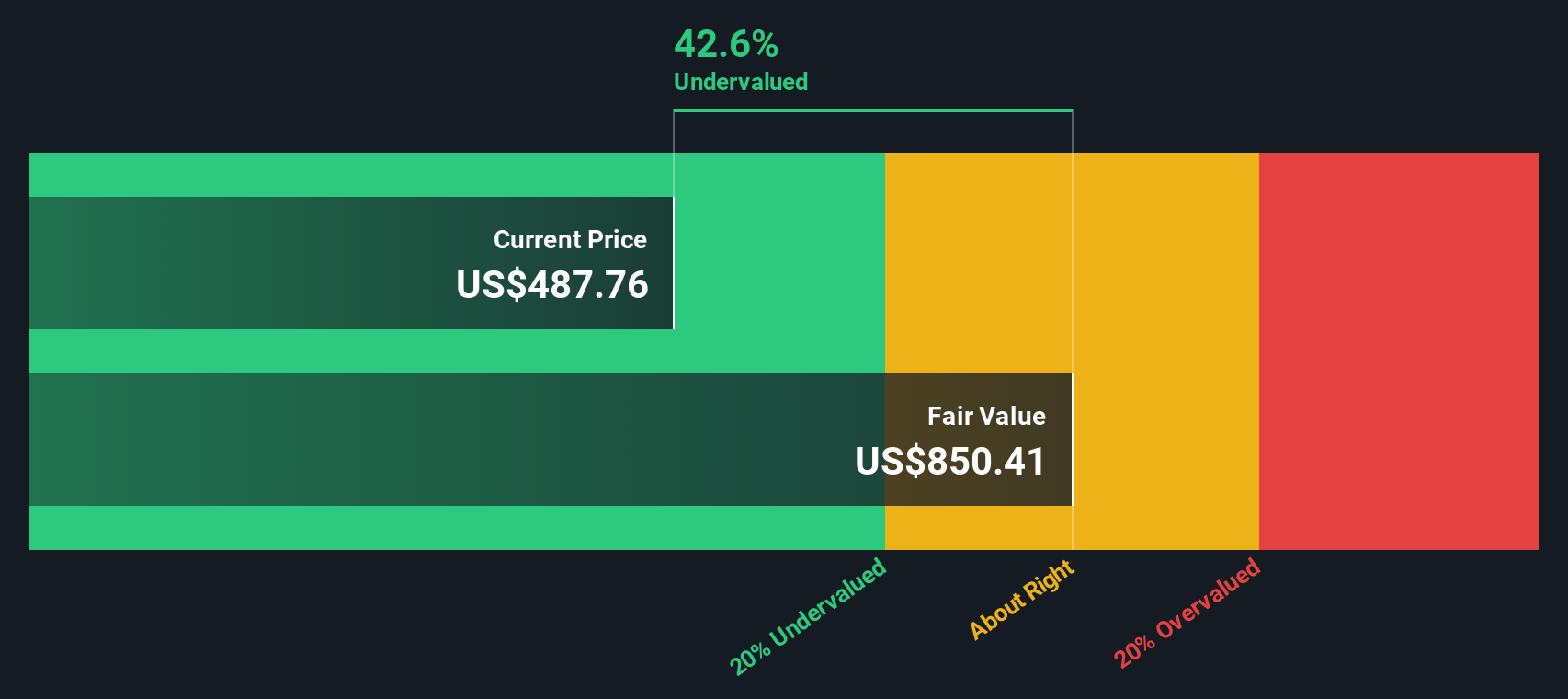
With Deere shares up around 22% over the past month and trading near US$567, the stock sits close to some analyst targets yet shows an estimated 12% intrinsic discount. This raises the question: is there still upside here, or is future growth already priced in?

Most Popular Narrative: 7.7% Overvalued

At $567.26, Deere sits above a widely followed fair value estimate of about $526.91, which is built around precision agriculture, margins, and a maturing cycle.

Rapid adoption of Deere’s precision agriculture and automation solutions (e.g., JDLink Boost, Precision Essentials bundles, See & Spray tech, and new automation features) is driving higher-value product sales and increased software engagement globally, positioning Deere to benefit from shifts toward high-efficiency, technology-enabled farming. This is expected to support both future revenue and net margins through higher-margin recurring software and data services.

Read the complete narrative.

Curious what kind of earnings power this assumes? The narrative leans heavily on margin expansion, recurring software revenue and a richer profit multiple. The exact numbers might surprise you.

Result: Fair Value of $526.91 (OVERVALUED)

Have a read of the narrative in full and understand what’s behind the forecasts.

However, there are clear pressure points, including higher tariff and input costs, as well as a softer North American large ag market, that could cap margins and challenge the upbeat Precision Ag story.

Find out about the key risks to this Deere narrative.

Another View: Cash Flows Point To Undervaluation

The narrative fair value of about $526.91 suggests Deere is 7.7% overvalued at $567.26, but our DCF model points in the opposite direction. On that view, the shares trade around 12% below an estimated future cash flow value of $644.77. Which picture do you think better reflects the risks and rewards?

Look into how the SWS DCF model arrives at its fair value.

DE Discounted Cash Flow as at Feb 2026DE Discounted Cash Flow as at Feb 2026

Simply Wall St performs a discounted cash flow (DCF) on every stock in the world every day (check out Deere for example). We show the entire calculation in full. You can track the result in your watchlist or portfolio and be alerted when this changes, or use our stock screener to discover 867 undervalued stocks based on their cash flows. If you save a screener we even alert you when new companies match – so you never miss a potential opportunity.

Build Your Own Deere Narrative

If you look at this and think the story should read differently, you can test the assumptions yourself in minutes with Do it your way.

A great starting point for your Deere research is our analysis highlighting 2 key rewards and 1 important warning sign that could impact your investment decision.

Looking for more investment ideas?

If Deere has sharpened your interest, do not stop here. Use the Simply Wall St screener to spot other stocks that might fit your style and goals.

This article by Simply Wall St is general in nature. We provide commentary based on historical data
and analyst forecasts only using an unbiased methodology and our articles are not intended to be financial advice.
It does not constitute a recommendation to buy or sell any stock, and does not take account of your objectives, or your
financial situation. We aim to bring you long-term focused analysis driven by fundamental data.
Note that our analysis may not factor in the latest price-sensitive company announcements or qualitative material.
Simply Wall St has no position in any stocks mentioned.

New: Manage All Your Stock Portfolios in One Place

We’ve created the ultimate portfolio companion for stock investors, and it’s free.

• Connect an unlimited number of Portfolios and see your total in one currency
• Be alerted to new Warning Signs or Risks via email or mobile
• Track the Fair Value of your stocks

Try a Demo Portfolio for Free

Have feedback on this article? Concerned about the content? Get in touch with us directly. Alternatively, email editorial-team@simplywallst.com

Free Training

Source link

Vestas CEO: Our tariff mitigation is sensible given our (not out) big U.S. manufacturing footprint


Real-time Estimate


Cboe Europe


04:02:19 2026-02-05 am EST

5-day change

1st Jan Change

183.45 DKK

-5.02%

Intraday chart for Vestas Wind Systems A/S

-1.04%

+7.24%

Published on 02/05/2026
at 03:17 am EST

Reuters

Reuters logo
© Reuters –
2026

DurationAuto.2 months3 months6 months9 months1 year2 years5 years10 yearsMax.

PeriodDayWeek

Chart Vestas Wind Systems A/S
VWS: Dynamic Chart
Logo Vestas Wind Systems A/S
Vestas Wind Systems A/S is the world’s leading manufacturer of wind turbines. Net sales by activity break down as follows:

– sale of wind turbines and wind energy production systems (78.6%): 2,837 turbines and systems (with a total capacity of 12,900 MW) delivered in 2024. The group also sells replacement parts;

– services (21.4%): notably maintenance services and warranty extension agreements.

Net sales are distributed geographically as follows: Denmark (2%), Germany (13.4%), Europe/Middle East/Africa (31.2%), the United States (20%), Brazil (10.1%), Americas (8.7%) and Asia/Pacific (14.6%).

More about the company

Trader

Trader

This super rating is the result of a weighted average of the rankings based on the following ratings: Global Valuation (Composite), EPS Revisions (4 months), and Visibility (Composite). We recommend that you carefully review the associated descriptions.

Investor

Investor

This super composite rating is the result of a weighted average of the rankings based on the following ratings: Fundamentals (Composite), Global Valuation (Composite), EPS Revisions (1 year), and Visibility (Composite). We recommend that you carefully review the associated descriptions.

Global

Global

This composite rating is the result of an average of the rankings based on the following ratings: Fundamentals (Composite), Valuation (Composite), Financial Estimates Revisions (Composite), Consensus (Composite), and Visibility (Composite). The company must be covered by at least 4 of these 5 ratings for the calculation to be performed. We recommend that you carefully review the associated descriptions.

Quality

Quality

This composite rating is the result of an average of the rankings based on the following ratings: Capital Efficiency (Composite), Quality of Financial Reporting (Composite), and Financial Health (Composite). The company must be covered by at least 2 of these 3 ratings for the calculation to be performed. We recommend that you carefully review the associated descriptions.

More RatingsSellConsensusBuy

Average target price

23.26EUR

Spread / Average Target

-10.14%

Consensus

Quarterly revenue – Rate of surprise

Download from Apple Store

OUR EXPERTS ARE HERE FOR YOU

Monday – Friday 9am-12pm / 2pm-6pm GMT + 1

MarketScreener, Stock Market Live
Legal information
|
Cookie settings
|
MarketScreener Blog
|
About us
|
Copyright © 2026 Surperformance SAS. All rights reserved.

Stock quotes are provided by Factset, Morningstar and S&P Capital IQ

Select your edition

All financial news and data tailored to specific country editions

Free Training

Source link

Siemens Energy to invest $421 million in NC 


This week Siemens Energy announced that it would be investing $421 million to expand its’ operations in North Carolina. The expansions will occur at multiple locations, involve the manufacturing of energy infrastructure equipment, and are expected to create 500 new jobs statewide.

“The equipment we produce in North Carolina is helping meet our nation’s unprecedented growth in energy,” Matt Neal, Siemens Energy’s President of North America said. “We are building on a strong, decades-long foundation in the state, supported by a dedicated workforce that consistently rises to meet new challenges and a pipeline of young and eager talent ready to build the machines that will power the United States into the next century.” 

The $421 million North Carolina investment is part of a larger, nationwide strategy by Siemens Energy to bolster domestic manufacturing of energy infrastructure equipment and strengthen the US power grid. The company has committed roughly $1 billion to expand its manufacturing footprint across the country, including in states such as Mississippi, Alabama, New York, Texas, and Florida, to meet growing grid demands and supply chain needs.

“This tremendous investment in a critical part of our power grid supply chain underscores President Trump’s success in expanding supply chain access and bringing major manufacturing back to America,” said US Interior Secretary Doug Burgum in a press release. “We appreciate great partners like Siemens Energy, who proactively partner with the Trump administration for the benefit of the American people, prioritizing critical components to make the United States Energy dominant!”

Expanding on the $150 million investment announced in 2024, this investment will stretch the power transformer manufacturing facility in Charlotte and increase service capacity to keep up with demand. Siemens Energy currently produced large gas turbines in Berlin, Germany, and part of the expansion plan would bring production to Charlotte, after a six-year pause.   

Gas turbine parts are to be produced in Winston-Salem and expanding grid technology project execution, research, and development will occur in Raleigh.  

Like much of the United States, North Carolina—with Charlotte at the helm, is seeing an uptick in proposed AI driven data centers. Facilities house machinery used to process large amounts of data and information, requiring massive storehouses of energy.  

“Siemens Energy has been making things in the United States for more than a century and we are experiencing a once-in-a-generation growth opportunity due to the resurgence of US manufacturing and the growth of artificial intelligence,” Christian Bruch, CEO and President of Siemens Energy, said in a press release. “The current policy environment has contributed to this momentum. The Trump Administration has made energy security, a reliable and resilient grid, and growing US manufacturing jobs a priority. This has supercharged the energy demand which is supporting new investments across the energy sector. We are excited to help write this next chapter of American energy expansion.” 

While this latest Siemens Energy investment in North Carolina’s economy is not backed by a Job Development Investment Grant (JDIG), previous investments have been JDIG-funded. This includes the Charlotte investment announced in February 2024.  

“State incentive records show Siemens Energy has received four JDIGs from North Carolina — approved in 2009, 2010, 2010, and 2024 — with both 2010 agreements later terminated, placing the company squarely within the program’s broader pattern of underperformance,” Joseph Harris, fiscal policy analyst for the John Locke Foundation, told the Carolina Journal. “According to state data, nearly half of all JDIG agreements approved from fiscal years 2003 to 2025, or 222 out of 449 deals, have been terminated or withdrawn before meeting their job-creation targets.” 

In 2024, The North Carolina Economic Investment Committee (NCEIC) approved a $6,979,500 reimbursement to Siemens Energy over the spam of 12 years with the hope of creating more jobs in the state. An additional $2,326,500 was allocated to the state’s Industrial Development Fund – Utility Account, bringing the total cost of the grant to $9.3 million.  

Even without JDIG support for the expansion announced this week, Siemens Energy has stated that the project will create a substantial number of jobs. Job creation benchmarks are a key requirement of the JDIG program, and some past recipients have failed to meet those benchmarks, resulting in terminated agreements.

JDIG grants are performance-based, discretionary incentives tied to a company’s ability to meet investment and employment commitments intended to support economic development. When projects do not meet those requirements, expected economic benefits—such as job creation and capital investment—may not materialize in the affected communities.

“Siemens Energy is a valued member of North Carolina’s advanced manufacturing community, and we welcome this meaningful expansion of the company’s operations in our state,” said Gov. Josh Stein. “From our state’s world-class transportation infrastructure to our skilled workforce, North Carolina offers manufacturers the best place to do business in the United States.”

Gas turbine manufacturing began in Charlotte in 2011 and then terminated in 2020 due to low demand. Starting back this year, Siemens Energy expects the first gas turbines to be shipped from Charlotte in the next 2-3 years.  

Siemens Energy is also investing in the Winston Technology Center in Rural Hall, North Carolina. The company currently manufactures and services parts for power generation equipment.   

Globally, Siemens Energy employees over 103,000 people in more than 90 countries. In the fiscal year 2025, they generated over $46 billion in revenue.  

Free Training

Source link

Has Trump’s tariff policy backfired, leading to a contraction in U.S. manufacturing?


The manufacturing boom promised by Trump has failed to materialize. Months after the implementation of his hallmark tariff policies, manufacturing jobs continue to decline, and industry activity has remained in prolonged contraction.

Trump once promised a ‘golden age’ for American manufacturing, but this prosperity is now receding. After years of economic intervention under both the Trump and Biden administrations, the number of manufacturing jobs in the United States has dropped to its lowest point since the end of the pandemic.

Federal data shows that in the eight months following Trump’s announcement of the ‘Liberation Day’ tariff, manufacturing jobs declined month by month, continuing a contraction trend that has seen over 200,000 jobs disappear since 2023. The index of factory activity tracked by the Institute for Supply Management remained in contraction territory for 26 consecutive months through December of last year, although a surprise rebound in new orders and production indexes in January caught analysts off guard. Manufacturing construction spending, which had surged under Biden-era funding for chips and renewable energy, fell month by month during Trump’s first nine months in office, according to estimates from the U.S. Census Bureau.

This gradual slowdown is, to some extent, a continuation of decades-long trends that shifted factory jobs overseas and accelerated the decline of Midwestern cities. In an industry where capital planning and construction cycles often span several years, reversing these trends will not happen overnight.



In November last year, the Federal Reserve significantly revised downward its estimates of total U.S. output since the pandemic when it conducted its annual revision of industrial production indicators.

“We never fully recovered from the pandemic,” said Josh Lehner, a U.S. economist at SGH Macro Advisors. Although automakers and chip manufacturers cut tens of thousands of jobs over the past year, the steady pace of layoffs across the industry suggests that job losses have been gradual.

Lehner and other economists also pointed out signs that output has stabilized and even grown slightly, though increased efficiency may limit the number of new jobs created. A White House spokesperson highlighted a modest rise in manufacturing productivity in recent quarters and noted that wage growth for workers exceeded inflation over the past year.

U.S. manufacturing jobs

U.S. manufacturing job additions

In the long run, tariffs may achieve their intended effect of enhancing the competitiveness of some manufacturers relative to overseas producers. Economists believe that lowering interest rates and deregulation could also provide support. However, in the short term, tariffs have raised costs for many companies importing raw materials and components, forcing businesses reliant on foreign parts to raise product prices or hurriedly seek alternative supplies.

The intermittent policymaking from the White House—Trump threatened new tariffs on Europe, Canada, and South Korea in recent weeks—has also led many business executives to view the past year as a ‘lost year for investment.’ The possibility that the Supreme Court might overturn some import taxes has added further uncertainty.

Meanwhile, despite the tariffs, some countries continue to expand their exports, driving down prices in the global market and making it difficult for U.S. manufacturers to compete.

“In our product portfolio, there are hardly any products that have benefited from tariffs,” said the CEO of Insteel Industries, headquartered in North Carolina.$Insteel Industries (IIIN.US)$H.O. Woltz III. With foreign steel tariffs doubling to 50% this year, Insteel has found it increasingly difficult to obtain steel from its U.S. suppliers for producing concrete infrastructure reinforcements, such as those required for the upcoming Gordie Howe Bridge connecting Detroit and Canada.$TRADELINK (00536.HK)$On the contrary, when domestic supply in the U.S. is insufficient, Insteel sometimes has no choice but to turn to importing tariffed steel from places like Algeria and India.

“Our growth today could be undermined by a lack of available (domestic) raw materials,” Woltz said.

In the trucking industry, a multi-year slump following the pandemic hit metal component manufacturers such as NN. The company, headquartered in Charlotte, North Carolina, and operating 23 plants across six countries, has cut its U.S. workforce in recent years to compete with low-cost factories overseas while addressing slowing demand for electric vehicles. CEO Harold Bevis believes tariffs will ultimately benefit NN by curbing competition from rivals in precision components like steering systems and audiovisual controls. However, import duties have driven up costs for steel and aluminum, while surging market prices for gold and silver—used in some of NN’s products—have added further pressure.

This squeezes the company’s ability to invest in new potentially profitable areas such as data centers and electrical equipment. “So you get hit,” Bevis said. NN is attempting to offset the costs by raising prices in subsequent orders. Bevis noted that NN’s business has accelerated amid Ford and General Motors’ push for localized sourcing, following multibillion-dollar asset write-downs on their EV businesses. However, when evaluating locations for expanding production for the auto sector, Bevis cautioned that places like Michigan and Massachusetts remain less attractive compared to Mexico, where many products can still enter the U.S. duty-free under trade agreements.

Trump has also taken other measures to try to revitalize manufacturing. He pressured trading partners like Japan and South Korea into agreements promising to invest tens of billions of dollars in the U.S.$Apple (AAPL.US)$ 、$Taiwan Semiconductor (TSM.US)$and$AstraZeneca (AZN.US)$Companies have announced large-scale projects that could create thousands of manufacturing jobs. Government officials stated that the long-term vision is achieving industrial self-sufficiency. However, these investments often span several years, leaving the short-term outlook for manufacturing uncertain. “I don’t know when all this money will start to pay off,” Trump told The Wall Street Journal in December last year.

Analysts pointed out that new investments might focus on areas that fascinate Wall Street, such as robotic tools and artificial intelligence components, meaning the likelihood of a surge in permanent factory jobs is low. After years of inflation and high borrowing costs, some sectors of the economy remain lagging, impacting certain types of manufacturing.$Qualcomm (QCOM.US)$After experiencing years of inflation and high borrowing costs, certain segments of the economy continue to lag behind, affecting specific types of manufacturing.

“If people aren’t buying homes, they won’t buy furniture,” said Meganne Wecker, CEO of Skyline Furniture Manufacturing, a family-owned business founded in 1946 located outside Chicago. Skyline ventured early into e-commerce and began sourcing metal materials domestically in 2018. However, tariffs have impacted hardwood imports from Vietnam and textiles from India and China, leading to price increases.

Wecker is more concerned about the impact of tariffs not directly on Skyline but on suppliers and retailers. “The entire industry feels somewhat fragile,” she said of the furniture sector, adding that tariff uncertainties have dampened prospects for new domestic capacity investment. “I don’t know anyone who feels confident enough to make an investment that might only last a few years.”

Some investors believe that interest rate cuts and stimulative fiscal policies should help accelerate economic growth this year. “The biggest overall factor determining how well manufacturing performs is how well our economy performs. There’s no escaping that,” said Scott Paul, president of the Alliance for American Manufacturing, which supports tariffs on steel and many products. “It’s too early to tell what the new normal will be because we’ve just come out of that roller-coaster period.”

Editor/Doris

Free Training

Source link

Copper Mountain Technologies Advances Global Production Strategy with Expanded Manufacturing Operations in Cyprus


INDIANAPOLIS, Feb. 03, 2026 (GLOBE NEWSWIRE) — Copper Mountain Technologies (CMT) enters 2026 after a year of significant advances in manufacturing capability, security compliance, and product development. Throughout 2025, the company invested in strengthening its infrastructure and delivering VNA solutions to better support RF engineers and test and measurement professionals worldwide.

To support rising global demand, CMT expanded its production capabilities through strategic investment in operations and resources. In addition to its established manufacturing site in the United States, the company has extended its footprint in the European Union.

While the Cyprus office was originally established in 2022, this February, the company has moved into a new, larger manufacturing facility. The new facility brings design engineering, production, software development, and service under one roof — enhancing agility, scalability, customer support, reliable supply and faster delivery worldwide.

Together with US manufacturing operations, this European Union expansion strengthens CMT’s ability to meet increasing demand across Europe and the EMEA region.

About Copper Mountain Technologies

Copper Mountain Technologies develops innovative RF test and measurement solutions for engineers around the world. Headquartered in Indianapolis, Indiana (USA), CMT maintains manufacturing, R&D, applications engineering and service operations in both the United States and Paphos, Cyprus (EU), with additional regional offices in Singapore, London, and Miami. They offer a broad range of USB vector network analyzers, calibration kits, and accessories for 50 Ohm and 75 Ohm impedances to 330 GHz. Their VNAs use software for Windows® and Linux® operating systems on an external computer, PC, or tablet. Every CMT VNA includes robust application and automation support, backed by years of RF engineering expertise dedicated to customer success.

A photo accompanying this announcement is available at https://www.globenewswire.com/NewsRoom/AttachmentNg/ea94e617-829d-47a7-ab62-3a20b453193f

Primary Logo

Free Training

Source link

Siemens Energy to invest $1bn in the US


Siemens Energy has confirmed it will invest $1bn expanding its manufacturing facilities and workforce in the US.

The commitment, drawn up at its Capital Market Day in Charlotte in November, comes as the US is experiencing an unparalleled surge in electricity demand, driven by the growth in data centres and AI.

Meeting this growth requires the accelerated deployment of modern, resilient grid infrastructure and a substantial increase in power‑generation capacity.

The program will include several brownfield expansions, increasing transformer production and servicing plus strengthening the manufacturing of large gas turbines on American soil.

It also includes construction of a new factory in Mississippi that will build essential grid components. With that approach, Siemens Energy is pursuing a strategy of targeted expansion to ensure the efficient use of manufacturing capacity to meet market demand.

Siemens Energy expects to create more than 1,500 highly skilled roles in manufacturing, operations and engineering to help deliver more power to more people throughout the country.

Christian Bruch, CEO and President of Siemens Energy, said it has been present in the US for more than a century and experiencing a once-in-a-generation growth opportunity due to the resurgence of US manufacturing and the growth of artificial intelligence.

“The current policy environment has contributed to this momentum,” he said. “The Trump Administration has made energy security, a reliable and resilient grid, and growing US manufacturing jobs a priority. This has supercharged the energy demand which is supporting new investments across the energy sector.”

The company plans to resume gas turbine manufacturing in Charlotte, produce gas turbine parts in Winston-Salem, and expanding grid technology project execution, engineering and sales alongside research and development in Raleigh.

In New York (Painted Post) and Texas (Houston) it will upgrade facilities that manufacture and service compression equipment used to move gas and liquids through pipelines.

Free Training

Source link

Stocks Climb as Solid US Manufacturing News Bolsters Economic Optimism


The S&P 500 Index ($SPX) (SPY) on Monday closed up +0.54%, the Dow Jones Industrials Index ($DOWI) (DIA) closed up +1.05%, and the Nasdaq 100 Index ($IUXX) (QQQ) closed up +0.73%.  March E-mini S&P futures (ESH26) rose +0.57%, and March E-mini Nasdaq futures (NQH26) rose +0.76%.

Stock indexes settled higher on Monday as signs of strength in US manufacturing activity bolstered optimism about the economic outlook, following the release of the Jan ISM manufacturing index, which expanded by the most in more than 3.25 years.  Also, strength in chip makers and AI-infrastructure stocks supported gains in the broader market on Monday.

Join 200K+ Subscribers:
Find out why the midday Barchart Brief newsletter is a must-read for thousands daily.


The US Jan ISM manufacturing index rose +4.7 to 52.6, stronger than expectations of 48.5 and the strongest pace of expansion in more than 3.25 years.

Comments from Atlanta Fed President Raphael Bostic were bearish for stocks on Monday, when he said, “We have so much momentum in the US economy that the Fed needs to keep the policy rate in a mildly restrictive stance,” and therefore doesn’t project any rate cuts for 2026.

Energy producers were under pressure Monday, as WTI crude oil prices sank by more than 4% amid easing geopolitical risks after President Trump said the US is talking to Iran, and Iran’s foreign ministry said it hopes diplomatic efforts will avert a war. 

Cryptocurrency stocks retreated on Monday as Bitcoin (^BTCUSD) tumbled more than -7% to a 9.75-month low.  According to Coinglass, nearly $590 million in long Bitcoin positions were liquidated over the weekend.

Signs of weakness in China’s economy are bearish for global growth prospects and stocks.  The Shanghai Composite Stock Index fell more than -2% on Monday to a 4-week low after the China Jan manufacturing PMI unexpectedly fell -0.8 to 49.3, weaker than expectations of no change at 50.1.  Also, the Jan non-manufacturing PMI unexpectedly fell -0.8 to 49.4, weaker than expectations of an increase to 50.3 and the steepest pace of contraction in three years.

The partial US government shutdown, now in its third day on Monday, has dampened investor sentiment as markets await the House’s approval of a funding deal President Trump worked out with Democrats.  The funding lapse may be short-lived, however, with the House returning from a week-long break Monday and possibly voting on the spending bill later Monday or on Tuesday.

The markets this week will focus on tariff news, earnings, and economic news.  On Wednesday, the Jan ADP employment change is expected to increase by +45,000. Also, the Jan ISM services index is expected to fall by -0.3 to 53.5.  On Thursday, initial weekly unemployment claims are expected to increase by 3,000 to 212,000.  On Friday, the University of Michigan Jan consumer sentiment index is expected to fall -1.5 to 54.9.   

Q4 earnings season is in full swing, with 150 of the S&P 500 companies scheduled to report earnings this week.  Earnings have been a positive factor for stocks, with 78% of the 167 S&P 500 companies that have reported beating expectations.  According to Bloomberg Intelligence, S&P earnings growth is expected to climb by +8.4% in Q4, marking the tenth consecutive quarter of year-over-year growth.  Excluding the Magnificent Seven megacap technology stocks, Q4 earnings are expected to increase by +4.6%.

The markets are discounting an 12% chance for a -25 bp rate cut at the next policy meeting on March 17-18.

Overseas stock markets settled mixed on Monday.  The Euro Stoxx 50 closed up by +1.00%.  China’s Shanghai Composite fell to a 4-week low and closed down -2.48%.  Japan’s Nikkei Stock 225 fell from a 2.5-week high and closed down -1.25%.

Interest Rates

March 10-year T-notes (ZNH6) on Monday closed down by -7.5 ticks.  The 10-year T-note yield rose +3.2 bp to 4.269%.  T-notes gave up an early advance and turned lower on Monday, and the 10-year T-note yield rose to a 1.5-week high of 4.281% after the Jan ISM manufacturing index expanded by the most in more than 3.25 years, dampening expectations of further Fed rate cuts.  Also, strength in stocks today has reduced safe-haven demand for T-notes.  Losses in T-notes accelerated on Monday after Atlanta Fed President Raphael Bostic said he doesn’t project any rate cuts for 2026.

T-notes also have some negative carryover from last Friday when President Trump nominated Keven Warsh as the next Fed Chair.  Mr. Warsh is seen as more hawkish than other Fed Chair candidates and often emphasized inflation risks during his tenure as a Fed Governor from 2006-2011. 

European government bond yields were mixed on Monday.  The 10-year German bund yield rose +2.5 bp to 2.868%.  The 10-year UK gilt yield fell -1.5 bp to 4.506%.

The Eurozone Jan S&P manufacturing PMI was revised upward by +0.1 to 49.5 from the previously reported 49.4.

German Dec retail sales rose +0.1% m/m, right on expectations, and Nov retail sales were revised upward by +0.1 to -0.5% m/m from the previously reported -0.6% m/m.

Swaps are discounting a 2% chance of a +25 bp rate hike by the ECB at Thursday’s policy meeting.

US Stock Movers

Chip makers and AI infrastructure stocks rallied on Monday, lifting the overall market.  Sandisk (SNDK) closed up more than +15% to lead gainers in the S&P 500 after CTBC Securities Investment Service Co Ltd initiated coverage on the stock with a buy recommendation and a price target of $660. Also, Western Digital (WDC) closed up by more than +7% to lead gainers in the Nasdaq 100, and Seagate Technology Holdings Plc (STX), Micron Technology (MU), and Intel (INTC) closed up by more than +5%.  In addition, Texas Instruments (TXN) and Advanced Micro Devices (AMD) closed up more than +4%, and Microchip Technology (MCHP) and NXP Semiconductors NV (NXPI) closed up more than +2%. 

Airline stocks rose on Monday after crude prices fell by 4%, which lowers fuel prices and increases airlines’ profits, and after US manufacturing activity expanded by the most in 3.25 years, boosting optimism about the economic outlook.  United Airlines Holdings (UAL), Delta Air Lines (DAL), Southwest Airlines (LUV), and Alaska Air Group (ALK) closed up by more than +4%, and American Airlines Group (AAL) closed up by more than +3%. 

Energy producers and energy service companies retreated on Monday as WTI crude oil fell by more than -4%.  Diamondback Energy (FANG) and Occidental Petroleum (OXY) closed down more than -3%, and ConocoPhillips (COP), Exxon Mobil (XOM), and Halliburton (HAL) closed down more than -2%.  In addition, APA Corp (APA) and Chevron (CVX) closed down more than -1%.

Cryptocurrency-exposed stocks sold off on Monday as Bitcoin plunged more than -7% to a 9.75-month low.  Galaxy Digital Holdings (GLXY) closed down more than -7%, and Strategy (MSTR) closed down more than -6%.  Also, MARA Holdings (MARA) and Coinbase (COIN) closed down more than -3%, and Riot Platforms (RIOT) closed down -0.84%. 

Natural gas producers fell on Monday after nat-gas prices plunged by more than -25%.  Antero Resources (AR) closed down more than -6%, and Range Resources (RRC) closed down more than -5%.  Also, EQT Corp (EQT) and Expand Energy (EXE) closed down more than -4%, and CNX Resources (CNX) and Coterra Energy (CTRA) closed down more than -3%. 

Caterpillar (CAT) closed up more than +5 to lead industrial stocks higher, and gainers in the Dow Jones Industrials after Monday’s news showed US manufacturing activity expanded at the strongest pace in more than 3.25 years.

Teradyne Inc (TER) closed up more than +4% after Alethia Capital Limited initiated coverage on the stock with a recommendation of buy and a price target of $400.

Autodesk (ADSK) closed up more than +1% after JPMorgan Chase upgraded the stock to overweight from neutral with a price target of $319.

Walt Disney (DIS) closed down by more than -7% to lead losers in the Dow Jones Industrials after several analysts said the company’s quarterly outlook for Q2 was disappointing.

IDEXX Laboratories (IDXX) closed down more than -4% after reporting Q4 gross margin of 60.3%, below the consensus of 61%. 

Humana (HUM) closed down more than -4% after Morgan Stanley downgraded the stock to underweight from equal weight with a price target of $174.

Tesla (TSLA) closed down -2% on signs that weak European car sales are continuing after French Jan Tesla sales fell -42% y/y and Norway Jan Tesla sales fell -88% y/y.

Earnings Reports(2/3/2026)

Advanced Micro Devices Inc (AMD), Amcor PLC (AMCR), AMETEK Inc (AME), Amgen Inc (AMGN), Archer-Daniels-Midland Co (ADM), Atmos Energy Corp (ATO), Ball Corp (BALL), Broadridge Financial Solutions (BR), Chipotle Mexican Grill Inc (CMG), Chubb Ltd (CB), Clorox Co/The (CLX), Corteva Inc (CTVA), Eaton Corp PLC (ETN), Electronic Arts Inc (EA), Emerson Electric Co (EMR), Gartner Inc (IT), Hubbell Inc (HUBB), Illinois Tool Works Inc (ITW), Jack Henry & Associates Inc (JKHY), Jacobs Solutions Inc (J), Marathon Petroleum Corp (MPC), Match Group Inc (MTCH), Merck & Co Inc (MRK), Mondelez International Inc (MDLZ), PayPal Holdings Inc (PYPL), Pentair PLC (PNR), PepsiCo Inc (PEP), Pfizer Inc (PFE), Prudential Financial Inc (PRU), Skyworks Solutions Inc (SWKS), Super Micro Computer Inc (SMCI), Take-Two Interactive Software (TTWO), TransDigm Group Inc (TDG), Veralto Corp (VLTO), Willis Towers Watson PLC (WTW), WW Grainger Inc (GWW).

On the date of publication,

Rich Asplund

did not have (either directly or indirectly) positions in any of the securities mentioned in this article. All information and data in this article is solely for informational purposes.

For more information please view the Barchart Disclosure Policy

here.


More news from Barchart

The views and opinions expressed herein are the views and opinions of the author and do not necessarily reflect those of Nasdaq, Inc.

Free Training

Source link

FDA Announces New Domestic-Manufacturing-Focused Pilot Program


The current administration continues efforts to boost domestic manufacturing.

One of President Trump’s stated goals across all industry has been a desire to reduce the United State’s dependence on imported goods. While he has targeted a wide swath of industries, he has specifically targeted the pharmaceutical industry.

This is most likely due to this particular issue playing a key role in another of the President’s initiatives, reducing the cost of pharmaceuticals in the United States.

On February 1, FDA announced a new pilot program designed to promote the construction of domestic manufacturing sites, along with increasing regulatory predictability and and streamlining manufacturing facility assessments.1

FDA PreCheck will begin in 2026 and include a group of domestic facilities that the agency says are aligned with national priorities. The criteria used to decide this will be:

  • Products to be manufactured
  • Phase of facility development
  • Timeline to producing products to US market
  • Innovation in facility development

Also, any facility developing critical medications for the US market will be considered for the initial group.

In a statement FDA Commissioner Marty Makary, MD, MPH, said, “After 35 years of globalists taking pharmaceutical manufacturing overseas, the FDA is taking bold steps to bring it back. The PreCheck program is one of several powerful incentives we are providing to make the U.S. pharmaceutical manufacturing sector more resilient and competitive.”

This is just the latest effort by FDA to promote domestic manufacturing and reduce dependence on imports.

In late January, the agency announced the results of the ImportShield Program, which aims to bring consistent oversight to the import review process across the entire country.2 In order to achieve this, the existing five regional teams were restructured into just one centralized team.

According to FDA, this resulted in:

  • An increase to processing speed by 66%
  • An increase to monthly volume capacity by 33%
  • A reduction in staff hours by 20%

In a press release, Makary said, “Whether it’s detecting counterfeit medications or identifying contaminated food products, the FDA ImportShield Program and other modernization efforts add a powerful new layer of protection for American families.”

Meanwhile, major pharmaceutical companies have been announcing major manufacturing projects within the United States.

The latest example of this is Eli Lilly, who just announced plans to invest $3.5 billion in a manufacturing facility in Lehigh Valley, Pennsylvania.3 The site will focus on injectal medicine and device manufacturing. The site should be operational by 2031.

In a press release, Lilly chair and CEO David A. Ricks said, “”Our mission starts with patients and delivering the medicines they need. To meet increasing demand, we’re expanding our U.S. manufacturing network, with Lehigh Valley adding capacity for next‑generation weight-loss medicines. We’re creating high‑quality jobs and collaborating across the region—with suppliers, educators, and workforce‑development partners—to make critical medicines in the U.S. That’s our commitment—to patients, to our new Pennsylvania home and to our country.”

In the same press release, Pennsylvania Governor Josh Shapiro said, “”When we announced our Economic Development Strategy here in the Lehigh Valley two years ago, we set out to win historic, life-changing deals like the one we’re announcing with Lilly today. Before I took office, Pennsylvania wasn’t even in the conversation for major investments like this, but thanks to our work to cut red tape, invest in site development, and expand our workforce, our Commonwealth is now competing—and winning—on a national scale. Lilly’s commitment to the Lehigh Valley and to Pennsylvania will bring billions of dollars of investment and hundreds of good-paying jobs, solidifying our position as a leader in the growing life sciences industry.”

Sources

  1. FDA Launches PreCheck Pilot Program to Strengthen Domestic Pharmaceutical Manufacturing. FDA. February 1, 2026. https://www.fda.gov/news-events/press-announcements/fda-launches-precheck-pilot-program-strengthen-domestic-pharmaceutical-manufacturing
  2. FDA ImportShield Program Delivers Impressive Results in Strengthening FDA Oversight at U.S. Ports of Entry. FDA. January 21, 2026. https://www.fda.gov/news-events/press-announcements/fda-importshield-program-delivers-impressive-results-strengthening-fda-oversight-us-ports-entry
  3. Lilly selects Pennsylvania as home for its newest injectable medicine and device manufacturing facility. Eli Lilly. January 30, 2026. https://investor.lilly.com/news-releases/news-release-details/lilly-selects-pennsylvania-home-its-newest-injectable-medicine

Free Training

Source link

As US influence wanes, the Chinese trade surplus strangles manufacturing across the globe | US economy


When the Canadian prime minister, Mark Carney, took to the podium at the World Economic Forum in Davos last week to lament how “great economic powers” were dismantling the international order, it seemed clear that he was talking about the United States. He might have been talking about China as well.

Not a week earlier, Beijing had revealed that China’s trade surplus ballooned by 20% in 2025, to $1.2tn. Despite Donald Trump’s wall of tariffs that crashed Chinese sales to the US, its overall exports expanded more than 5%. Sales to the 11 countries in Asia’s Asean bloc increased more than 13%. Exports to the European Union rose over 8%. Chinese imports, by contrast, were flat.

This gargantuan imbalance is strangling manufacturers from rich countries in Europe to poorer nations in Asia and Latin America. As Eswar Prassad, a former head of the China division at the International Monetary Fund, now at Cornell University, pointed out: “Forget Trump’s Tariffs. The Real Danger Lies in China’s Trade Surplus.”

The wave of Chinese exports should remind us that the United States’ turn against the global order it did so much to build did not happen in a vacuum. The US commitment to globalization and liberal democracy blew up under the strain imposed by China’s export-led economic surge.

America’s fragility is not China’s responsibility. But Beijing must understand that its strategy is putting enormous stress on international economic institutions. If it wants to preserve any semblance of the global trading order upon which it built its wealth and power, it must reconsider mercantilistic policies that are mopping up global demand in the service of Chinese jobs, undercutting other countries’ shot at prosperity.

Many factors contributed to the implosion of American governance. But Trump’s rise was largely propelled by a sense of grievance against a world order that, Americans believed, had taken the US for a ride.

America’s pain was largely self-inflicted. Manufacturing’s footprint shrunk in Germany over the last quarter century, like it did in the US. It shrunk in the UK and France, Italy and Japan. While those shifts have caused domestic political disruptions, in none of these other countries did voters try to punish the rest of the world for the loss, as Trump has.

The “China shock” – the wave of imports from China following its accession to the World Trade Organization in 2001 – played a big role in twisting America’s politics, delivering a blow to manufacturing in many regions of the United States which have yet to recover, providing Maga fertile ground in which to grow.

But Americans’ exceptional fury arose largely because the US failed to build the social infrastructure deployed in other affluent countries to manage these industrial disruptions and mitigate the downsides of increased globalization and technological change. Even as the US got extremely rich from the globalized economy, ordinary Americans fumed about being left behind.

China, however, would be making a huge mistake if it were to conclude that its policies had no part in setting off convulsions across the global economy.

China’s overbearing exports are changing minds about the benefits of open trade well beyond the United States. The World Trade Organization (WTO) reports more than 300 antidumping investigations since 2020 by low- and middle-income countries against Chinese exports, from steel and cutlery to footwear and washing machines.

Late last year, Mexico imposed tariffs of up to 50% on Chinese goods. India raised tariffs on steel imports to stem a surge in imports, largely from China. And China’s export wave is a big part of the reason that the European Union now agrees with the US that the WTO no longer works.

“We urgently need a new system of global trade governance fit for the 21st century,” Maroš Šefčovič, the EU commissioner for trade, wrote as the meetings in Davos got under way. In particular, he noted that it may be time to jettison the WTO’s bedrock “most favored nation” rule, which ensures that tariff reductions offered to one trading partner must in most cases be offered to all.

The principle was embraced in the heyday of globalization, when the overriding goal of trade negotiations was to expand global trade. It responded to the concern that a spaghetti bowl of differential tariffs might distort investment, encouraging firms to invest based on a country’s tariff portfolio rather than its natural and human endowments, undercutting global prosperity.

And yet the sense that China does not play fairly – undervaluing its currency and providing state support to exporting firms in the form of subsidized credit and other incentives, even as it keeps its own domestic market largely closed to imports – is nurturing a consensus that countries need new tools to protect themselves from China’s overbearing tactics.

“A single country’s manufacturing production exceeds that of the nine next-largest manufacturing countries combined,” noted the United States in a communication to the WTO about ways to reform the organization. “These imbalances and policies present the greatest threat to a global economy of fair and reciprocal trade.” Šefčovič largely agreed. “Access to lower tariffs cannot be unconditional,” he wrote. “It must be earned through stronger, credible commitments to the core principles of free and fair trade.”

The world needs an engaged China. As the US turns its back on international law and institutions, the world’s second-largest economy could provide a valuable counterbalance to preserve the open trading system. Before traveling to Davos, Carney visited Beijing, where he and China’s president, Xi Jinping, signed a new strategic partnership. Last October, China expanded its free trade agreement with the Asean bloc. South Korea and China have traded state visits.

But preserving a liberal trading regime requires China to do much more than define itself as a reasonable nation, in contrast with a United States that went off the rails. From steel to cars, it is producing stuff way beyond the world’s capacity to absorb. Beijing’s argument that its purchases of raw materials are producing prosperity across the global south, even as its exports overwhelm developing countries’ manufacturing industries, is unlikely to build support for China’s leadership in the global economy.

Sticking to its export-led strategy does not even serve China well. Business investment is hitting diminishing returns, requiring more capital to generate each additional job. And this is delivering scant prosperity to ordinary Chinese. China’s household spending amounts to only 40% of GDP, compared with 60% across the nations in the Organisation for Economic Co-operation and Development.

Trump is offering Beijing an unparalleled opportunity, opening space for China to become a global leader as the US retreats into itself, the steward of an alternative trading system. But by sticking to its guns China will, instead, validate the US turn against the global economy, and continue to erode faith in a trading system by which it has done remarkably well.

Free Training

Source link