Fresenius Kabi and Phlow Corp. Enter First US End-to-End Manufacturing Collaboration


Fresenius Kabi and Phlow Corp. have announced a collaboration to onshore the manufacture of epinephrine injection, USP, including the production of APIs and finished doses.¹ This first-of-its-kind initiative represents a strategic response to the chronic shortages that have long impacted the availability of this essential medicine in the US. The arrangement utilizes a divided production model where Phlow Corp. produces the APIs at its advanced manufacturing campus in Virginia, while Fresenius Kabi manages the formulation and production of finished doses at its existing US facilities.

How Does This End-To-End Model Address Domestic Supply Chain Vulnerabilities?

The integration of API and finished dose manufacturing is a significant development because, while domestic production of the finished injection has existed, there has been no US-based source for the epinephrine API. To address this gap, a successful US-based validation campaign for the API was recently completed, and a Drug Master File has been filed with FDA.¹ This move aligns with a broader local-for-local strategy supported by over $1 billion in investments to modernize domestic manufacturing and logistics centers. Joel Rosenstack, president, US pharmaceuticals at Fresenius Kabi, stated in a press release,¹ “Fresenius is a committed partner in advancing America’s vision of a fully domestic, end-to-end, supply chain for essential medicines, closing a vital gap in national security.” By establishing a domestic source for both components, the collaboration aims to secure the supply of a drug indicated for critical applications, including the treatment of anaphylaxis and increasing mean arterial blood pressure during septic shock.

Why Is a Scalable Manufacturing Framework Vital for Future Pharmaceutical Security?

This collaboration is designed to be a scalable model that can be applied to other essential medicines identified by FDA and the WHO. The focus is on creating resilient supply assurance through tech-enabled processes and advanced development techniques. Eric Edwards, MD, PhD, CEO of Phlow, noted in a press release that, “Phlow is pioneering bold solutions to restore pharmaceutical sovereignty and strengthen America’s national health security”. He further commented, “For several years, we have worked alongside Fresenius Kabi to build resilient, end-to-end supply assurance for essential medicines. This expanded collaboration is focused on securing a reliable domestic supply of epinephrine, one of the most critical, life-saving drugs used across emergency and acute care settings in the United States.”¹ Pending necessary regulatory approvals, the product resulting from this domestic pipeline is expected to be available to US hospitals in 2027, potentially setting a new standard for how critical care medicines are developed and manufactured domestically.

How Else Is Fresenius Kabi Utilizing Collaborations?

Beyond the onshoring of traditional injectables, the drive for manufacturing innovation extends into the emerging field of cell and gene therapy. A strategic development agreement between Fresenius Kabi and TQ Therapeutics aims to enhance accessibility by enabling scalable and efficient manufacturing through integrated cell selection technology. Under this agreement Fresenius Kabi has the ability to develop, produce, and distribute products that are created with TQ Therapeutics’ proprietary cell selection technology.²

How Is Automated Cell Selection Streamlining Complex Manufacturing Workflows?

The integration of affinity and column-based isolation technology into automated processing systems is designed to produce high-purity cells quickly and consistently. This addresses the significant manufacturing challenges associated with process development and full commercialization. Saurabh Bhasin, head of Portfolio, Cell Therapies & contract manufacturing operations at Fresenius Kabi, noted in a press release,² “By integrating TQ Therapeutics’ novel selection technology into our Cue system, our aim is to improve manufacturing success and scalability—key steps toward supporting the advancement of cell and gene therapies.”

What Role Does Point-of-Care Processing Play in the Future of Individualized Medicine?

Advancing these technologies allows for ultra-short processes that can be performed closer to the point of care, simplifying treatment workflows. This modular approach supports the development of next-generation therapies delivered directly to the patient. “With Fresenius Kabi’s expertise in cell and gene therapy device technologies development and commercialization, and TQ Therapeutics’ focus on developing ultra-short processes for clinical cell therapies from manufacturing to in vivo applications, we are creating a novel value proposition for scaling and enabling the supply of cell therapies for broader patient populations,” stated Christian Eckert, CEO of TQ Therapeutics, in a press release. Such advancements reflect a broader commitment to utilizing technological knowledge to ensure access to world-class therapies through improved clinical practice and industrial production.

References

  1. Fresenius Kabi. Fresenius Kabi and Phlow Corp. Announce First-Ever, End-to-End, U.S. Manufacturing Collaboration for Epinephrine Injection, USP. Press Release. Feb 9, 2026.
  2. Fresenius Kabi. Fresenius Kabi, TQ Therapeutics Announce Cell Therapy Technology Agreement. Press Release. Feb 9, 2026.

Free Training

Source link

PharmaEssentia Plans New U.S. Manufacturing Facility In Puerto Rico


PharmaEssentia Puerto RicoPharmaEssentia Puerto Rico(Photo: PharmaEssentia)

Taiwan-based PharmaEssentia Corporation and its Massachusetts-based U.S. subsidiary PharmaEssentia USA Corporation will invest approximately $46 million to establish a new, wholly owned manufacturing subsidiary in Puerto Rico. PharmaEssentia is a global biopharmaceutical company that develops novel biologics for hematology and oncology.

PharmaEssentiaPharmaEssentiaKo-Chung Lin, Ph.D.
Founder, CEO / US General Manager, PharmaEssentia

The Puerto Rico operation will support the company’s global manufacturing expansion strategy and is intended to serve as a future manufacturing center for the U.S. market and long-term global demand for BESREMi®, a treatment for adults with polycythemia vera (PV). The project reflects sustained global demand growth for the biologic, particularly in the U.S., as well as the potential additional demand growth from regulatory approvals for new uses.

Puerto Rico is widely recognized as a leading global hub for pharmaceutical manufacturing, hosting a strong ecosystem of experienced talent, infrastructure, and regulatory expertise. The planned manufacturing facility is expected to provide several long-term strategic benefits for PharmaEssentia, including enhanced supply security, increased operational flexibility, improved cost efficiency, and scalable manufacturing capacity to support future growth.

“Expanding manufacturing capacity outside Taiwan is a core strategic priority for PharmaEssentia as we continue to strengthen supply resilience, scalability, and geographic diversification,” said Ko-Chung Lin, Ph.D., Founder and Chief Executive Officer of PharmaEssentia. “We are proud to take this important step toward establishing U.S.-based manufacturing, with Puerto Rico serving as a future center for the U.S. market. This investment underscores our long-term commitment to reliably serving patients worldwide as demand for BESREMi® continues to grow.”

“PharmaEssentia’s decision to establish a manufacturing operation in Puerto Rico underscores the island’s role as a strategic U.S. hub for life sciences and advanced manufacturing,” said Governor of Puerto Rico Jennifer González. “This investment strengthens supply-chain resilience, creates high-value jobs, and reinforces Puerto Rico’s position as a trusted location for biopharmaceutical innovation and production serving patients in the United States and around the world.”

Read more about corporate expansion in the pharmaceuticals industry on Business Facilities.

Free Training

Source link

Bulten Consolidates Manufacturing in the USA Following Review


Logo Bulten AB
Bulten AB, formerly FinnvedenBulten AB, is a Sweden-based company engaged in the provision of products, technical solutions and systems in metallic materials, primarily to the automotive industry. On June 30, 2014, the Company completed the divestment of its Finnveden Metal Structures (FMS) division to Shiloh Industries Inc. Its other business area, Bulten, offers fasteners to the European automotive market. It develops, manufactures and markets a range of metallic fasteners and related services. Its production processes include stamping, die casting and joining.

Free Training

Source link

Manufacturing plant headed to Upper Macungie – Lehigh Valley Press


Eli Lilly and Company and the Lehigh Valley are joining together to build a new state-of-the-art manufacturing facility that will be designed for the research and production of injectable weight loss medications.

On Jan. 30 at Curiosity Hall in the Da Vinci Science Center, Allentown, an assortment of community members, business and political stakeholders joined Eli Lilly Chair and Chief Executive Officer Dave Ricks and Pennsylvania Gov. Josh Shapiro to announce a major collaboration.

Ricks said it is expanding manufacturing sites in the United States and considered 800 applicants for this project before choosing the Lehigh Valley. He credits the tenacity of Shapiro as this project will come to fruition at a site in Upper Macungie.

“Our mission starts with patients and delivering the medicines they need. To meet increasing demand, we’re expanding our U.S. manufacturing network, with Lehigh Valley adding capacity for next‑generation weight-loss medicines. We’re creating high‑quality jobs and collaborating across the region – with suppliers, educators and workforce development partners – to make critical medicines in the U.S.,” Ricks said. “That’s our commitment – to patients, to our new Pennsylvania home and to our country.”

The property in Upper Macungie Township, owned by the Jaindl Corporation (under contract to buy), will be the “single largest investment in economic development since the days of Bethlehem Steel,” Don Cunningham, Lehigh Valley Economic Development Corporation president and CEO said.

Manufacturing in Pennsylvania is 4% higher than the national average and is the largest industry within the state. Lilly proposes to invest $3.5 billion in this specific project. This will boost the Lehigh Valley economy on many levels.

For every dollar Lilly invests, it estimates up to $4 in additional local economic activity.

Ricks said Lilly is committed to the community and an interactive workforce development by including existing businesses and educational opportunities in its program. Lilly will connect with local nonprofits and encourage volunteerism.

Lehigh County Executive Josh Siegel pointed out, “Things are still made in the Valley and we should be proud of that. This is more than creating jobs and buildings; it is creating futures and careers for our residents and their families.”

This project will employ 850 engineers, scientists, operations personnel and lab technicians.

Lehigh Valley Building and Construction Trades Council President Paul Anthony pointed out the many benefits of the shared commitment to building a safe, quality facility by skilled union tradesmen. “Government, businesses and labor, working together has made this project happen,” Anthony said.

This project will offer employment in the building trades, as well as apprenticeships leading to skilled union jobs. Construction is expected to begin this year and Lilly expects to create 2,000 construction jobs. The site will be operational in 2031.

Shapiro also pointed out the permitting reforms, the Pennsylvania Economic Development for a Growing Economy (PA EDGE), a collection of tax credit programs designed to attract new investments from businesses in critical manufacturing sectors, as well as The Pennsylvania Strategic Investments to Enhance Sites Program (PA SITES), established to provide grant and loan funding to eligible applicants, helped this project.

PA SITES invested an initial $500,000.

The PA SITES program encourages businesses to build or relocate within Pennsylvania. The funding for the program includes two components that support the development of competitive sites within the commonwealth, and expansion of existing sites. Funding is made available through planning grants, construction grants and loans.

Ricks said this project is where “Curiosity meets Capability.” He reminded the audience of Lilly’s long history with pharmaceuticals starting post-Civil War. The emphasis was on defining ingredients and making safe, quality, accessible and affordable drugs for all Americans.”

The Lilly name will be seen throughout the valley.

“If it bares the red Lilly, you know it’s right,” Ricks said.

PRESS PHOTOS BY JENN RAGOEli Lilly and Company and the Lehigh Valley are joining together to build a new state-of-the-art manufacturing facility where 850 new pharmaceutical jobs and 2,000 union construction jobs will be available in the Lehigh Valley with the proposed manufacturing plant in Upper Macungie Township.

Pennsylvania Gov. Josh Shapiro announces a partnership with Eli Lilly and Company to build a manufacturing plant at a media event at the Da Vinci Science Center in Allentown.

Chair and Chief Executive Officer of Eli Lilly and Company Dave Ricks and Pennsylvania Gov. Josh Shapiro take questions after announcing the newest Lilly manufacturing plant to be built in Upper Macungie Township, Lehigh County.

Lehigh Valley Economic Development Corporation President and CEO Don Cunningham points out this was a bipartisan effort. Cunningham was instrumental in unifying all parties involved in this project.

Gov. Josh Shapiro speaks to a full house of guests at Curiosity Hall at the Da Vinci Science Center in Allentown. Shapiro announced the final plans to build a large manufacturing center in Upper Macungie.

“We still make things happen here [in the Valley. This project shows government delivering,” Lehigh County Executive Josh Siegel tells the crowd.

Eli Lilly and Company Chair and Chief Executive Officer Dave Ricks explains the growth of the life science industry as Gov. Josh Shapiro mentions this facility will include research as well as manufacturing.

Gov. Josh Shapiro and Chair and Eli Lilly and Company Chief Executive Officer Dave Ricks place the Lilly pin/marker on the map of the Lehigh Valley, denoting where Lilly will make their mark.

Eli Lilly and Company Chair and Chief Executive Officer Dave Ricks tells the audience “800 municipalities and sites were considered for this project.” Upper Macungie Township was chosen for Lilly’s injectable manufacturing plant.

Free Training

Source link

Siemens Energy to Invest $1 Billion in U.S. Manufacturing, Add 1,500 Jobs


Siemens Energy plans to invest $1 billion to expand U.S. manufacturing capacity for grid equipment and gas turbines, adding more than 1,500 jobs as power demand accelerates from data centers, AI infrastructure and electrification.

(P&GJ) — Siemens Energy has finalized plans to invest $1 billion to expand manufacturing operations across the United States, a move that will create more than 1,500 highly skilled jobs as electricity demand rises sharply due to data centers, artificial intelligence infrastructure and industrial electrification.

The investment builds on plans outlined at the company’s Capital Market Day in Charlotte, North Carolina, last November and includes a mix of brownfield expansions and one greenfield project. Siemens Energy said the program will increase domestic production of grid equipment, transformers and large gas turbines, while strengthening U.S.-based manufacturing capacity to meet growing demand.

As part of the expansion, Siemens Energy will construct a new high-voltage switchgear manufacturing facility in Mississippi and expand transformer production, gas turbine manufacturing and grid technology operations in several states. The company said the approach allows it to use manufacturing capacity efficiently while supporting long-term market growth.

“Siemens Energy has been making things in the United States for more than a century and we are experiencing a once-in-a-generation growth opportunity due to the resurgence of U.S. manufacturing and the growth of artificial intelligence,” said Christian Bruch, CEO and President of Siemens Energy. “The current policy environment has contributed to this momentum. The Trump Administration has made energy security, a reliable and resilient grid, and growing U.S. manufacturing jobs a priority. This has supercharged the energy demand which is supporting new investments across the energy sector. We are excited to help write this next chapter of American energy expansion.”

The expansion is expected to add more than 1,500 roles across manufacturing, engineering and operations. Siemens Energy said it will also expand apprenticeship programs and training initiatives to support workforce development across the energy industry.

“This tremendous investment in a critical part of our power grid supply chain underscores President Trump’s success in expanding supply chain access and bringing major manufacturing back to America,” said U.S. Interior Secretary Doug Burgum. “We appreciate great partners like Siemens Energy, who proactively partner with the Trump administration for the benefit of the American people, prioritizing critical components to make the United States Energy Dominant!”

Planned Site Investments

Siemens Energy said the investment will be spread across multiple states:

  • Mississippi (Greater Richland area): Construction of a new high-voltage switchgear plant, including a training center, with plans to hire up to 300 employees.

  • North Carolina (Charlotte, Winston-Salem and Raleigh): Expanded transformer manufacturing and servicing, resumption of gas turbine manufacturing in Charlotte, turbine component production in Winston-Salem, and expanded grid technology, engineering and R&D operations in Raleigh. About 500 jobs are expected across the state.

  • Florida (Orlando and Tampa): Expansion of turbine blade and vane manufacturing in Tampa and upgrades to research and development capabilities in Orlando, including an artificial intelligence digital grid technologies laboratory with NVIDIA. The company will also relocate and modernize its regional headquarters in Orlando.

  • Alabama (Fort Payne): Expanded production of copper and insulation components for generators, creating about 120 jobs.

  • New York (Painted Post) and Texas (Houston): Facility upgrades supporting the manufacture and servicing of compression equipment used to transport gas and liquids through pipelines.

Siemens Energy said the U.S. remains a core market for the company, accounting for nearly 29% of global order volume last fiscal year. The company currently employs more than 12,000 people across 25 U.S. facilities and works with nearly 5,000 domestic suppliers.

Free Training

Source link

US manufacturing access opens new Alpha-GPC format options as cognitive health market matures


According to market insights firms SPINS, U.S. cognitive health vitamin, mineral and supplement sales reached approximately $499 million over the latest 52-week period, with unit sales exceeding 19.5 million. While the category remains one of the industry’s largest condition-specific segments, dollar sales declined slightly year over year, underscoring the difficulty of sustaining growth in a mature market.

Within that landscape, CHEMI Nutra says expanded U.S. manufacturing access to its choline-rich Alpha-GPC ingredients is enabling shorter formulation timelines while preserving Italian pharma-level purity and stability. CHEMI Nutra, incorporated in 2001, manufacturers Alphasize at CHEMI S.p.A.’s pharmaceutical-grade facilities in Milan and Patrica, Italy.

Alpha-GPC (Alpha-glycerylphosphorylcholine) is used across a wide range of cognitive health products, particularly in blended formulations positioned for focus, memory and mental performance. Its use, however, has largely remained concentrated in powders and capsules.

Accessing the AlphaSizeLiquid-Science Platform

Mike Petteruti, president & general manager of CHEMI Nutra highlighted that delivery format innovation continues to shape future development strategies for choline ingredients.

“Future development will focus on delivery systems that improve bioavailability, format flexibility and consumer compliance, including liquids, softgels and hybrid systems,” he told NutraIngredients. “The biggest opportunity lies in integrating choline solutions into multi-benefit formulations without compromising stability or sensory experience.”

Efforts to expand Alpha-GPC into liquid and softgel formats have historically faced stability challenges, and the “main barriers were limited access to suitable liquid Alpha-GPC and a lack of confidence and know-how around softgel applications,” according to Petteruti.

“Alpha-GPC’s sensitivity to moisture and interaction with lipid systems made long-term stability difficult without system-level expertise,” he noted.

Those issues have limited how quickly brands could pursue alternative delivery formats, but Petteruti said those challenges can now be addressed via CHEMI Nutra’s AlphaSize Liquid-Science Platform.

Introduced in 2025, this platform allows for the use of “Liquid 85L” Alpha-GPC in applications such as shots, ready-to-drink (RTD) beverages, gummies, drops and softgels, while maintaining the stability and efficacy of the ingredient.

Moving forward, Petteruti added, regulatory clarity and scientific substantiation will continue to influence how quickly new formats reach the market.

Added value of U.S. manufacturing and regulatory clarity

As competition heats up, regulatory positioning is also playing a more substantial role in ingredient selection. Alphasize is the only New Dietary Ingredient (NDI)-cleared Alpha-GPC in the U.S. market.

“Expanded U.S. manufacturing access to an NDI-supported Alpha-GPC increases regulatory confidence and commercial clarity for brands,” Petteruti said. “NDI support provides a well-documented safety and quality foundation, while domestic production improves traceability, continuity and alignment with FDA expectations.”

He added that those factors shorten supply chains and allow brands to plan innovation cycles with greater certainty in cognitive health and brain-mood formulations.

US-based manufacturing is also becoming more closely tied to transparency and documentation expectations.

“The AlphaSize Liquid-Science platform combines U.S.-based manufacturing with the same transparency and quality standards applied across CHEMI Nutra’s global operations,” Petteruti said. “Domestic production enables clearer documentation, tighter quality oversight and closer collaboration around formulation, stability and delivery formats.”

On-shoring can also make technical or regulatory decision-making processes less complex, as it “provides more direct access to this know-how and more consistent answers around regulatory confidence and performance expectations,” he added.

Free Training

Source link

Siemens Energy to add 120 jobs in Fort Payne as part of $1 billion U.S. manufacturing investment


Siemens Energy plans to add 120 advanced manufacturing jobs at its Fort Payne facility as part of a more than $1 billion U.S. investment initiative, according to a joint announcement from the DeKalb County Economic Development Authority and the City of Fort Payne.

The expansion will increase production capacity at the longtime Northeast Alabama plant and is expected to strengthen the region’s role in energy-sector manufacturing.

The Fort Payne facility, which opened in 1988, currently employs about 250 workers. Officials said the added positions will support expanded production of copper and insulated electrical components used in power-generation equipment. The growth is expected to position Siemens Energy among DeKalb County’s five largest manufacturing employers based on current employment levels.

Siemens Energy President of North America Matt Neal said the company’s technology already plays a major role in U.S. power generation and demand is rising.

“Twenty-five percent of the power generated in the United States relies on Siemens Energy technology and that process starts here in Alabama. We need more electricity to fuel our daily lives and our growing economy and that has increased demand for our equipment. Throughout the country we are expanding manufacturing and hiring more workers and doing so in places like Fort Payne where we already have a great workforce, a robust pipeline of talent, and strong partnerships with the community,” Neal said.

Alabama Commerce Secretary Ellen McNair said the expansion reflects confidence in the state’s workforce and business climate.

“Siemens Energy’s expansion in Fort Payne is a tremendous vote of confidence in the highly skilled local workforce and underscores the strong community partnerships with business in our state,” McNair said. “We are excited to watch this new phase of growth unfold and stand ready to help the company achieve its future strategic goals and innovations.”

Brett Johnson, Executive Director of the DeKalb County Economic Development Authority, said the project strengthens the county’s industrial base.

“Existing industries like Siemens Energy are the backbone of DeKalb County’s growing economy,” Johnson said. “As a major employer, Siemens Energy’s continued reinvestment creates long-term stability, higher-wage jobs, and sustained economic growth for our communities. The work being done at the Siemens Energy manufacturing plant in Fort Payne is literally helping generate reliable power around the globe, and that is the kind of work we can all be proud to say is made right here in DeKalb County, Alabama.”

Fort Payne Mayor Brian Baine said the additional jobs will have a regional ripple effect.

“These are the kinds of high-quality, advanced manufacturing jobs that strengthen families and elevate our workforce,” Baine said. “This manufacturing investment will transform the trajectories of 120 families across our region and create a wider ripple effect throughout our local economy. Investments like these create new opportunities for small businesses, workforce development, and our entire community. We welcome this investment and stand ready to support Siemens Energy throughout the process.”

Bryan Wilkin, Siemens Energy’s Director of Operations in Fort Payne, said the company plans to grow both its workforce and its community involvement.

“Siemens Energy is buzzing with excitement as we announce significant growth and investment in our Fort Payne factory. This expansion not only marks a milestone in our company’s journey but also brings a wave of new job opportunities to the area. We are thrilled to share that we will be hiring a substantial number of new employees, which will undoubtedly have a positive impact on our local economy and provide stability for many families. Our current employees can also rest assured that their positions remain stable and secure as we recognize and appreciate their continued hard work and dedication. In addition to these exciting developments, we are proud of our ongoing involvement in community initiatives. Our factory remains dedicated to supporting local events, charities, and projects that benefit the well-being of our neighbors. As we move forward with these plans, we invite the community to join us in celebrating this new chapter together,” Wilkin said.

Siemens Energy became an independent energy technology company after being spun off from Siemens AG in 2020 and operates more than two dozen facilities across the United States, including multiple manufacturing sites.

With the planned hiring and production increase, local leaders say the Fort Payne expansion adds to growing momentum for advanced manufacturing across Northeast Alabama.

Sherri Blevins is a reporter for 256 Today.

Free Training

Source link

Bowling manufacturer plans $9M expansion, 90 new jobs in Muskegon


Updated Feb. 6, 2026, 1:08 p.m. ET

A Michigan bowling equipment manufacturer is expanding its presence in the Muskegon area, investing nearly $9 million to renovate a facility, a move it says is expected to create 90 new jobs.

Motiv Bowling said in a news release on Feb. 4 that it plans to acquire a 96,000-square-foot facility in Roosevelt Park, which is just a few miles outside Muskegon. The facility will be renovated and used for bowling ball manufacturing and as an exporting logistics hub.

Free Training

Source link

Manufacturing Construction Spending Declines Under Trump


Spending to build, expand and rehabilitate manufacturing sites in the U.S. has declined since President Donald Trump took office, according to U.S. Census Bureau data. Yet, Trump has repeatedly boasted that “factory construction” is up 41%.
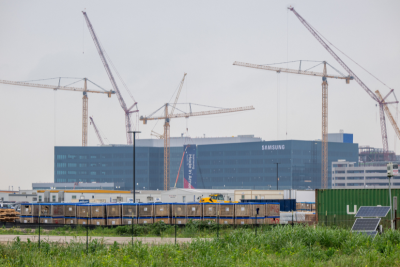
A general view of the Samsung Austin Semiconductor plant on April 16, 2024, in Taylor, Texas, which received CHIPS Act funds. Photo by Brandon Bell/Getty Images.

Trump cited the 41% statistic in a White House press conference on Jan. 20 – calling it a “record” increase and suggesting that other presidents cannot compare to this “record.” 

“Investment in American factories is up 41%. That’s a record. Nobody goes 41% up. You go 2% up, 1% up. You go down by 3%. If Kamala [Harris] got elected, the 41% up would be 41% down,” Trump said at the press conference, referring to the former vice president and Democratic presidential nominee who lost to Trump in the 2024 election.

A day later, in a Jan. 21 speech at the World Economic Forum Annual Meeting in Davos, Switzerland, Trump repeated the 41% figure. 

“Factory construction is up by 41%, and that number is really going to skyrocket right now, because that’s during a process that they’re putting in to get their approvals and we’ve given very, very quick, fast approvals,” Trump said. 

This claim is part of a theme the president has emphasized of a “manufacturing boom” or “booming” economy due to his trade policies.

At our request, the White House sent us a link to the Census Bureau’s manufacturing construction spending data via the Federal Reserve Bank of St. Louis’ online database known as FRED. We provide more about the White House response later, but let’s focus first on what the data show.

Under President Joe Biden — who served from Jan. 20, 2021, to Jan. 20, 2025 — there was a significant increase in manufacturing construction spending in all four years, according to the Census Bureau’s annual average estimates. After declining 6.9% in 2020 – the last year of Trump’s first term – manufacturing construction spending started to rise in 2021, the data show. 

(Technical note: The Census Bureau provides average quarterly and annual estimates and monthly reports for construction spending, including manufacturing construction spending, based on its monthly Value of Construction Put in Place survey. We use all three in this story.) 

Initially, the increases during the Biden years were in response to the COVID-19 pandemic, Anirban Basu, chief economist for the Associated Builders and Contractors, an industry trade association, told us in an email. 

“Supply chain disruptions at the start of the COVID-19 pandemic convinced many producers to reshore capacity, while a sudden and sharp increase in construction materials prices—which rose more than 40% during the early years of the pandemic—also boosted nominal construction spending,” Basu said. 

Manufacturing construction spending accelerated after Biden signed legislation in August 2022 designed to encourage private investment in U.S. manufacturing for semiconductors and clean energy. The bipartisan CHIPS Act, for example, included $39 billion to help fund semiconductor manufacturing facilities in the U.S., as explained in an April 2023 report by the Congressional Research Service.

During Biden’s four years, the annual average rate of manufacturing construction spending jumped more than 200%, from $75.5 billion to $235.6 billion, according to Census Bureau estimates. Spending surged 62% in a single year – 2023, a year after Biden signed the CHIPS Act. 

But manufacturing construction spending peaked in the third quarter of 2024 and has been trending down slightly ever since. Census Bureau quarterly data show that under Trump, measuring from the last quarter in 2024 through the third quarter in 2025, spending declined 6.7%. 

That decline is expected to continue in 2026 and 2027, according to the most recent survey of construction economists that is conducted twice a year by the American Institute of Architects.

“Manufacturing construction spending has seen phenomenal growth in recent years, increasing by over 50% in 2022, another 62% in 2023, and then another 16% in 2024,” the AIA consensus construction forecast published Jan. 15 said. “However, growth paused last year as spending in this category fell about 5% and is projected to decline another 4% this year and 1% in 2027.”

Despite the slight declines, the AIA construction forecast noted that the semiconductor fabrication plants continue to fuel manufacturing construction spending and will do so in the long term.

“The longer-term prospects look much more promising, as construction starts for manufacturing projects have shot up again,” the AIA forecast said. “Since many of these starts are for megaprojects, such as large semiconductor fabrication plants that entail a complex construction process, it may take a while before the activity shows up in the construction spending data.”

In January, Basu analyzed the Census Bureau’s most recent monthly report for nonresidential construction spending, which showed manufacturing construction spending as of October had declined for nine straight months. 

“With CHIPS Act-enabled megaprojects winding down and the stiff headwind of trade policy, manufacturing construction spending has fallen by nearly 10% over the past 12 months, accounting for more than the entire decline in private nonresidential spending,” Basu said in an ABC press release issued Jan. 21. (By “trade policy,” Basu is referring to the economic impact of Trump’s tariffs on construction materials.)

On a monthly basis, the Census Bureau shows a 7.3% decline in manufacturing construction spending last year under Trump from January through October, the most recent data available.

Beginning on Jan. 23, we asked the White House on multiple occasions to provide support for the 41% figure used in Trump’s Jan. 20 and 21 remarks. After not receiving a response, we sent another email on Feb. 2 after the president wrote an opinion piece for the Wall Street Journal on Jan. 30 that said, “Factory construction is up by 42% since 2022.” We asked how it arrived at a 42% increase “since 2022.” That evening, the White House sent us a link to the Census Bureau’s manufacturing construction spending data, saying it compared “averages of Jan – August 2025 vs 2021-2024 average.”

That’s true — as far as it goes. On an annualized basis, monthly manufacturing construction spending averaged $226.1 billion for January through August — which is 40% higher than the annual average of $161.1 billion in Biden’s four years. But Trump wrote that the 42% increase was “since 2022,” not 2021. (We’ve asked the White House for a clarification.)

More importantly, the White House methodology fails to take into account the 212% increase in factory construction spending over Biden’s four years, which peaked in 2024 at an annual average of $235.6 billion, and how the Biden-era CHIPS Act continues to fuel manufacturing construction spending.

As we noted earlier, Basu attributed the recent decline to Trump’s tariffs and the slowing — not the halting — of construction projects spurred by the CHIPS Act. Asked to elaborate on his analysis, Basu told us that the manufacturing construction spending in 2025 is “largely due” to the CHIPS Act.

“While spending in the segment remains elevated from 2022 levels, that’s partially due to a precipitous increase in materials prices that occurred in 2022 and 2023 — these data are in nominal terms — and largely due to the surge in megaproject activity induced by the CHIPS Act,” Basu said.

He added that Trump’s tariffs have helped drive up the costs of fabricated metal — which has increased manufacturing construction costs.

“[I]t should be noted that spending in the fabricated metal manufacturing subsegment is up 19% over the past year,” Basu said. “Some of the increase can be contributed to tariffs and the resulting increase in demand for domestic production.”

We should note that even with the recent surge in manufacturing construction spending, there has been a decline in the number of manufacturing jobs. As we reported last month, the economy lost 63,000 manufacturing jobs in Trump’s first 11 months. That followed a loss of 98,000 in the preceding 11 months, according to the Bureau of Labor Statistics.

Shortly before Biden left office, Manufacturing Today, a trade magazine, wrote in December 2024 that manufacturing jobs were slow to materialize despite Biden’s incentives to spur manufacturing construction. But the magazine predicted the jobs “will materialize in the future.”

“Unlike traditional industrial projects, today’s semiconductor and clean energy facilities require longer timelines,” the article said. “Factories of this scale can take two to three years to complete, with even longer delays for more complex facilities, such as semiconductor plants. This extended timeline means the full benefits will not be realized for several more years.”

Basu agreed that CHIPS-related spending will result in an overall increase in U.S. manufacturing jobs – but cautioned that the impact of Trump’s tariffs could offset those gains. 

“The massive facilities incentivized by the CHIPS Act will employ thousands of people,” Basu told us. “That said, all else is not equal, and recent trade policy and the effects on manufacturing input prices have put downward pressure on the industry’s employment.” (Input prices are costs of materials and other resources manufacturers need to produce goods, with some of those materials being imported.)

Others are bullish that Trump’s trade policies will encourage more manufacturers to expand in the U.S. 

In April, when Trump announced higher tariffs on nearly all foreign imports, Morgan Stanley analyst Chris Snyder called tariffs “a positive catalyst” for relocating manufacturing to the U.S. More recently, Snyder said in a podcast last month that the tariffs have changed the “supply chain cost calculation” and will result in new U.S. factories. 

“What we’re seeing is the cost of imports have gone higher with tariffs, and now it’s more economically advisable for these companies to make the product in the United States,” Snyder said. “And if that’s the case, that means that when they need a new factory, it’s going to come to the United States. They might not need a factory now, but when they do, the U.S. is at least incrementally better positioned to get that factory.”

In a January news article, the Wall Street Journal wrote that Trump’s tariffs “haven’t worked, so far.” The article said tariffs have increased manufacturers’ costs for foreign parts, adding that the “White House’s stop-and-start” tariff policy announcements have “also led to what many executives view as a lost year for investment.”

In a December interview with the Wall Street Journal, Trump cited — as he often does — the value of investments that he says his administration has secured to date. (As we’ve written, he has exaggerated pledges to invest made by various companies and countries that may or may not materialize, experts say.) But he couldn’t say if the investments would show results in time for the midterm elections, when the Republican Party is in jeopardy of losing its slim majority in the House. “I can’t tell you. I don’t know when all of this money is going to kick in,” the president told the Journal, adding that it may happen in the second quarter of this year.

What will happen in the coming months and years remains to be seen. But what we can say is that factory construction so far has declined under Trump and his claim that it has increased 41% depends on a spending surge that occurred under Biden. 

Editor’s note: FactCheck.org does not accept advertising. We rely on grants and individual donations from people like you. Please consider a donation. Credit card donations may be made through our “Donate” page. If you prefer to give by check, send to: FactCheck.org, Annenberg Public Policy Center, P.O. Box 58100, Philadelphia, PA 19102. 

Free Training

Source link

The US is a Small Country


In my recent post on US manufacturing jobs and tariffs, I mentioned a Wall Street Journal article that pointed toward American tariffs having little impact on Chinese exports; the exports are simply being shifted to other countries.  In the earlier post, I discussed what that fact meant for US manufacturing jobs.  Here, I discuss what that shift means for who bears the burden of the tax.

Economists argue that the burden of a tariff falls primarily on the importing country.  In fact, the model we teach our Intro students shows that the burden falls exclusively on the importing nation.  In op-eds, that same model is what we generally present.  However, as readers of this blog know, it’s not completely correct to state that a tariff will always fall entirely upon the importing country.  Our Intro students also learn that who bears the burden of a tax depends on the relative elasticities of supply and demand.  Whoever is least sensitive to a change in price will bear a greater burden of the tax.  Consequently, whoever is the most sensitive to a change in price will bear the lower burden.  In the simple model of international trade, we economists typically show a perfectly elastic supply of the imported good.  In other words, foreign producers are highly sensitive to a change in price; foreign producers have many other consumers beyond the importing country and will simply shift their business elsewhere.  Consequently, the importing nation must face the entire burden of the tax.  This is called the small-country tariff model; the importing country is simply too small to influence the world price of the tariffed good.

But what if that condition does not hold?  What if the importing country is sufficiently large that it can influence the world price of the imported good?  This is called the large-country model.  When a nation is such a large importer of a particular good that their behavior can influence the world price, the global supply curve is relatively inelastic (upward sloping).  When the nation imports a lot, the world price rises and global producers produce more.  Likewise, when the importing nation purchases less, the global price falls and world producers supply less of the good.

The large-country model has an interesting implication.  With a sufficiently small tariff, the large country can actually improve its terms of trade and, consequently, the trading partner’s terms of trade will fall.  The terms of trade for a country is:

Terms of Trade = Export Price Index/Import Price Index

In other words, the terms of trade is how much it costs (exports) for a country to consume (import) foreign goods.  Imposing a tariff reduces the quantity demanded of the imported good. Under the large country model, the importing nation is sufficiently large that if the quantity demanded of the good falls, the world price falls, and the exporting nation must absorb some of the tariff, otherwise the transaction ceases to be profitable.  Domestic imports fall but the domestic price of the good does not rise by the full amount of the tariff. 

In sum: if a country is sufficiently large, the relative elasticities are known, and the exporting nations’ behavior does not change other than to reduce prices on the tariffed goods (i.e., no retaliation and no reduction of their own imports or investment into the domestic country), a sufficiently small tariff can improve the economic welfare of the importing country.  Yes, there is a loss from a reduction in imports (recall that imports are the benefit of international trade), but there is a gain due to the lower price of imports.  If the gain from the lower price outweighs the loss from the reduction of imports, then the country will marginally increase their welfare.  (This tradeoff is why the tariff must be sufficiently small; one wouldn’t want to reduce imports too much!).  The tariff that achieves this result is called an optimal tariff; it is a tariff that optimizes total economic welfare in a country.  

Any International Trade textbook will discuss these models.  I recommend International Economics by Robert Carbaugh.  The book is written on the assumption that the reader has no more than a principles of economics understanding.

Some argue that the US is sufficiently large that the tariffs imposed will increase welfare in the US.  We saw almost immediately that the argument for an optimal tariff was violated; shortly after tariffs were imposed in 2025, other countries retaliated with their own tariffs. Various studies indicate Americans are bearing almost all of the tariff.  

A recent WSJ piece points to another issue: at least as far as China is concerned, the US is not a sufficiently large country.  According to data from the US Census Bureau, US imports from China are down some 45.6% from last year, but China’s exports are up.  Rather than reducing prices, China simply found other buyers for their goods.  Consequently, these data imply that US consumers and individuals are likely bearing most, if not all, of the tariff on Chinese goods.  The tariffs reduced imports, increased prices for Americans, but the global price did not change. China simply found other buyers.  The supply curve was, for all intents and purposes, perfectly elastic.

The usefulness of a model derives from its ability to make sense of the real world and give us the ability to make predictions.  The “realism” or complexity of a model is not necessarily a feature.  In many ways, the large-country model is more realistic than the small-country model.  It’s quite unlikely that any country, let alone the United States, is so small that they cannot influence world prices at all.  Ultimately, all trade is done by individuals and not nations, so it’s reasonable to assume there will be some influence on a case-by-case basis.  However, the large-country model is not particularly helpful in explaining real-world outcomes.  The small-country model, despite its lack of realism, provides far clearer analysis, at least as a first approximation of effects.  

Free Training

Source link