Fulflex Acquires 300,000-Square-Foot Texas Medical Manufacturing Facility to Expand U.S. Healthcare Platform


Fulflex Acquires 300,000-Square-Foot, Fully Automated Medical Products Manufacturing Facility In Texas

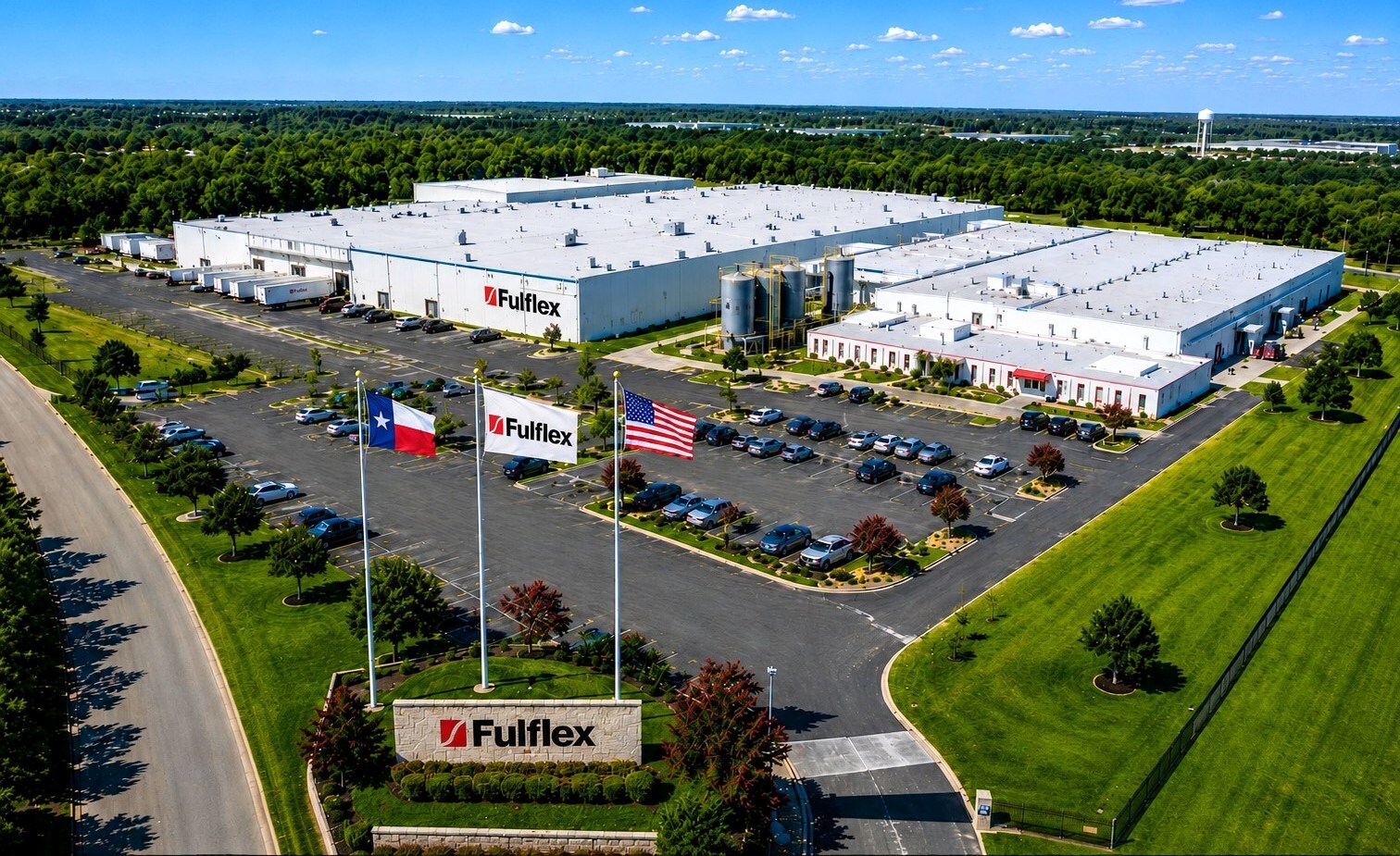
Fulflex has completed the acquisition of a 300,000-square-foot medical products manufacturing facility in Jacksonville, Texas, significantly expanding its North American production capacity and reinforcing its strategy to build a larger global healthcare manufacturing platform.

Located on a 30-acre campus, the facility becomes one of Fulflex’s largest and most advanced manufacturing sites worldwide. The acquisition also brings more than 250 employees into the company, strengthening its manufacturing workforce while establishing a larger operational presence in East Texas.

The Jacksonville facility produces a broad range of medical products used by healthcare providers and patients globally. Its manufacturing capabilities include plastics injection molding, blow molding, thermoforming, extrusion, automated assembly and other advanced production technologies, enabling Fulflex to increase output while supporting customers with scalable, high-quality manufacturing solutions.

“This is an exciting day for Fulflex and for the Jacksonville community,” said Diya Garware Ibanez, Chairperson of Fulflex. “We are delighted to officially welcome the Jacksonville team into the Fulflex family. This acquisition reflects our confidence in the exceptional people, the advanced manufacturing capabilities of this facility, and the long-term future of healthcare manufacturing in East Texas. We are committed to investing in this facility, creating new opportunities for our employees, supporting our customers with world-class manufacturing, and contributing positively to the Jacksonville community for many years to come.”

The acquisition expands Fulflex’s manufacturing footprint across North America while increasing capacity in polymer processing, medical device manufacturing and automated production. The additional facility also enhances supply chain resilience by providing greater geographic diversification and production flexibility for customers operating in global healthcare markets.

The investment aligns with Fulflex’s long-term strategy of expanding through advanced manufacturing assets that strengthen operational scale and support growing demand for medical products. The company said it plans to build on the Jacksonville facility’s existing capabilities through continued investments in manufacturing technology, quality systems, operational excellence and workforce development.

“Every acquisition begins and ends with people,” Garware Ibanez said. “The dedication, experience, and commitment of the Jacksonville employees are the foundation of this facility’s success. We are honored that so many talented people have chosen to continue this journey with us, and we look forward to building an organization where our employees can grow, our customers can succeed, and our community can thrive.”

The transition was formally marked with a community event attended by employees, customers, local officials and business leaders, underscoring the company’s commitment to maintaining the facility’s operations while investing in its long-term growth.

Following the acquisition, Fulflex operates 14 locations worldwide, including four manufacturing facilities in the United States, one manufacturing facility in the Dominican Republic, two manufacturing facilities in India, and seven sales offices and distribution centers across eight countries. The company’s global network serves customers in more than 85 countries, providing medical products and engineered polymer solutions for applications spanning medical devices, patient care, rehabilitation and personal protective equipment.

By expanding its U.S. manufacturing base with one of its largest production facilities, Fulflex is positioning itself to support increasing demand from healthcare customers while strengthening its role as a global contract manufacturing partner with enhanced capacity, operational flexibility and regional supply chain capabilities.

Free Training

Source link

Bikaji invests $2.9 million to expand US manufacturing footprint – Indian Television Dot Com


MUMBAI: Looks like Bikaji is adding a dash of local flavour to its global recipe. The packaged snacks maker is strengthening its American ambitions with a fresh capital infusion into its US subsidiary, betting on local manufacturing to serve the growing appetite for Indian snacks across North America.

Bikaji Foods International has invested an additional $2.9 million (around Rs 25 crore) in its wholly owned subsidiary, Bikaji Foods International USA Corp, as part of its strategy to deepen its presence in one of its fastest-growing overseas markets.

The company subscribed to 290,000 equity shares, taking the subsidiary’s paid-up capital to $4.05 million. The transaction does not alter Bikaji’s ownership structure, with the Indian parent continuing to hold 100 per cent of the US business.

The fresh capital will be used to establish a manufacturing facility in the United States, enabling Bikaji to produce locally instead of relying solely on exports. The company expects the move to strengthen its supply chain, improve customer access and accelerate business growth while meeting rising demand for Indian packaged snacks in the region.

Established in 2023, Bikaji Foods International USA Corp is engaged in the trading of packaged food products, including bhujia, namkeen, sweets and frozen foods. The subsidiary has recorded steady growth since its launch, with turnover rising from $1.1 million in FY24 to $1.77 million in FY25, before reaching $2.62 million in FY26.

The investment reflects a broader trend among Indian packaged food companies, which are expanding overseas to tap into the growing Indian diaspora as well as increasing mainstream demand for ethnic and ready-to-eat food products.

For Bikaji, which has been steadily scaling its international business alongside domestic growth, the US remains a strategically important market, with local manufacturing expected to provide a stronger platform for its next phase of expansion.

Free Training

Source link

Argon & Co Appoints Lotfi Maroizy to Expand North American Manufacturing Practice


Argon & Co has appointed manufacturing and operations executive Lotfi Maroizy as a partner in its North American Manufacturing Practice, a move aimed at expanding the consulting firm’s capabilities as manufacturers accelerate investments in digital transformation, supply chain modernization and operational efficiency.

Based in Houston and aligned with the firm’s Atlanta office, Maroizy will lead the growth, strategy and execution of Argon & Co’s expanded manufacturing services across the United States. His appointment comes as industrial companies face mounting pressure to modernize operations, address workforce challenges and improve competitiveness through technology-driven transformation initiatives.

The addition reflects increasing demand among manufacturers for consulting support that combines operational expertise with digital capabilities. Across sectors ranging from consumer goods and chemicals to automotive and food production, companies are seeking ways to improve resilience, automate processes and optimize increasingly complex supply chains.

“We are thrilled to welcome Lotfi to our leadership team as we aggressively scale our North American Manufacturing Practice,” said Simon Clarke, managing partner at Argon & Co.

Maroizy brings more than two decades of experience leading large-scale operational, supply chain and manufacturing transformation programs. Throughout his career, he has worked with organizations undergoing significant change initiatives aimed at improving productivity, reducing costs and enhancing operational performance.

Prior to joining Argon & Co, Maroizy held senior leadership positions at EFESO Consulting, Riveron and Accenture. In those roles, he led consulting teams responsible for implementing complex transformation programs across a range of industries. According to the company, initiatives he helped oversee generated more than $1 billion in cumulative cost savings and revenue improvements.

His industry experience spans several sectors that continue to face rapid technological and competitive shifts, including consumer products, food and beverage, chemicals, pulp and paper, and automotive manufacturing. Those industries are increasingly investing in smart factory technologies, advanced analytics, automation and digital supply chain tools as they respond to changing customer expectations and evolving market conditions.

At Argon & Co, Maroizy will focus on expanding the firm’s go-to-market strategy by integrating traditional operational improvement methodologies with digital manufacturing capabilities. The company views this combination as increasingly important as manufacturers seek practical solutions that deliver measurable business results rather than standalone technology deployments.

“Argon & Co’s hands-on, ‘roll-up-your-sleeves’ culture perfectly aligns with my philosophy on transformation,” Maroizy said. “True operational change isn’t born in a silo; it happens alongside the client on the shop floor.”

He added that the firm’s expanded supply chain, operations and digital capabilities will help manufacturers address legacy operational challenges while adopting automation and modern manufacturing technologies designed to improve profitability and market competitiveness.

The appointment comes at a pivotal time for the North American manufacturing sector. Many companies are balancing investments in automation and artificial intelligence with efforts to strengthen domestic production capabilities, improve supply chain visibility and address ongoing labor shortages. Those trends have created growing demand for advisory firms capable of guiding transformation efforts from strategy development through implementation.

Argon & Co specializes in supply chain strategy, operational transformation and managed services, working with organizations across North America, Europe and Asia-Pacific. The firm’s consulting model emphasizes direct engagement with clients throughout execution rather than focusing solely on strategic planning.

By adding a leader with extensive experience in manufacturing operations and digital transformation, Argon & Co is positioning itself to capture growing demand from industrial organizations seeking to modernize operations and build more resilient, technology-enabled supply chains. The move also reinforces the firm’s commitment to expanding its presence in North America as manufacturers continue investing in operational excellence and digital innovation.

Free Training

Source link

Siemens, Jabil expand electrical equipment manufacturing


Siemens and Jabil Inc. (NYSE: JBL) recently announced plans to operate a new manufacturing facility at the Crosspointe Logistics Center in Prince George County, Va., supporting the energy infrastructure industry. As demand for power infrastructure continues to accelerate, particularly driven by rapid growth in data centers and electrification, this investment will help expand capacity and increase how quickly new infrastructure can be brought online. The Prince George facility, operated by Jabil, will feature approximately 300,000-square-feet of modern industrial space, allowing Siemens to expand U.S. production capacity for its medium-voltage switchgear and integrated power delivery solutions. This facility will expedite the availability of critical equipment needed to energize new infrastructure.

The $30 million investment will go towards scaling-up equipment, tooling, production readiness and operations at the Virginia site. The facility will produce the advanced systems and solutions necessary to protect, control and safely operate equipment in data center, utility, and industrial power generation and distribution applications. With production slated to begin in fall 2026, the Prince George facility is expected to add at least 350 jobs once operational.

“Our data center, utility and industrial customers are under intense pressure to add capacity quickly, with less risk and more predictability,” said Brian Dula, President of the Electrification and Automation business unit at Siemens Smart Infrastructure USA. “By adding additional avenues to expand dedicated manufacturing of Siemens‑designed switchgear and power delivery solutions here in the U.S., we’re helping customers shorten project timelines and improve delivery confidence — while reinforcing a resilient domestic supply chain.”

“Our new Prince George facility will help us build the energy management solutions Siemens needs to meet customers’ growing power requirements with greater speed and scale,” said Brent Tompkins, SVP, Global Business Units, Renewables and Energy Infrastructure, at Jabil. “We’re proud to collaborate with Siemens to expand Jabil’s capabilities within the United States and enable the world’s most important technologies.” Recently achieving a $1 billion manufacturing investment milestone, this expansion reflects Siemens’ continued focus on strengthening domestic supply chains, reindustrializing the U.S. and adding capacity to meet accelerating demand for critical power infrastructure. This will allow Siemens to expand its leadership position in the electrification of data centers and the related grid infrastructure. For Jabil, this investment adds to the company’s growing U.S. manufacturing footprint, spanning more than 30 sites with proven experience and investments in automation, robotics, and process optimization to support production at scale across industries.

Jabil is one of the world’s largest manufacturing solutions providers and has worked with Siemens across the globe for numerous years, supporting high standards for quality and delivery performance. The Prince George collaboration builds on that foundation to help Siemens scale production in the U.S. while maintaining rigorous oversight and adherence to Siemens’ specifications and quality requirements, delivering essential power infrastructure at the pace demand now requires.

To learn more about career opportunities at the Prince George facility, click here.

Free Training

Source link

Skydio Commits $3.5 Bn to Expand U.S. Manufacturing and Secure American Drone Leadership


Skydio Commits $3.5 Bn to Expand U.S. Manufacturing and Secure American Drone Leadership  Skydio ©

Skydio ©

Skydio’s commitment is an investment in American drone dominance, powered by rapidly growing demand for autonomous flying robots that serve America’s critical industries.

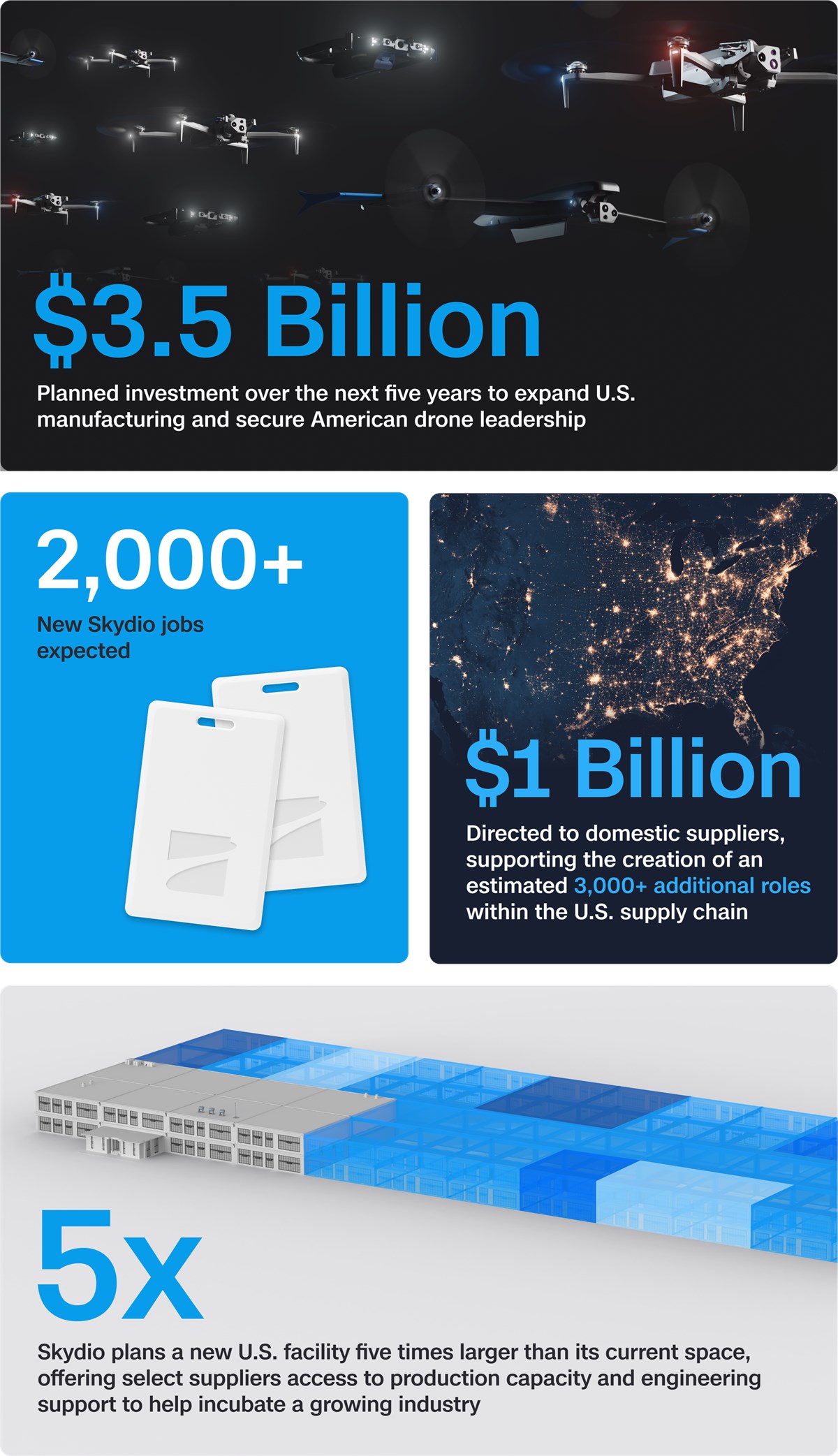
Skydio, the largest U.S.-based drone manufacturer and the world leader in flying robots, today announced plans to invest $3.5 billion in the United States over the next five years to expand its domestic manufacturing, accelerate R&D, and strengthen American supply chains. The investment is expected to create over 2,000 new Skydio jobs, support the creation of more than 3,000 additional roles within the U.S. supply chain, and direct more than $1 billion to domestic suppliers.

Skydio already manufactures more dual-use drones than any company outside of China. The company has shipped more than 60,000 flying robots to more than 3,800 customers, including more than 1,200 public safety agencies throughout the country, every branch of the U.S. military, and 29 allied nations, as well as more than 450 utility and energy companies.

A key component of the investment is SkyForge, a new company program designed to ensure the future of flight is built in America. In addition to the billion-dollar investment in U.S. suppliers, Skydio plans to open a new U.S. manufacturing facility five times larger than its current space. The company has outgrown four American manufacturing facilities in eight years; this will be its fifth expansion to meet extraordinary demand. Skydio’s investment in world-class suppliers will help expand – and in some cases initiate – domestic manufacturing of crucial parts and components. The company will invite select suppliers to co-locate production capacity with Skydio, giving suppliers access to production space and Skydio’s engineering talent to help incubate a growing industry.

In the span of little more than a decade, drones evolved from toys to tools to critical infrastructure for the industries that form the backbone of this country. Skydio leads this new era of drones as infrastructure on the strength of its AI and autonomy innovation: In public safety, for example, our Skydio DFR gives agencies aerial awareness that allows drones to arrive on scene first 71% of the time, resolving nearly a quarter of calls without sending a patrol unit. When lives and livelihoods are on the line, Skydio’s systems are in the field, every day, protecting both.

With this commitment, Skydio is making clear that the United States will lead in flying robotics autonomy, manufacturing, and scale. The investment will reinforce domestic electronics and component manufacturing and strengthen secure supply chains vital to national resilience. At the same time, Skydio will continue to scale domestic production capacity to meet the growing demand across public safety, national security, and utilities.

Free Training

Source link

Tariffs drive companies to expand manufacturing in U.S., Gerdau says


Gustavo Werneck, chief executive of Gerdau, said the U.S. administration’s tariff policy may be viewed as an unexpected measure, but it also reflects a long-term vision and confidence in the revival of American industry.

According to Werneck, Gerdau does not base its investment decisions on short-term volatility and continues to invest because it believes in the long-term recovery of U.S. manufacturing.

“There has been an additional incentive for Brazilian companies to establish manufacturing operations here in the United States,” Werneck said during the third edition of the Summit Valor Brazil-USA on Wednesday in New York.

The executive, who took part in a panel on trade and investment relations between Brazil and the United States, said the cost of key industrial inputs such as energy and natural gas in the U.S. is unmatched, making it impossible to offset the price gap between the two countries solely through management efficiency.

“In Brazil, we pay around $16 per cubic meter of natural gas. Here, despite all the volatility, we are still paying around $4,” he said.

Gerdau operates 13 of its 29 steel production units in North America, with facilities spread across the United States and Canada.

According to Werneck, the reindustrialization of the U.S. is already visible through customers building new factories in the country.

“We are currently supplying a significant amount of steel to new semiconductor plants being established here,” he added.

Gustavo Werneck — Foto: Vanessa Carvalho/Valor Gustavo Werneck — Foto: Vanessa Carvalho/Valor

Free Training

Source link

FH Capital to Acquire 75.1 Percent Stake in JinkoSolar US Manufacturing Unit, Expand Solar and BESS Platform – Asia Pacific


FH Capital will acquire 75.1 percent of JinkoSolar’s US manufacturing subsidiary, expand 2 GW solar module capacity, and launch domestic BESS production to strengthen America’s clean energy manufacturing and supply chain.

May 13, 2026. By EI News Network

FH Capital has entered into an agreement to acquire a 75.1 percent majority stake in JinkoSolar’s US manufacturing subsidiary, creating a domestic solar and Battery Energy Storage Systems (BESS) platform anchored by a 2 GW solar module manufacturing facility in the United States. JinkoSolar will retain a 24.9 percent minority stake in the venture.

Following the transaction, FH Capital plans to inject additional expansion capital to at least double the facility’s current solar module production capacity while also launching domestic BESS manufacturing operations. The move is aimed at strengthening US-based clean energy manufacturing amid rising demand for locally sourced solar and storage products and evolving US energy policies.

FH Capital is led by Sanjeev Chaurasia, a renewable energy investment banker with more than two decades of experience. Chaurasia previously served as Managing Director at Credit Suisse, where he co-founded the firm’s renewable energy practice and led JinkoSolar’s 2010 NYSE IPO.

According to Chaurasia, the transaction combines JinkoSolar’s established US manufacturing presence, technology portfolio, and customer network with FH Capital’s investment and operational capabilities to support growing domestic solar and storage demand.

Nigel Cockroft, US General Manager of JinkoSolar, said that the partnership provides strategic direction and ownership support to expand manufacturing capacity and serve increasing demand for US-sourced renewable energy products.

The transaction remains subject to customary regulatory approvals and closing conditions. Financial details of the deal were not disclosed.

Free Training

Source link

Skydio to invest $3.5 billion to expand U.S. drone manufacturing


Skydio announced plans to invest $3.5 billion in the United States over the next five years to expand domestic manufacturing and research capabilities. The company said the initiative aims to strengthen supply chains and support long-term growth in the U.S. drone industry.


The investment is expected to create more than 2,000 jobs within Skydio and support over 3,000 additional roles across the domestic supply chain. More than $1 billion of the total funding will be directed to U.S.-based suppliers.

Skydio said it already produces more dual-use drones than any company outside China. The company has delivered over 60,000 systems to more than 3,800 customers, including public safety agencies, U.S. military branches, allied nations and commercial operators.

A central element of the expansion is the SkyForge program. This initiative is designed to support domestic production and reinforce U.S.-based manufacturing capabilities.


The company plans to open a new manufacturing facility that will be five times larger than its current site. This will mark Skydio’s fifth expansion in eight years as it responds to increased demand.

The investment will also support the development of domestic suppliers for critical components. Skydio said it will work with selected partners to co-locate production and provide access to engineering expertise.

Adam Bry, co-founder and Chief Executive Officer of Skydio, said: “U.S. innovation invented the airplane, ramped up manufacturing to win WWII, put a man on the moon, broke the sound barrier, and commercialized space travel.” He added: “Skydio has proven that American companies can compete and win in the civilian drone market against products from our adversaries.”

The company said drones have rapidly evolved into critical infrastructure tools across multiple sectors. Its systems are used in public safety, where aerial capabilities can support faster response times.


Skydio said its technology enables drones to arrive first at incident scenes in a majority of cases. In some situations, operations can be resolved without deploying additional units.

The company said the investment will reinforce domestic manufacturing of electronics and components. It also aims to strengthen secure supply chains that support national resilience.

Skydio said it will continue expanding production capacity to meet demand from public safety, national security and utility sectors. The company added that the initiative reflects a broader effort to position the United States as a leader in autonomous aerial systems.


Free Training

Source link

Toyota Invests $1 Billion to Expand U.S. Manufacturing Capacity


GEORGETOWN, Ky. — Toyota is investing $1 billion across its Kentucky and Indiana manufacturing operations to expand production capacity and support electrification, as the company marks 40 years of vehicle assembly in Kentucky.

The investment includes $800 million at Toyota’s Georgetown, Kentucky plant to prepare the facility for a second battery electric vehicle and increase assembly capacity for the Camry and RAV4. An additional $200 million will go to Toyota’s Indiana plant to expand production of the Grand Highlander SUV.

Toyota said the investment is part of a previously announced plan to invest up to $10 billion in U.S. manufacturing over the next five years, aimed at meeting customer demand and supporting a broader vehicle lineup.

The Georgetown facility, Toyota’s largest manufacturing plant globally, has produced more than 14 million vehicles since opening in 1986. The site remains a key hub for vehicle assembly and is central to the company’s strategy to expand production in North America.

In Indiana, the investment will increase output of the Grand Highlander, which will be assembled alongside the Sienna minivan in the plant’s East facility while continuing production with the Lexus TX in the West facility.

“Today’s announcement reflects the company’s commitment to meeting customer demand and the belief in our team to get it done,” said Jason Puckett, president of Toyota Indiana.

Toyota said the investments are designed to increase throughput and support production of both traditional and electrified vehicles as demand shifts across the automotive market.

]]>


Looking for quick answers on assembly and manufacturing topics?


Try Ask ASM, our new smart AI search tool.

Ask ASM

In addition to manufacturing expansion, the company is investing in workforce development programs tied to its production operations. Toyota Kentucky announced $4 million in funding for STEM education initiatives in local school systems and $400,000 to support manufacturing engineering programs at Eastern Kentucky University.

The company said the efforts are intended to support workforce readiness and ensure a pipeline of skilled workers for future production needs.

Toyota’s Kentucky plant employs approximately 10,000 workers, while its Indiana facility employs more than 7,000. The company said continued investment in facilities and workforce development is essential to maintaining production capacity and supporting long-term manufacturing growth in the United States.

Free Training

Source link

Apple to Expand American Manufacturing Programme by US$400m


“We are very proud to be working with Apple to accelerate US manufacturing. We share their commitment to do more in the US, and our teams are working side-by-side with theirs in the US.”

TDK’s US facility will supply TMR sensors in devices shipped all over the world, and will increase the volume of chips that Apple will source from US silicon supply chains.

Expanded with other partners

As part of this new investment in Apple’s AMP, Cirrus Logic and GlobalFoundries will establish new semiconductor process technologies at GlobalFoundries’ facility in New York that will enable Apple to develop mixed-signal solutions for a number of applications, including advanced ICs to power Face ID systems.

Tim Cook, Apple’s CEO, says: “At Apple, we believe in the power of American innovation and manufacturing, and we’re proud to partner with even more companies to produce critical components and cutting-edge materials for our products right here in the US.

“Today, we’re joining with world-class partners like Bosch, Cirrus Logic, TDK, and Qnity Electronics to further expand Apple’s US supply chain through our American Manufacturing Program. This is another powerful example of what is possible when we invest in American ingenuity, and we’re excited to build the future together.”

Free Training

Source link