


Kentucky anchors Toyota’s U.S. manufacturing expansion
GEORGETOWN, Ky. (Oct. 29, 2026) — Nearly four decades after its first Kentucky-built Camry rolled off the assembly line, Toyota’s Georgetown plant remains central to the automaker’s U.S. manufacturing strategy as the company invests billions in domestic production and prepares for its next generation of vehicles.
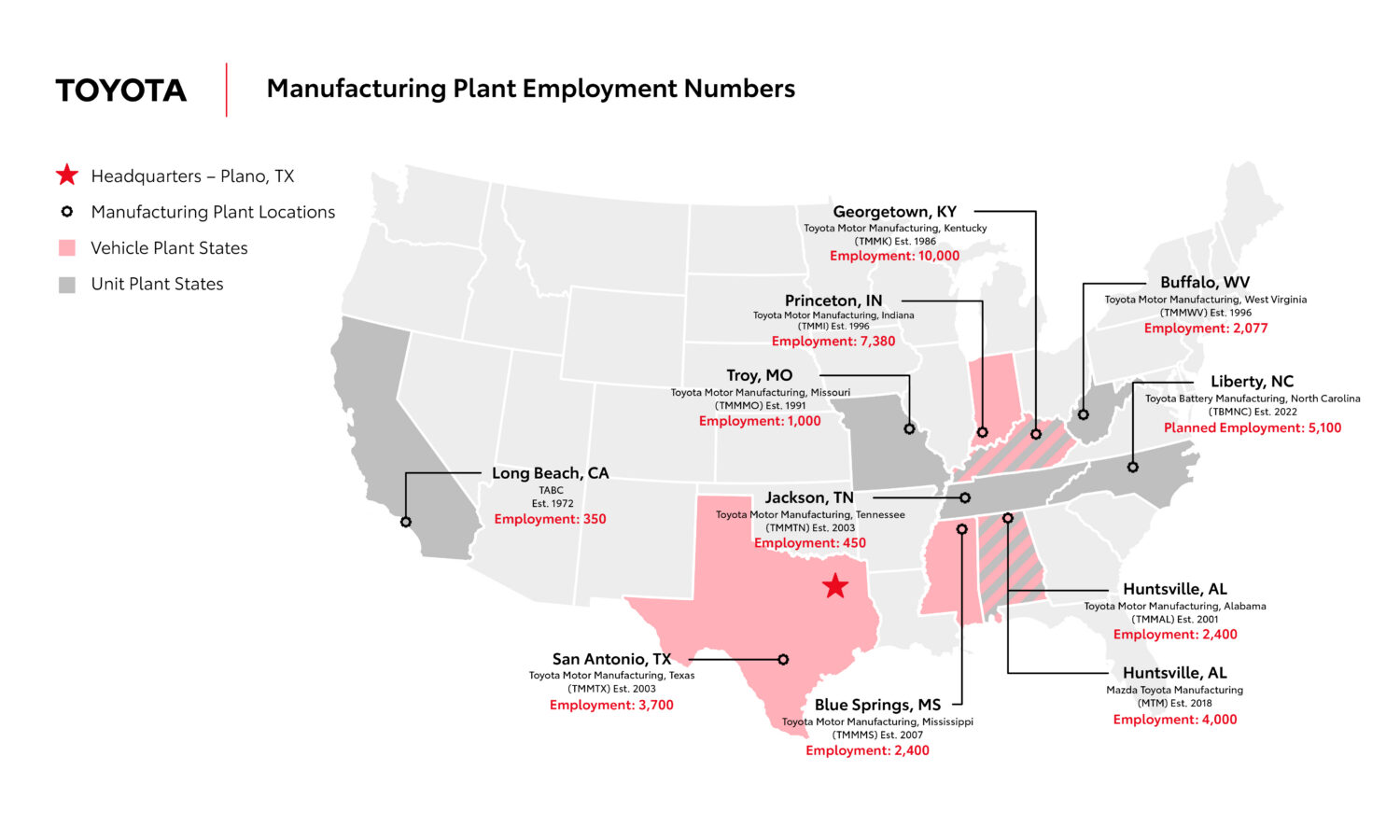
Toyota Motor Manufacturing Kentucky is the company’s largest vehicle manufacturing plant in the world. Its production of the Camry Hybrid and RAV4 Hybrid, along with engines and other components, places Scott County at the center of a manufacturing network spanning 11 facilities in 10 states.
For Kentucky, Toyota’s continued investment connects one of the state’s most significant industrial developments with the automotive industry’s transition toward a broader mix of hybrid and battery-electric vehicles.
That commitment includes an $800 million Kentucky investment announced in March to prepare for battery-electric vehicle production and increase production capacity for the Camry and RAV4. The project is part of Toyota’s pledge to invest up to an additional $10 billion in U.S. manufacturing over five years.
Georgetown’s role stretches back to 1988, when the plant assembled its first Camry and became Toyota’s first wholly owned U.S. vehicle manufacturing facility. Since then, the operation has grown into a major production center whose responsibilities extend well beyond vehicle assembly.
Toyota Kentucky’s manufacturing capabilities include engines, hydrogen fuel cell kits, axles, steering components, machined engine parts and dies. That range gives the plant a role in both finished vehicles and the components supporting automotive production.
Its position also gives Kentucky a direct stake in Toyota’s strategy of building more vehicles in the country where they are sold.
“Our ultimate objective is to simply assemble more of what you and our customers want and need here in the U.S.,” Mark Templin, executive vice president and chief operating officer of Toyota Motor North America, said at the company’s National Dealer Meeting.
Toyota’s U.S. manufacturing network employs more than 31,000 people, according to the company. Those operations include vehicle assembly plants, engine and transmission facilities, component manufacturers and battery production.
While Georgetown is the largest operation, the newest is Toyota’s North Carolina battery plant, which began assembling hybrid vehicle batteries in late 2025. The facility adds domestic battery production to a network that already manufactures vehicles and powertrain components across much of the country.
Toyota’s other assembly operations include Indiana, where workers build the Grand Highlander, Highlander, Highlander Hybrid, Lexus TX and Sienna Hybrid; Mississippi, which produces the Corolla; and Texas, which builds the Tundra and Sequoia. Mazda Toyota Manufacturing in Alabama produces the Corolla Cross.
Supporting facilities manufacture engines and differentials in Alabama, cylinder heads in Missouri, engine blocks and transmission cases in Tennessee, and engines, transmissions and hybrid transaxles in West Virginia. Toyota’s TABC operation in California supplies body and service parts.
Together, those operations illustrate how Georgetown fits into a domestic production system linking vehicle assembly with specialized component manufacturing.
For Kentucky manufacturers and suppliers, the significance extends beyond the vehicles leaving Toyota’s assembly lines. The Georgetown operation supports demand for parts, materials, equipment, transportation and technical services, connecting the plant’s production needs with businesses throughout the automotive supply chain.
The expansion of hybrid production and preparations for battery-electric vehicles also underscore the changing skills required in automotive manufacturing. Kentucky’s ability to support that transition will depend in part on workers trained in advanced manufacturing, automation, maintenance and emerging vehicle technologies.
Toyota’s broader investment plans suggest domestic manufacturing will remain a priority. The company says its U.S. facility investment announcements from the beginning of 2024 through the end of 2025 totaled nearly $20 billion, including the $13.9 billion North Carolina battery operation. Its subsequent commitment of up to $10 billion provides another framework for expansion, including the Kentucky investment announced this year.
For Georgetown, the next phase builds on a manufacturing relationship established in 1988. For Kentucky, it reinforces the state’s role in Toyota’s efforts to produce more vehicles and key components in the United States.
Here’s a plant-by-plant summary of their output:
- Toyota Alabama — Four-cylinder + HEV engines; 2.4L Turbo + HEV engines; Twin-turbo V6 + HEV engines; differentials
- Toyota Kentucky — Camry Hybrid, RAV4 Hybrid, 4-cylinder & V6 engines, hydrogen fuel cell kits, axles, steering components, machined blocks, cylinder heads, crankshafts, camshafts, rods and axle assemblies, and dies
- Toyota Indiana — Grand Highlander, Highlander, Highlander Hybrid, Lexus TX, Sienna Hybrid
- Toyota Missouri — Cylinder heads
- Toyota Mississippi — Corolla
- Toyota North Carolina — Lithium-ion batteries
- Toyota Tennessee — Engine blocks, automatic transmission cases and housings
- Toyota Texas — Tundra, Tundra HEV, Sequoia HEV, rear axles (begins fall 2026 for Tacoma, Tundra and Sequoia)
- Toyota West Virginia — TNGA 4-cylinder and 2.5 L engines, transmissions and hybrid transaxles
- Mazda Toyota Manufacturing — Corolla Cross
- TABC, Inc. — Body parts for Toyota Tacoma and service parts for all models
