American Rheinmetall expands U.S. Tier 1 manufacturing network supporting missile structures and major military modernization programs


American Rheinmetall is positioning its U.S. Tier 1 manufacturing network to support rising demand for precision components used in critical defense systems. The company highlighted missile body structures as one area where its domestic facilities provide advanced metal forming, machining and finishing capabilities.

The missile structures require tight manufacturing tolerances and must withstand demanding operational environments, according to the company. American Rheinmetall said its manufacturing teams are delivering at the speed and volume required by the U.S. Department of War.

The manufacturing network forms part of a broader U.S. industrial operation spanning six facilities in Michigan, Ohio and Maine. American Rheinmetall operates more than 1.7 million square feet of manufacturing space and employs more than 1,500 people.

The workforce supports fabrication, machining, assembly and welding activities for defense and commercial customers. The company said its facilities also retain significant capacity for future expansion.

Headquartered in Auburn Hills, Michigan, American Rheinmetall designs, develops and produces tracked and wheeled military vehicles and components. It operates as both a full-service original equipment manufacturer and a Tier 1 supplier to the U.S. defense sector.

Its portfolio includes vehicle systems, mechanical systems, ground-vehicle electronics, ISR platforms and soldier lethality technologies. The company also supplies short-range air defense solutions, fabricated structures, armored products, rubber products and track systems.

American Rheinmetall’s U.S. industrial footprint expanded significantly after Rheinmetall AG acquired Loc Performance Products in late 2024. The Michigan and Ohio-based business supplied track and mechanical systems, fabricated structures and precision-machined components to defense, industrial and commercial customers.

Loc Performance Products now operates under the American Rheinmetall name, with its legacy products and capabilities incorporated into the wider business. Rheinmetall said the acquisition would directly support the growth of its U.S. military vehicle operations.

American Rheinmetall Systems also began operating under the unified American Rheinmetall name in 2025. The Biddeford, Maine-based operation focuses on next-generation lethality, fire control, vision systems and short-range air defense technologies.

The company said the unified structure is intended to streamline operations and improve collaboration across its U.S. businesses. American Rheinmetall continues to supply the U.S. government, major defense prime contractors and customers in several commercial industries.

Its U.S. strategy combines domestic manufacturing capacity with access to Rheinmetall’s wider vehicle and electronics portfolios. American Rheinmetall said that approach allows it to adapt and integrate established platforms for specific U.S. military requirements.

Free Training

Source link

Survey Shows U.S. Manufacturing Activity Reaches More Than Four-Y…


Reports related to this article:

Written by Danny Levin, Deputy Editor for IIR News Intelligence (Sugar Land, Texas)

Summary

The Institute of Supply Management’s (ISM) Purchasing Managers Index showed economic activity in U.S. manufacturing reached its highest level since May 2022. Industrial Info Resources’ project data shows strong spending in the U.S. Industrial Manufacturing Industry.

U.S. Manufacturing Activity Rolls On

The Institute of Supply Management’s (ISM) Purchasing Managers Index showed economic activity in U.S. manufacturing reached its highest level since May 2022, with demand indicators showing faster growth. Strong spending in the U.S. Industrial Manufacturing Industry is reflected in Industrial Info Resources’ project data.

The PMI, which tracks 18 manufacturing sectors in the U.S., registered 55.6% in July, up from 53.3% in June–indicating faster growth month-over-month. Any reading over 50% indicates expansion in the manufacturing economy. July also marks the seventh month in a row of expansion.

According to Industrial Info Resources data, there is $687 billion worth of projects under construction in the U.S. Industrial Manufacturing Industry; more than half of the investment is attributed to data centers and semiconductors. The Global Market Intelligence (GMI) Project Database offers a full list of projects.

Any reading under 50% indicates contraction in the manufacturing economy.

“We have a really strong report this month,” Susan Spence, chair of ISM’s Manufacturing Business Survey Committee, said during a news media call.

Three of the four demand indicators–the New Orders, Backlog of Orders and New Export Orders indexes–expanded in July. The New Orders Index expanded for the seventh consecutive month, up 0.7% from June.

In terms of output, July’s Production Index jumped 6.3% month-over-month and reached its highest level since November 2021.

In a press release accompanying the survey, Spence said 38% of respondents’ comments were positive while 62% were negative, with a 1:1.6 ratio of positive to negative sentiment.

In the call, she acknowledged that “the continued Iran war and remaining price volatility” are still risk factors for manufacturing operations. Survey respondents echoed that sentiment.

Pricing volatility was mentioned in 57% of the negative comments, the Iran war 43%, increasing lead times 22% and tariffs 18%.

Mixed Feelings


Although July’s Prices Index, an indicator of input and raw materials costs, continues to show elevated price pressures, the reading of 71.1% lessened from June’s 73%.

The elevated index continues to be driven by increases in steel and aluminum prices impacting the entire value chain; tariffs applied to many imported goods; and increases in petroleum-based products as a result of the recent Middle East conflict.

“Demand is up, and prices are up as a result,” Spence said. She added that although the list of shortages “is pretty significant” and “certainly could get worse” depending on geopolitical factors, currently “orders are flowing.”

The PMI considers shortage items to be specific commodities, raw materials, components, or labor services that are reported to be in short supply or difficult to source.

“Overall, we’re definitely optimistic,” she said.

A Transportation Equipment survey respondent said, “Continued tariffs on products utilized in our product lines are being monitored by the business, which is working to mitigate or limit tariff risk. Geopolitical risk, especially in the Middle East, pertaining to commodity and energy markets remains a concern. There has been some increased cost and transit time for rerouted shipments due to conflicts in the Red Sea, Strait of Hormuz and Suez Canal.”

On a positive note, one respondent from Computer & Electric Products said a favorable demand environment is driven by growth in the semiconductor, artificial intelligence (AI), advanced packaging and high-performance computing (HPC) markets. “Recent company reports indicate strong sales growth and continued investment in manufacturing capacity.”

The ISM considers semiconductors and data-center components to be part of the sector.

Strong U.S. Manufacturing Capex


IIR data show data centers account for about 46% of the total investment value of U.S. Industrial Manufacturing Industry projects under construction.

AI cloud infrastructure provider Fluidstack is building out a multi-billion-dollar grassroot data enter in Abernathy, Texas, north of Lubbock. The facility is expected to feature 168 megawatts (MW) of critical load capacity, in order to provide expanded high-performance computing (HPC) support in the region.

Also in Texas, the first building of Google’s planned six-building data center campus in Oklaunion, near the Oklahoma border, kicked off in March. Construction is expected to wrap up next year.

Readers can view the two project reports.

IIR’s North American Construction Starts Index also shows strong capital spending: The monthly index for the U.S. Industrial Manufacturing industry in June (the latest available data) indicated 1,719 construction starts, with a project value of $209 billion–up from 1,604 projects worth $160 billion year over year.

Key Takeaways

  • The ISM’s PMI survey shows U.S. manufacturing activity in June reached its highest level since May 2022.
  • Three of four demand indicators–including new orders–are growing at a faster rate.
  • The Iran war and tariffs still are driving ongoing price pressures for manufacturers.
  • $687 billion: value of projects under construction in the U.S. Industrial Manufacturing Industry. About half is attributed to data centers.


  • About Industrial Info Resources

    Industrial Info Resources (IIR) is the leading provider of industrial market intelligence. Since 1983, IIR has provided comprehensive research, news and analysis on the industrial process, manufacturing and energy related industries. IIR’s Global Market Intelligence (GMI) helps companies identify and pursue trends across multiple markets with access to real, qualified and validated plant and project opportunities. Across the world, Industrial Info Resources is tracking over 250,000 current and future projects worth $30.2 trillion (USD).

Free Training

Source link

Logo Brands Expands U.S. Manufacturing Capabilities with Acquisition of Brass Reminders | National


Strategic acquisition expands manufacturing in Spring Hill, Tennessee, while continuing production at Brass Reminders’ existing Mexico facility, broadens specialty retail distribution, and creates new opportunities for customers across North America.

FRANKLIN, TN / ACCESS Newswire / August 6, 2026 / Logo Brands, a leading designer, manufacturer, and distributor of licensed sports and lifestyle products, announced the acquisition of Brass Reminders, a respected manufacturer of premium decals and magnets serving the specialty retail and destination markets.

The acquisition represents another strategic step in Logo Brands’ long-term commitment to expanding its domestic manufacturing capabilities while strengthening its position in the specialty name-drop industry. By combining the strengths of both organizations, Logo Brands will further enhance its North American manufacturing network, enabling the company to offer retailers a broader assortment of high-quality products while increasing U.S. production capacity.

For years, Brass Reminders has earned the trust of its customers by producing premium decals and magnets backed by exceptional service and quality. Logo Brands was drawn not only to the company’s manufacturing expertise but also to its loyal customer relationships. The acquisition creates an opportunity to provide those customers with a more complete assortment of coordinated hard goods while continuing to deliver the premium decal and magnet products they have come to expect.

“At Logo Brands, we are focused on expanding our vertical domestic manufacturing capabilities and increasing our capacity to build more of our products here in the United States,” said Matt McCauley, CEO of Logo Brands. “Brass Reminders allows us to do exactly that while also introducing Logo Brands to new retail customers. Together, we can offer a more complete collection of products with the same marks and designs, creating greater value for our customers, and increasing opportunities for growth.”

Brass Reminders previously operated production facilities in Kentucky and Mexico. As part of the integration, Logo Brands will move the Kentucky manufacturing operation to its manufacturing and distribution facility in Spring Hill, Tennessee, further expanding the company’s U.S. production capabilities and creating greater operational efficiencies. The Mexico production facility will remain in operation for strategic manufacturing purposes, providing additional production capacity, supply chain flexibility, and uninterrupted service for customers across North America.

The acquisition strengthens Logo Brands’ manufacturing footprint and reinforces the company’s commitment to investing in domestic production, operational excellence, and long-term partnerships with retailers across North America.

Together, Logo Brands and Brass Reminders are well positioned to deliver expanded product offerings, enhanced manufacturing capabilities, and continued innovation while maintaining the quality and customer service both companies are known for.Media Contacts:Rachel Schmucker, Matt McCauley,SOURCE: Logo Brands

Copyright 2026 ACCESS Newswire. All Rights Reserved.

Free Training

Source link

The Trump Administration’s Promises of a US Manufacturing Revival Fell Flat, First-Half Data Shows


Despite claiming that his preeminent trade policy would shrink America’s export gap with the rest of the world, President Donald Trump’s tariffs haven’t managed to rebalance trade or prompt a reshoring renaissance.

In fact, an analysis of first-half 2026 trade and manufacturing data conducted by Rethink Trade, a program under the American Economic Liberties Project, revealed that the U.S. manufactured goods trade deficit is 5 percent wider than before the president took office for a second term.

While Trump campaigned on a promise that tariffs on foreign imports would drive more purchases of American-made goods, the truth has been much more complicated.

Since taking the oath of office in January 2025, the U.S. has shed 75,000 manufacturing jobs, and there’s been little evidence to show that companies are laying the foundation for a comeback, as construction spending on manufacturing facilities also declined by 30 percent during that period.

According to data from the U.S. Census Bureau, the manufactured goods trade deficit amounted to $785 billion in the first half of 2026—15 percent smaller than the first half of 2025, but higher than the first six months of 2024, as well as the first-half deficits seen from 2015 to 2021.

Rethink Trade director Lori Wallach cautioned against viewing the first-half 2025-to-2026 contraction in the deficit as an all-out win, given that there were special circumstances that precipitated it. Importers were rushing to get inventory into the country during the first three months of the year before Trump’s tariffs took effect—but after that period, the overall U.S. manufactured goods trade deficit jumped by $63 billion in 2025 compared to the previous year, she said.

In looking at the goods trade deficit, which contracted to $545 billion in the first half of 2026 (compared to $750 billion in the first half of 2025 and $603 billion in the first half of 2024), there are also telling signs that the apparent wins may not be what they seem.

For one: most of the gains stemming from goods exports weren’t related to manufacturing output—they were driven by commodities: gold, silver, oil and gas, as well as aircrafts. When it comes to the metals, a large share are re-exports of products that weren’t mined in the U.S., and that’s a sign that the flows are driven more by capital movements than bona fide goods trade.

Wallach put it succinctly. “The whole global economy is a little bit unstable because he”—Trump—”changes his mind every 30 seconds and started a war with Iran. And so you know what do people do? They rush to silver and gold. And so, we’re selling basically the economic security blanket metals as bulk ores (that there’s new demand for because Trump has destabilized the global economy), and then we’re selling oil and gas because the Iran War has basically undermined other supply chains of those things,” she said.

“Trump has caused temporary disruption, and so we’re getting a temporary boom related to this behavior that is also causing major downsides,” she added. “The promised renaissance is not happening because you would not have a net decline in manufacturing jobs since Trump returned to office. You would not have a manufacturing trade deficit that is higher than it was before he was inaugurated for the second term.”

In Wallach’s estimation, using tariffs to prompt reshoring would take a much more nuanced and comprehensive approach than the one the Trump administration has employed thus far. Tariffs should have been a single building block propping up the president’s trade and economic strategy, not the entire structure.

In addition to applying tariffs more surgically, Wallach said the administration should have helped build demand for American-made products through policies—tax incentives for consumers who purchase domestically made goods, for example, and requirements for domestic procurement by the federal government.

On the investment side, she said, the government should have offered subsidies for companies hoping to reshore, “because as well as creating demand for the goods and protecting the sectors not to be surged to death once you are getting the demand, you also need to basically incentivize the investment.”

Wallach pointed to the end of the Inflation Reduction Act subsidies put in place by President Joe Biden as a possible factor in the decline in factory construction. “The most recent peak in the past 15 years of manufacturing employment was the first quarter of 2023, and that is when all of that money was flowing,” she said.

Biden used tariffs in conjunction with subsidies, she added, pointing to duties on China for electric vehicles and heightened tariffs on solar products. The combination of strategically applied tariffs on specific industries and the subsidies and tax breaks for American makers “was working together hand in glove,” she said.

The way the current administration is leveraging tariffs, by contrast, amounts to throwing down a few puzzle pieces and hoping to build a full picture of a robust trade economy. According to Wallach’s research, the new data underscores “what public opinion polls are already capturing.”

“We have a growing gap between the economy Trump promised and the damage his tariff malpractice is causing.” she said.

Free Training

Source link

Enphase Energy Expands U.S. Manufacturing for Solar, Battery and AI Data Center Power Electronics


Enphase Energy has reaffirmed its commitment to designing and manufacturing critical power electronics in the United States, expanding domestic production across residential and commercial solar, battery energy storage systems (BESS), and next-generation power infrastructure for artificial intelligence (AI) data centers.

Growatt

The company said it currently manufactures its IQ® Microinverters and IQ® Batteries at facilities in South Carolina and Texas, and plans to manufacture its upcoming IQ® Solid-State Transformer (IQ® SST) platform for AI data centers in the United States.

According to Enphase, the move supports U.S. energy security, strengthens domestic supply chains, and addresses the increasing importance of secure power electronics as electricity demand rises from electrification and the rapid growth of AI data centers.

The company noted that its U.S.-manufactured IQ Microinverters and IQ Batteries, identified with a “DOM” suffix, can help eligible solar and storage projects meet domestic sourcing requirements and qualify for U.S. domestic content tax incentives. Select products also comply with Buy American Act and Build America, Buy America requirements, while certain products may qualify as Foreign Entity of Concern (FEOC)-compliant for rooftop solar and distributed battery energy storage applications.

Enphase also plans to manufacture the power electronics for its forthcoming IQ® Bidirectional EV Charger in the United States, further expanding its domestic clean energy product portfolio.

The company’s upcoming IQ SST platform is designed for AI data centers and other high-power applications. Based on gallium nitride (GaN) technology, the platform will convert medium-voltage alternating current (AC) directly into 800 V direct current (DC) required by modern AI computing infrastructure through a modular architecture featuring distributed control, software intelligence, and built-in redundancy.

Enphase estimates that a 1 GW AI data center would require approximately 250,000 IQ SST power modules, excluding redundancy, while 10 GW of deployments could require around 2.5 million modules, highlighting the significant scale of future demand.

The company said its manufacturing experience provides a strong foundation for scaling the platform, having shipped approximately 89.4 million microinverters globally, including 5.5 million units manufactured in the United States during 2025.

While expanding U.S. manufacturing capabilities, Enphase emphasized that it remains committed to serving international markets, including Europe, Australia, India, and other regions, where it will continue developing products tailored to local grid requirements, regulations, and customer needs.

Discover more from SolarQuarter

Subscribe to get the latest posts sent to your email.

Free Training

Source link

U.S. manufacturing expands at fastest pace in over 4 years amid foreign investment surge


WASHINGTON — U.S. manufacturing activity expanded in July at its strongest pace in more than four years, marking a seventh consecutive month of growth, as foreign companies announced billions of dollars in new American investments that are expected to create thousands of jobs, according to data cited by the White House.

The Institute for Supply Management’s Manufacturing Purchasing Managers’ Index showed the sector expanding in July, according to the White House, which said the figure reversed a pattern of contraction during the previous administration outside a brief post-pandemic period. New export orders also returned to expansion territory, the White House said in a statement.

“U.S. manufacturing is booming, expanding at the fastest pace since 2022 and beating expectations in many metrics for the month of July,” Bloomberg’s Lisa Abramowicz posted on X. An economist cited in the same report noted that the ISM production index rose by the most for any July since 1951.

US manufacturing is booming, expanding at the fastest pace since 2022 and beating expectations in many metrics for the month of July. Omar Sharif of Inflation Insights points out that the ISM production index rose by the most for any July since 1951. https://t.co/SiVnhJghQA pic.twitter.com/I1tbaOyiJi

— Lisa Abramowicz (@lisaabramowicz1) August 3, 2026

Manufacturing wages rose 4.2% year over year, outpacing inflation, the White House said. The Federal Reserve Bank of Philadelphia’s latest survey showed general activity and new orders near five-year highs.

The White House credited President Donald Trump’s Working Families Tax Cuts and America First trade policies for the turnaround. The administration said the tax cuts have supported 6 million American jobs, protected $540 billion in worker wages and preserved $1.1 trillion in U.S. economic activity.

Factory construction has added 83,000 jobs since Trump took office, and more than 18,000 manufacturing jobs have been created in 2026 alone, reversing earlier declines, according to the White House.

Broader economic indicators also pointed upward. The Atlanta Fed’s GDPNow model projected 6.2% annualized growth in the third quarter. Nonresidential fixed investment rose 11.7% in the prior quarter, the fastest pace since 2023. Orders for business equipment were on track for an all-time high in 2026, and capital goods imports exceeded 40% of all U.S. goods imports, a record share as factories expand and retool, the White House said.

Foreign investment announcements this year underscore the trend. The White House highlighted several recent investment announcements, including Switzerland-based Octapharma, which said this week it will invest $1.5 billion to build its first U.S. production facility in South Carolina, creating 1,500 jobs.

Other recent commitments include:

  • Novartis: $23 billion across 10 U.S. manufacturing and research facilities, creating 4,000 jobs.
  • Roche: $50 billion in U.S. manufacturing and R&D, creating more than 12,000 jobs.
  • UCB: $2 billion for its first U.S. biologics plant in Georgia, creating more than 800 jobs.
  • Toyota: $3.6 billion to expand truck production in San Antonio, creating 2,000 jobs.
  • TSMC: $265 billion in U.S. semiconductor manufacturing, expected to create tens of thousands of jobs.
  • Wistron, in partnership with NVIDIA: $700 million for AI-related manufacturing in Texas, creating up to 1,000 jobs.
  • Siemens: $165 million to expand U.S. manufacturing, creating more than 350 jobs.
  • Zerluma: $50 million for an aluminum recycling plant, creating 70 jobs.

The White House said the administration will continue policies aimed at reshoring manufacturing, strengthening domestic supply chains and prioritizing American workers.


Free Training

Source link

US manufacturing hits 4-year high as exports rebound in July


US factory indicators strengthened in July, with demand, production and hiring improving in signals relevant to manufacturers, importers, exporters and sourcing teams tracking US industrial capacity.

For textile and apparel supply-chain participants, the key signals include the return of export-order growth, rising factory payrolls and increased capital-goods imports linked to retooling and expansion of factory capacity.

US manufacturing activity surged in July at the strongest rate in more than four years, with the ISM PMI expanding for a seventh straight month.
New export orders returned to expansion, while production, payrolls and wages rose, signalling stronger demand for US-made goods.
Capital goods imports exceeded 40 per cent of US goods imports as factories retooled and expanded.

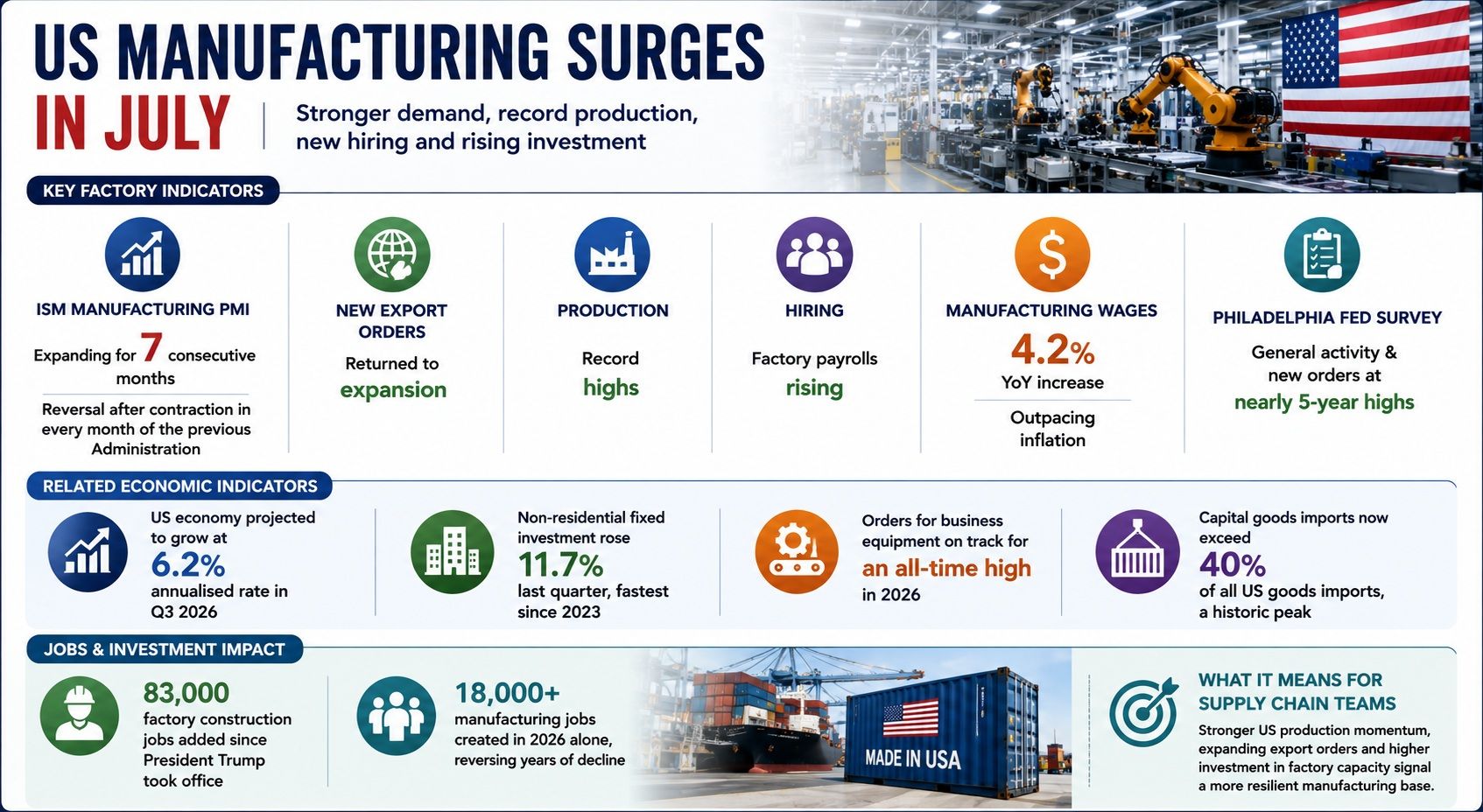
US manufacturing activity surged in July at the strongest rate in more than four years, driven by strong demand, record production and new hiring, the White House said in press release.

The White House noted that the Institute for Supply Management (ISM) Manufacturing PMI showed the sector expanding for the seventh consecutive month. It described this as a reversal after contraction in every month of the previous Administration, outside a temporary post-pandemic bounce. New export orders also moved back into expansion.

Citing Federal Reserve indicators, the White House said manufacturing activity, payrolls and wages were rising nationwide. Manufacturing wages climbed 4.2 per cent year-on-year (YoY), outpacing inflation. Philadelphia Fed survey showed general activity and new orders at nearly five-year highs, added the release.

It mentioned President Trump’s Working Families Tax Cuts had supported six million American jobs, protected $540 billion in worker wages and preserved $1.1 trillion in US economic activity.

The White House also listed several related indicators: the US economy is projected to grow at a 6.2 per cent annualised rate in the third quarter of 2026; non-residential fixed investment rose 11.7 per cent last quarter, the fastest since 2023; orders for business equipment are on track for an all-time high in 2026; and capital goods imports now exceed 40 per cent of all US goods imports, which it called a historic peak as factories retool and expand.

The release further added that 83,000 factory construction jobs had been added since President Trump took office, and more than 18,000 manufacturing jobs had been created in 2026 alone, reversing years of decline. For sourcing and manufacturing teams, the published indicators frame July as a month of stronger US production momentum, expanding export orders and higher investment in factory capacity.

Fibre2Fashion News Desk

Free Training

Source link

Nebraska Manufacturing Growth Slows as Regional Economy Continues to Expand


By Allison Peck

 The Tyson beef plant in Lexington, shown in December, 2026 closure accounted for 3,212 jobs. (Juan Salinas II/Nebraska Examiner) The Tyson beef plant in Lexington, shown in December, 2026 closure accounted for 3,212 jobs. (Juan Salinas II/Nebraska Examiner)
Manufacturing activity across the Mid-America region remained in growth territory for the sixth consecutive month in July, according to the latest Creighton University Mid-America Business Conditions Index. While the regional economy continues to show steady expansion, Nebraska recorded the weakest manufacturing performance among the nine states included in the monthly survey.

The overall Business Conditions Index slipped slightly to 55.7 in July from 56.0 in June. A reading above 50 indicates growth in the manufacturing sector.

Ernie Goss, director of Creighton University’s Economic Forecasting Group, said regional manufacturers continue to perform well despite persistent inflationary pressures.

“Regional manufacturing growth continues on a solid pace but with elevated inflationary pressures at the wholesale level,” Goss said.

Inflation remains a major concern for manufacturers. Although the wholesale price index declined from June, it stayed well above growth-neutral levels, leading researchers to conclude the Federal Reserve is unlikely to lower interest rates over the next several months.

Supply managers also reported continued effects from the war in Iran. Nearly two-thirds said the conflict has led to shipping delays and higher transportation costs, while more than 93 percent reported they have been able to pass those increased costs on to customers.

Employment across the region showed modest improvement, with the manufacturing employment index moving above growth-neutral for only the second time in the past year. About one in four companies reported adding workers during July, while only one in 13 reported layoffs.

Some manufacturers also reported signs that production is returning to the United States.

“It is encouraging to see reshoring taking place,” one supply manager said. “Two major customers have moved operations from Mexico to the U.S.”

In Nebraska, the Business Conditions Index fell to 51.1 in July from 52.5 in June, the lowest reading among the nine-state region. While the state’s manufacturing sector continued to expand slightly, its employment index dropped to 46.6, indicating continued job losses.

According to U.S. Bureau of Labor Statistics data cited in the report, Nebraska has lost approximately 4,700 manufacturing jobs over the past 12 months, a decline of 4.6 percent. The food processing industry accounted for about 4,000 of those lost jobs.

Despite Nebraska’s weaker performance, business leaders across the region remain cautiously optimistic. The six-month Business Confidence Index climbed to 57.7 in July, its highest level since January. However, Goss warned that continued geopolitical tensions, higher oil prices and supply disruptions could weaken confidence in the months ahead.

The Creighton University survey measures manufacturing activity in Arkansas, Iowa, Kansas, Minnesota, Missouri, Nebraska, North Dakota, Oklahoma and South Dakota and is considered a leading indicator of economic conditions across the Mid-America region.

Free Training

Source link

Solid manufacturing and JOLTs in focus – Danske Bank


Danske Research Team underscores strong United States (US) cyclical signals, with the ISM manufacturing index rising to 55.6 in July, beating expectations and June’s reading. New orders, employment and production all improved, while prices moderated. The team also highlights the June JOLTs report, where higher job openings historically point to rising wage pressures, and notes Fed guidance on inflation and potential rate hikes.

Manufacturing strength and labour signals

“In the US, the ISM manufacturing activity index came in at 55.6 in July, above consensus expectations of 54.0 and up from 53.3 in June. The release followed a similar positive uptick in the PMIs.”

“Within the ISM details, new orders and especially employment improved, while the prices index moderated slightly. The production index moved sharply higher to 58.5 from 52.2, marking the strongest reading since November 2021.”

“Furthermore, the order-inventory balance continued to improve, indicating a further need for increasing output. The bottom line is that US cyclical data is still looking very solid.”

“Today’s most interesting data release will be the US June JOLTs report; job openings have shifted moderately higher this year, which has historically predicted rising wage pressures ahead.”

“June trade balance data will also be released in the afternoon and the preliminary reading pointed towards a stable trade deficit from May. The Fed’s Schmid (non-voter, hawk) will be on the wires overnight.”

“The Fed’s Williams said he still expects inflation to cool gradually and reach the 2% target on a sustained basis by 2028, assuming energy prices and tariffs have peaked. He described policy as “well positioned” but stressed that the Fed would hike rates if inflation does not slow as expected.”

(This article was created with the help of an Artificial Intelligence tool and reviewed by an editor. Know more.)

Free Training

Source link

US manufacturing hits 4-year high, with AI buildout a major driver of growth, though price volatility looms: survey


Manufacturing activity in July hit a four-year high, with massive AI infrastructure investment a major driver of growth — even as industry leaders sounded the alarm over price volatility, according to a survey released Monday.

The Institute for Supply Management’s July manufacturing gauge jumped to 55.6 – expanding at its fastest pace since May 2022 and marking its seventh consecutive month of growth, the survey said.

President Trump has called for a return to US manufacturing. REUTERS

Any reading above 50 in the ISM’s monthly survey indicates growth while any measure below 50 signals contraction.

Susan Spence, chair of the ISM Manufacturing Business Survey Committee, said increased certainty around President Trump’s tariff policy and hopes for a more permanent deal to end the war in Iran helped encourage the boost in manufacturing.

“My gut is, it’s not just a one- or two-month trend,” Spence told reporters. “Companies are seeing six or more months of these solid demand factors going in the right direction.”

The survey’s gauge for production jumped to 58.5, its highest level since the end of 2021; the employment measure hit 52.8, rising for the first time in nearly three years; and new orders growth, which signals demand, also increased.

Massive business investments in AI infrastructure helped drive the expansion, along with political pressure to ramp up US manufacturing, according to experts.

Despite the growth in manufacturing, individuals’ responses to the ISM survey were overwhelmingly negative, with many industry leaders calling out price shocks from the Iran war and the chances that the Fed could raise interest rates next month to counter inflation fears.

“Pricing volatility was mentioned in 57% of negative comments, the Iran war 43%, increasing lead times 22% and tariffs 18%,” Spence said.

Among the survey responses, one metals producer remarked that “it makes me yearn for the coronavirus pandemic chaos, which was more manageable than whatever this is that we are in.”

The Institute for Supply Management’s July manufacturing gauge jumped to 55.6. AFP via Getty Images

Some transportation equipment manufacturers lamented increased costs and transit time “for rerouted shipments due to conflicts in the Red Sea, Strait of Hormuz and Suez Canal.”

Others noted that a spike in demand for certain electronics supplies due to the AI race was “challenging on-time fulfillment for our supply chains.”

Jackson Barnes, CEO of Novo, a financial platform for small businesses, said the build-out of massive AI data centers is largely driving manufacturing investments – but that has a lopsided impact on the industry. 

“Look at where the demand is coming from. It’s coming from semiconductors, AI infrastructure and defense. Those are capital-intensive supply chains dominated by large manufacturers,” Barnes told The Post.

Massive business investments in AI infrastructure helped drive the expansion, according to experts. Getty Images

“That gap shows up clearly in what we see. Across the small manufacturers we work with, the median firm’s quarterly revenue is down roughly 12% from two years ago, even though total volume across that same group is up about 14%.”

Tech giants like Meta and Microsoft have announced planned capital expenditures this year of as much as $145 billion and $190 billion, respectively, as they ramp up their AI efforts.

Rising oil prices amid the Iran war have multiplied costs for nearly every manufacturer – and the concern for many in the industry is that the Federal Reserve could soon raise interest rates as a result, which could hit their growth streak.

Overall, it was a strong report, according to experts, as all but one manufacturing industry reported growth in July — including electrical equipment, appliances and components and computer and electronic products. Chemical products marked the only sector that contracted over the month.

“I would say that a lot of the tech investment right now has a lag,” said Amrita Bhasin, co-founder and CEO of Sotira and a manufacturing expert. “There is a lot of money being poured into AI infrastructure and that infrastructure is very resource-intensive.”

“I am optimistic just because we’ve got a lot of factors that are all coinciding at the right time,” Bhasin told The Post.

Free Training

Source link