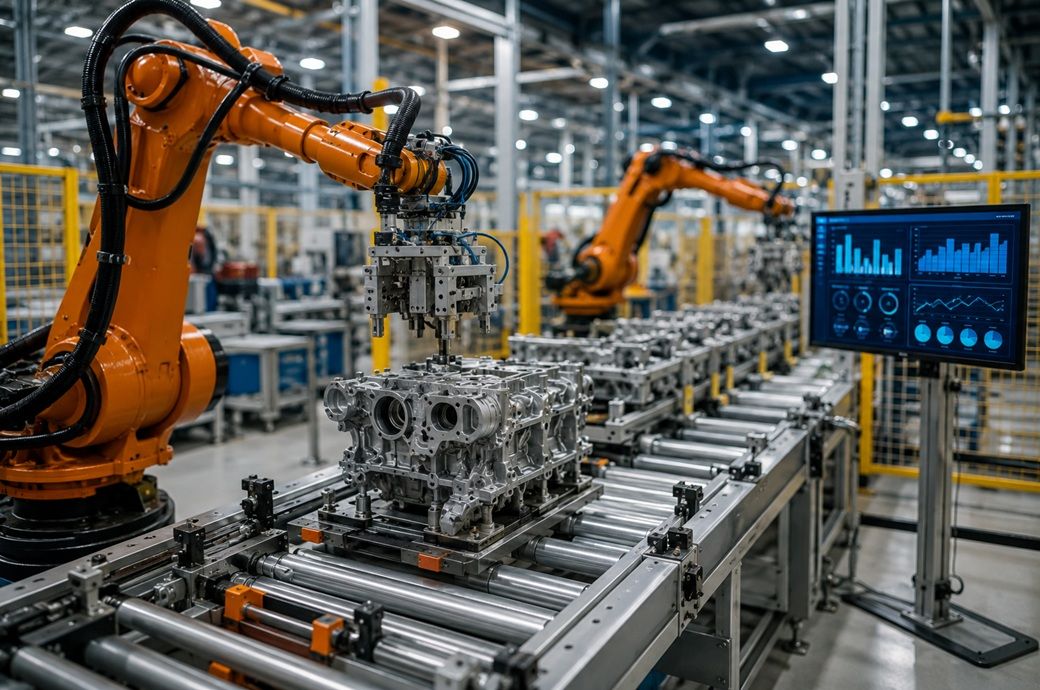
Wazoku and Nterprisers partner to bring world-class innovation expertise to U.S. manufacturing


Simon Hill, CEO, Wazoku

Wazoku’s open innovation network and Nterprisers’ manufacturing connection and intelligence platform give SME manufacturers access to enterprise innovation

Manufacturing is now in an era where visibility and innovation capability determine competitive advantage. Yet innovation services have historically only been available to the biggest manufacturers.”

— Simon Hill, CEO, Wazoku

PROVIDENCE, RI, UNITED STATES, June 11, 2026 /EINPresswire.com/ — Small and medium-sized manufacturers across the United States can now access world-class innovation capabilities through a new partnership between Rhode Island-based manufacturing intelligence startup Nterprisers and global innovation ecosystem provider Wazoku.

Nearly 99% of U.S. manufacturers are small and medium-sized businesses. Many remain effectively invisible and absent from the databases, networks, and innovation programmes that larger enterprises take for granted. The partnership will address this, allowing manufacturers to participate in open innovation challenges, access collaborative problem-solving, and connect with global R&D expertise.

“Manufacturing is now in an era where visibility and innovation capability determine competitive advantage,” said Simon Hill, CEO, Wazoku. “Yet innovation services have historically only been available to companies with dedicated innovation teams and significant budgets. Connecting Nterprisers’ infrastructure to our global problem-solving network means manufacturers who have never had access to open innovation now do. In an increasingly challenging business climate, that’s a major shift.”

Wazoku’s Innocentive is a global marketplace of 1M+ solvers, startups, subject matter experts, and vetted IP. Organisations including NASA, Enel, AstraZeneca and other leading organisations post challenges, source existing solutions and vetted IP, and commission invention on demand where no ready solution exists.

Founded in Rhode Island and launched in 2025, Nterprisers has already made tens of thousands of manufacturers visible and accessible to customers, suppliers, service providers, investors, and other stakeholders through its growing platform. Beginning in Rhode Island and rapidly expanding by region, Nterprisers is creating unprecedented visibility into the U.S. manufacturing base, unlocking new connections, opportunities, and insights across the industrial ecosystem.

“Manufacturing networks are critical to the economy, but the U.S. manufacturing base has been fragmented and hard to find,” said Deepa Krishnamurthy, co-founder and CEO, Nterprisers. “We have already built the visibility and connection layer that makes manufacturers discoverable, but partnering with Wazoku means we can now connect them directly to innovation ecosystems and global expertise that were previously out of reach. Together, we are closing a gap that has held back millions of American manufacturers from fully participating in innovation-driven growth.”

What the Nterprisers-Wazoku partnership delivers

The initial focus of the partnership will be on helping manufacturers and the wider industrial ecosystem to:

● Access open innovation challenges and global problem-solving networks via Innocentive

● Increase supply chain resilience through better capability discovery and sourcing intelligence

● Collaborate on shared industry-wide challenges in areas where pre-competitive cooperation can drive collective gains

● Connect with researchers, startups, and technology partners relevant to their sector

● Accelerate modernisation and digital transformation with access to proven innovation methodologies

The partnership brings capabilities typically available only to large enterprises within reach of smaller manufacturers across the United States. It is especially relevant for manufacturers operating in aerospace, defence, advanced manufacturing, energy, and critical infrastructure sectors, where the need to modernise operations, strengthen supply chains, and accelerate innovation has never been greater.

– ENDS –

About Wazoku

Wazoku’s combination of human and synthetic intelligence enables enterprises, public sector organisations and academic institutions to discover opportunities, access external expertise, manage innovation portfolios, commercialise IP, track value creation or simply outsource for a specific outcome.

About Nterprisers

Nterprisers is building the intelligence and connection infrastructure for the U.S. manufacturing economy, enabling manufacturers to become visible, discoverable, and actionable at scale. By transforming fragmented data into structured manufacturing intelligence, Nterprisers helps OEMs, investors, lenders, policymakers, and manufacturers make faster, better-informed decisions across sourcing, investment, and industrial strategy.

PR Contact:

Paul Allen – Rise PR

+44 (0) 7515 199 487 / paul@risepr.co.uk

P Allen
Rise PR
+44 7515 199487
email us here
Visit us on social media:
LinkedIn
Facebook
YouTube
X

Legal Disclaimer:

EIN Presswire provides this news content “as is” without warranty of any kind. We do not accept any responsibility or liability
for the accuracy, content, images, videos, licenses, completeness, legality, or reliability of the information contained in this
article. If you have any complaints or copyright issues related to this article, kindly contact the author above.

You just read:

News Provided By

June 11, 2026, 10:00 GMT


EIN Presswire’s priority is author transparency. We do our best to weed out false and misleading content. The content above is
the sole responsibility of the author who makes it available. If you have any complaints, kindly contact the author above.


Free Training

Source link

APAA celebrates one year of President Trump’s 50 per cent Section 232 aluminium tariff and historic investments in US manufacturing


Alternate Text

CBAM is applicable to trade volumes starting from 50 metric tonnes. For trade volumes below 50 metric tonnes, CBAM does not apply.

Usage Procedure – How to use the CBAM Calculator Sheet

Enter or update values only in the
INPUT
PARAMETERS section (Highlighted in blue)
,
including
the carbon price, benchmark emissions, CBAM
chargeable
percentage (as per the phase-in year),
and imported quantity.


The system will automatically calculate the
payable
emissions and the total CBAM cost (€)

based on the
inputs provided.


Notes:

• Change any input value to automatically update CBAM cost.

• Formula used: Carbon price × payable emissions × quantity.

• Model aligned with CBAM supplier-side illustrative methodology.

Free Training

Source link

Argonne and the Department of Energy Launch New Partnership to Speed up U.S. Manufacturing Innovation | Press Releases


The U.S. Department of Energy’s (DOE) Argonne National Laboratory has launched a new effort to help American companies develop and scale new products and manufacturing technologies more quickly.

Called the “National Science-at-Scale Collaborative,” the effort is supported by DOE’s Office of Critical Materials and Energy Innovation (CMEI). The collaborative brings together industry, government and the national laboratories to address complex challenges in critical materials and chemical manufacturing in the United States.

Argonne will work with industry partners on projects designed to move promising technologies from research to commercial production faster. Researchers will use advanced computer modeling, artificial intelligence, rapid synthesis tools and pilot-scale manufacturing systems at Argonne’s Materials Engineering Research Facility to help companies test and scale new production processes.

“American manufacturing has an opportunity to lead the next generation of innovation in critical materials and chemical processing,” said Paul Kearns, director of Argonne. “The National Science-at-Scale Collaborative will help connect discovery, engineering and deployment in ways that strengthen U.S. competitiveness and advance our economic security.”

The announcement followed an industry roundtable chaired by CMEI. Leaders from the chemical and critical materials sectors met to discuss manufacturing challenges and opportunities for collaboration.

“To compete globally, the U.S. must bring new technologies into domestic production more quickly,” said Assistant Secretary of Energy Audrey Robertson. “This collaborative will help connect DOE, the national laboratories and private industry to speed up that process.”

The collaborative supports CMEI’s broader mission to strengthen America’s critical minerals supply chains and accelerate next-generation energy technologies.

Industry roundtable participants list:

  • DOE: Critical Minerals and Energy Innovation Office.
  • National Laboratory System: Argonne National Laboratory.
  • Manufacturers: Aclara, Albemarle, ATALCO, BASF North America, Chemours, Dow, Entegris, Exxon Mobil, Orbia and Standard Lithium.

Media gallery

Free Training

Source link

Amazon’s multibillion-dollar deal with Corning creates 1,000 jobs in North Carolina


Today, Amazon announced a multibillion-dollar agreement with Corning Incorporated, a leading manufacturer of advanced glass and fiber optic technology, to supply the optical fiber, cable, and connectivity solutions that power Amazon’s expanding data center infrastructure across the United States. The investment will create 1,000 new, highly skilled jobs at Corning’s manufacturing facilities across North Carolina, and support hundreds of additional construction jobs to expand Corning’s facilities.

Free Training

Source link

Mexico, The United States Saw Numerous Manufacturing Job Losses


Mexico’s Ministry of Economy reports that Mexico and the United States lost thousands of manufacturing jobs during the past year. While the historical discourse regarding nearshoring in Mexico has focused primarily on the volume of incoming investment the nation could secure, the narrative is shifting toward a more critical inquiry: the country’s capacity to maintain long-term employment levels.

Recent data from Mexico’s Ministry of Economy reveals that Mexico and the United States lost more than 213,000 manufacturing jobs between February 2025 and February 2026, with the largest declines occurring in highly integrated sectors such as transportation equipment, plastics, rubber and machinery. The losses were concentrated in industries most exposed to recent tariff measures and trade uncertainty, highlighting the degree to which both countries now operate as a single manufacturing ecosystem. 

The impact was particularly severe in transportation equipment manufacturing, which lost nearly 65,000 jobs across Mexico and the United States in a single year, according to data cited by Mexico’s Ministry of Economy. The sector’s losses illustrate how trade disruptions increasingly affect not only production flows but also workforce stability across North America’s industrial ecosystem. 

The narrative often centers on tariffs, the underlying reality points to a fundamental shift redefining the competitiveness and labor landscape of Mexico. 

From Talent Availability to Workforce Resilience 

The first phase of nearshoring was defined by the relocation of production. The second focused on securing the talent needed to support industrial expansion. The next phase will be defined by workforce resilience: the ability to preserve critical skills, maintain productivity and adapt labor capacity during periods of economic, geopolitical, and regulatory disruption.

Mexico’s manufacturing success is increasingly tied to regional dynamics beyond its control. As the Ministry of Economy argued in its submission to US trade authorities, employment declines occurred almost simultaneously on both sides of the border, reflecting the deep integration of North American supply chains. Industries such as automotive, aerospace, electronics, and advanced manufacturing no longer operate as isolated national sectors but as interconnected production networks.


Historically, Mexico competed on labor costs. More recently, it competed on geographic proximity and access to the US market. Going forward, competitive advantage will increasingly depend on the resilience of its workforce ecosystem.

This shift is part of a broader global dialogue. The OECD highlights that geopolitical friction, regulatory changes, and economic instability are forcing governments and corporations to reconsider their supply chain strategies. Consequently, the focus is moving away from simple efficiency and toward resilience, prioritizing the capacity to withstand shocks while maintaining long-term productivity and expansion.

Within the Mexican landscape, the development of a resilient workforce is becoming the essential human capital equivalent to achieving supply chain security.

The challenge is particularly relevant as the country seeks to convert nearshoring momentum into sustainable industrial growth. Mexico continues to attract manufacturing investment, yet workforce vulnerabilities are becoming more visible. Talent shortages in engineering, digital technologies, and advanced manufacturing are already constraining industrial expansion and limiting the country’s ability to fully capitalize on nearshoring opportunities.


Mexico has successfully positioned itself as one of North America’s most attractive manufacturing destinations. However, attracting investment is not the same as protecting workforce capacity. If skilled workers exit key sectors during periods of uncertainty, rebuilding those capabilities can take years. The loss is not merely employment; it is accumulated knowledge, technical expertise, and future productivity. 

Workforce Stability as a Competitive Asset 

As a result, workforce strategy is becoming inseparable from business strategy. The core of corporate and national strategy is increasingly defined by workforce stability. For CEOs, the focus has shifted from the continuity of nearshoring to the preservation of access to essential talent amid periods of instability. Simultaneously, CHROs are finding that effective workforce planning now requires a scope beyond simple recruitment, prioritizing reskilling, internal mobility, and the protection of organizational capabilities to navigate volatility.

From an investment perspective, the resilience of the labor market is becoming a primary metric for evaluating long-term operational consistency. Geographies that demonstrate the ability to maintain talent ecosystems throughout various economic cycles will likely command greater interest for capital allocation. Policymakers face a parallel imperative; while industrial policies can bring physical facilities, maintaining a competitive edge necessitates deep, ongoing investments in technical education, workforce development, and retention strategies.

Looking ahead, the ultimate legacy of the nearshoring era in Mexico may not be measured by investment totals, but by the successful cultivation of a workforce capable of enduring global uncertainty. The future of Mexico’s competitiveness depends not just on manufacturing locations, but on the capacity to safeguard, modify, and enhance the human capital that drives the industrial sector.

Free Training

Source link

Amazon announces agreement with Corning to boost U.S. fibre optics manufacturing — TradingView News


  • The multibillion-dollar deal will also support hundreds of construction jobs to expand Corning’s North Carolina facilities and create a new workforce development program.
  • Amazon’s multiyear, multibillion-dollar agreement with Corning will produce optical fibre for data centres and strengthen the U.S. supply chain.
  • The deal creates 1,000 jobs at Corning’s North Carolina facilities, hundreds of construction jobs, and a workforce training program.
  • Amazon has invested more than $20 billion in North Carolina, creating over 26,000 jobs across the state.

Dubai, United Arab Emirates – Today, Amazon announced a multibillion-dollar agreement with Corning Incorporated, a leading manufacturer of advanced glass and fibre optic technology, to supply the optical fibre, cable, and connectivity solutions that power Amazon’s expanding data centre infrastructure across the United States. The investment will create 1,000 new, highly skilled jobs at Corning’s manufacturing facilities across North Carolina, and support hundreds of additional construction jobs to expand Corning’s facilities.

Through the agreement, Amazon will work with Corning on a new program that will expand its Fibre Optic Technician Training Program with Catawba Valley Community College to train students for careers in fibre optic manufacturing and related technical roles. The program provides hands-on education and courses that will increase the talent pool and offer pathways to high-paying technical roles. The efforts will help strengthen the domestic supply chain and U.S. manufacturing base while serving the region and state to help expand residential and commercial fibre densification efforts.

“Amazon’s investments in North Carolina have created more than 26,000 jobs across the state. This multibillion-dollar agreement with Corning continues that commitment, channeling investment into American manufacturing and creating 1,000 new jobs at their facilities near our data centres,” said Matt Garman, CEO of AWS. “We’re also partnering to train North Carolinians for highly skilled roles in fibre optics and fusion splicing. These long-term investments create long-term careers and real opportunity in the communities where we operate.”

Investing in North Carolina

This agreement with Corning is in addition to Amazon’s plans, announced last year, to invest $10 billion in North Carolina to expand cloud computing infrastructure. It builds on the more than $20 billion Amazon has invested in North Carolina since 2010, creating over 26,000 jobs spanning logistics, cloud infrastructure, and renewable energy across the Tar Heel State.

“Every day, North Carolina is proving that American manufacturing and cutting-edge technology go hand in hand. This multibillion-dollar agreement, between Amazon and Corning, will create 1,000 family-sustaining jobs for hardworking North Carolinians while also strengthening the critical infrastructure of the U.S. supply chain. This partnership further proves that North Carolina is the number one state in the country for American businesses to invest, build, and grow. As a leading voice in the Senate for workforce development and American manufacturing, I am proud that we are continuing to capitalise on that momentum in North Carolina,” said U.S. Senator Ted Budd.

Powering data centres, creating jobs, and fueling economic growth

Amazon’s data centres power the services millions of people and businesses rely on every day, from hospitals and emergency services to streaming entertainment and AI innovation. Corning’s fibre optics are a critical part of that infrastructure, and together, these investments help fuel the U.S. economic engine.

“This agreement with Amazon represents a significant milestone for Corning and for American manufacturing,” said Wendell Weeks – chairman, CEO, and president of Corning. “For 175 years, Corning has pioneered the technologies that connect people and transform industries. Amazon’s investment will help us expand production, create 1,000 new advanced manufacturing jobs at our facilities, and lead the way toward building a resilient U.S. manufacturing base.”

Amazon’s long-term commitment to North Carolina goes beyond direct investments and jobs created in the state. Through workforce development, Career Choice, and upskilling programs, Amazon has already provided practical training for nearly 7,000 people in North Carolina, helping to open new pathways for higher-paying jobs and fulfilling careers.

In the last decade, Amazon has contributed more than $72 million to charities and organisations supporting local needs across North Carolina, with $10 million provided in 2025 alone to 26 local community partners. This includes contributions like $1.5 million to enhance public safety services for southeastern Hamlet and surrounding Richmond County communities by funding a new fire substation that is expected to lower emergency response times and homeowner insurance premiums.

Learn more about Amazon’s community investments.

MEDIA Contacts

Corning

Radina Ralcheva

EMEA Communications Manager, Corning

Email: ralchevar@corning.com

Andrew Murgatroyd

Vice President, Corporate, Weber Shandwick

Email: amurgatroyd@webershandwick.com​​​​​

About Corning Incorporated

Corning (www.corning.com) is one of the world’s leading innovators in materials science, with a 170-year track record of life-changing inventions. Corning applies its unparalleled expertise in glass science, ceramic science, and optical physics along with its deep manufacturing and engineering capabilities to develop category-defining products that transform industries and enhance people’s lives. Corning succeeds through sustained investment in RD&E, a unique combination of material and process innovation, and deep, trust-based relationships with customers who are global leaders in their industries. Corning’s capabilities are versatile and synergistic, which allows the company to evolve to meet changing market needs, while also helping its customers capture new opportunities in dynamic industries. Today, Corning’s markets include optical communications, mobile consumer electronics, display, automotive, solar, semiconductors, and life sciences.

Corning Forward-Looking Statements

The statements contained in this release and related comments by management that are not historical facts or information and contain words such as “will,” “believe,” “anticipate,” “expect,” “intend,” “plan,” “seek,” “see,” “would,” “target,” “estimate,” “forecast” or similar expressions are forward-looking statements. These forward-looking statements are made pursuant to the safe harbor provisions of the Private Securities Litigation Reform Act of 1995 and include estimates and assumptions related to economic, competitive and legislative developments. Such statements relate to future events that by their nature address matters that are, to different degrees, uncertain. These forward-looking statements relate to, among other things, the Company’s Springboard plan, projected financial and operating performance, anticipated sales opportunities, long-term growth strategy, expected capital deployment, innovation and commercialization plans, and anticipated impacts of customer agreements.  These forward-looking statements also relate to the expected benefits, scope, and timing of the Company’s strategic partnership with NVIDIA, including planned expansions of U.S.-based optical connectivity and fiber manufacturing capacity, the construction and operation of new manufacturing facilities, anticipated job creation, and projected customer demand driven by AI infrastructure deployments.

Although the company believes that these forward-looking statements are based upon reasonable assumptions regarding, among other things, current estimates and forecasts, general economic conditions, its knowledge of its business and key performance indicators that impact the company, there can be no assurance that these forward-looking statements will prove to be accurate, as actual results and future events could differ materially from those anticipated in such statements. The company undertakes no obligation to update forward-looking statements if circumstances or management’s estimates or opinions should change except as required by applicable securities laws.

Some of the risks, uncertainties and other factors that could cause actual results to differ materially from those expressed in or implied by the forward-looking statements include, but are not limited to: global economic trends, competition and geopolitical risks, or an escalation of sanctions, tariffs or other trade tensions between the U.S. and other countries, and related impacts on our businesses’ global supply chains and strategies; changes in macroeconomic and market conditions and market volatility, including developments and volatility arising from health crisis events, inflation, interest rates, the value of securities and other financial assets, precious metals, oil, natural gas, raw materials and other commodity prices and exchange rates (particularly between the U.S. dollar and the Japanese yen, South Korean won, Chinese yuan, New Taiwan dollar, Mexican peso and euro), decreases or sudden increases of consumer demand, and the impact of such changes and volatility on our financial position and businesses; the availability of or adverse changes relating to government grants, tax credits or other government incentives; the duration and severity of health crisis events, such as an epidemic or pandemic, and its impact across our businesses on demand, personnel, operations, our global supply chains and stock price; possible disruption in commercial activities or our supply chain due to terrorist activity, cyber-attack, armed conflict, political or financial instability, natural disasters, international trade disputes or major health concerns; loss of intellectual property due to theft, cyber-attack, or disruption to our information technology infrastructure; ability to enforce patents and protect intellectual property and trade secrets; disruption to Corning’s, our suppliers’ and manufacturers’ supply chain, equipment, facilities, IT systems or operations; product demand and industry capacity; competitive products and pricing; availability and costs of critical components, materials, equipment, natural resources and utilities; new product development and commercialization; our solar business development, including manufacturing facility construction, ramp, and operations, and the achievement of solar revenue and profitability targets; order activity and demand from major customers; the amount and timing of our cash flows and earnings and other conditions, which may affect our ability to pay our quarterly dividend at the planned level or to repurchase shares at planned levels; the amount and timing of any future dividends; the effects of acquisitions, dispositions and other similar transactions; the effect of regulatory and legal developments; ability to pace capital spending to anticipated levels of customer demand; our ability to increase margins through implementation of operational changes, pricing actions and cost reduction measures; rate of technology change; adverse litigation; product and component performance issues; retention of key personnel; customer ability to maintain profitable operations and obtain financing to fund ongoing operations and manufacturing expansions and pay receivables when due; loss of significant customers; changes in tax laws, regulations and international tax standards; the impacts of audits by taxing authorities; the potential impact of legislation, government regulations, and other government action and investigations; and other risks detailed in Corning’s SEC filings.

For a complete listing of risks and other factors, please reference the risk factors and forward-looking statements described in our annual reports on Form 10-K and quarterly reports on Form 10-Q

About NVIDIA

NVIDIA (www.nvidia.com) is the world leader in AI and accelerated computing.

NVIDIA Forward-Looking Statements

Certain statements in this press release including, but not limited to, statements as to: the benefits, impact, performance, and availability of NVIDIA’s products, services, and technologies; expectations with respect to NVIDIA’s third party arrangements, including with its collaborators and partners; expectations with respect to technology developments; expectations with respect to AI and related industries; AI driving the largest infrastructure buildout—and a once-in-a-generation opportunity to reinvigorate American manufacturing and supply chains; together with Corning, NVIDIA inventing the future of computing with advanced optical technologies—building the foundation for AI infrastructure where intelligence moves at the speed of light while advancing the proud tradition of Made in America; and other statements that are not historical facts are forward-looking statements within the meaning of Section 27A of the Securities Act of 1933, as amended, and Section 21E of the Securities Exchange Act of 1934, as amended, which are subject to the “safe harbor” created by those sections based on management’s beliefs and assumptions and on information currently available to management and are subject to risks and uncertainties that could cause results to be materially different than expectations. Important factors that could cause actual results to differ materially include: global economic and political conditions; NVIDIA’s reliance on third parties to manufacture, assemble, package and test NVIDIA’s products; the impact of technological development and competition; development of new products and technologies or enhancements to NVIDIA’s existing product and technologies; market acceptance of NVIDIA’s products or NVIDIA’s partners’ products; design, manufacturing or software defects; changes in consumer preferences or demands; changes in industry standards and interfaces; unexpected loss of performance of NVIDIA’s products or technologies when integrated into systems; NVIDIA’s ability to realize the potential benefits of business investments or acquisitions; and changes in applicable laws and regulations, as well as other factors detailed from time to time in the most recent reports NVIDIA files with the Securities and Exchange Commission, or SEC, including, but not limited to, its annual report on Form 10-K and quarterly reports on Form 10-Q. Copies of reports filed with the SEC are posted on the company’s website and are available from NVIDIA without charge. These forward-looking statements are not guarantees of future performance and speak only as of the date hereof, and, except as required by law, NVIDIA disclaims any obligation to update these forward-looking statements to reflect future events or circumstances.

© 2026 NVIDIA Corporation. All rights reserved. NVIDIA and the NVIDIA logo are trademarks and/or registered trademarks of NVIDIA Corporation in the U.S. and/or other countries. Other company and product names may be trademarks of the respective companies with which they are associated. Features, pricing, availability and specifications are subject to change without notice.

Send us your press releases to pressrelease.zawya@lseg.com

Disclaimer: The contents of this press release was provided from an external third party provider. This website is not responsible for, and does not control, such external content. This content is provided on an “as is” and “as available” basis and has not been edited in any way. Neither this website nor our affiliates guarantee the accuracy of or endorse the views or opinions expressed in this press release.

The press release is provided for informational purposes only. The content does not provide tax, legal or investment advice or opinion regarding the suitability, value or profitability of any particular security, portfolio or investment strategy. Neither this website nor our affiliates shall be liable for any errors or inaccuracies in the content, or for any actions taken by you in reliance thereon. You expressly agree that your use of the information within this article is at your sole risk.

To the fullest extent permitted by applicable law, this website, its parent company, its subsidiaries, its affiliates and the respective shareholders, directors, officers, employees, agents, advertisers, content providers and licensors will not be liable (jointly or severally) to you for any direct, indirect, consequential, special, incidental, punitive or exemplary damages, including without limitation, lost profits, lost savings and lost revenues, whether in negligence, tort, contract or any other theory of liability, even if the parties have been advised of the possibility or could have foreseen any such damages.

Free Training

Source link

Zinke-Led Military Sales Bill Passes House, Bolstering U.S. Manufacturing and Global Alliances


Washington, D.C. – Today, the U.S. House of Representatives passed Congressman Ryan Zinke’s Allied Defense Sales Act, legislation aimed at strengthening American manufacturing by making it easier for allied nations to jointly purchase U.S.-made defense equipment while deepening strategic partnerships abroad. The bill is a continuation of Zinke’s work as Chairman of the Foreign Military Sales Task Force, where he has worked alongside the Department of War to modernize military sales, securing huge wins through legislation and executive order.

“America builds the best defense equipment in the world, and our allies need it to safeguard their – and our – people and interests,” said Zinke. “This bill helps cut through the bureaucracy so our partners can work together to buy American-made systems faster and more efficiently. That means stronger and more secure alliances, and more manufacturing jobs here at home.”

“Strengthening our partnerships abroad is critical to advancing our national security interests and maintaining a competitive edge in an increasingly complex and dangerous world,” said Representative Ami Bera, M.D. “I’m pleased the House has passed our bipartisan legislation to help trusted allies and partners coordinate purchases of U.S. defense equipment, improve interoperability, and deliver critical capabilities more efficiently.”

The bill is modeled after successful multinational cooperation efforts and focuses on helping groups of allied countries with similar defense needs coordinate joint purchases. By aligning demand across multiple partners, the legislation would help stabilize production and accelerate delivery timelines for American manufacturers.

Under the current system, many smaller countries face steep barriers when trying to purchase U.S. equipment due to the scale and complexity of the process. These hurdles can delay orders and create uncertainty for American manufacturers. The Allied Defense Sales Act addresses these challenges by creating a more flexible and coordinated approach for enabling multinational procurement, especially for partners in regions like Eastern Europe, Southeast Asia, and the Caribbean, further helping generate more consistent demand for U.S.-made systems.

The legislation directs the Department of War to assess interest among allied nations, identify potential lead coordinator countries for joint purchases, recommend ways to streamline approvals and licensing, and increase the exportability of defense articles and services. It also explores ways to expand access to financing tools and accelerate sales outside traditional programs, ensuring American defense companies can respond more quickly to allied demand.

Read the full text of the bill here.

###

Free Training

Source link

If Global Manufacturing Weakens, Here’s What Happens to This Copper ETF


If Global Manufacturing Weakens, Here’s What Happens to This Copper ETF

© bigjom jom / Shutterstock.com

The United States Copper Index Fund (NYSEARCA:CPER) has quietly become one of the better-performing commodity vehicles of the cycle, trading near $39 after a 33% run over the past year and an 8% jump in just the last month. With roughly $456 million in net assets, CPER is the largest pure-play copper futures ETF available to U.S. investors, and its recent move tracks a copper market that printed a 12-month high of $12,986 per metric ton in January before easing to $12,528 in March. The question for CPER holders now is whether the next leg is a continuation higher or a stall driven by softening industrial demand.

The Macro Signal That Matters Most: Global Manufacturing PMI

Copper is the textbook industrial barometer, and the single most important macro variable for CPER over the next 12 months is the trajectory of global manufacturing activity, best tracked through the monthly J.P. Morgan Global Manufacturing PMI (released the first business day of each month) and China’s Caixin Manufacturing PMI. A reading above 50 signals expansion; sustained readings below 50 historically coincide with copper drawdowns of 10% to 20%.

The early warning lights are already blinking. U.S. manufacturing value-added grew just 0.3% in Q4 2025 after a 3.2% Q3, construction stalled at 0.0% growth, and WTI crude has tumbled from roughly $112 in mid-May to under $98 a week later, a roughly 13% weekly decline that typically signals fading industrial demand expectations. For CPER, the threshold to watch is a Global Manufacturing PMI print below 49 for two consecutive months. That has historically been the level at which copper inventories on the LME and SHFE start building, and refined-copper premiums compress. Check it monthly. If China’s print stays at or above 50 while the U.S. weakens, copper’s bid likely holds. If both turn down together, the recent 3.5% monthly pullback in spot copper could extend.

The Fund-Specific Issue: Roll Yield in a Flattening Futures Curve

Because CPER holds COMEX copper futures rather than physical metal, its return diverges from spot whenever the futures curve shifts. The fund tracks the SummerHaven Copper Index, which dynamically selects contracts to minimize contango drag, but it cannot eliminate it. When near-dated futures trade above further-dated contracts (backwardation), CPER captures a positive roll yield each month. When the curve flips to contango, every monthly roll bleeds NAV even if spot copper is flat.

This is where the 1.06% expense ratio matters: it is roughly triple what a broad equity ETF charges, and it stacks on top of any negative roll. Investors should monitor the COMEX copper futures curve weekly using CME Group’s settlement data, specifically the spread between the front-month and the contract six months out. A persistent move into contango of more than 1% annualized would meaningfully erode CPER’s tracking of spot, and that often coincides with surging warehouse inventories. For investors who want copper exposure without futures mechanics, mining-equity vehicles like the Global X Copper Miners ETF (NYSEARCA:COPX) provide a different beta, levered to producer margins rather than the spot price itself.

What To Watch From Here

If the next two Global Manufacturing PMI prints hold above 50 and the COMEX copper curve stays in backwardation, CPER’s run has room to extend toward the January spot high. If PMIs slip below 49 and the curve flips into contango, the combination of softer demand and negative roll yield is the setup that historically punishes futures-based copper funds the hardest.

Free Training

Source link

Buy These 5 Stocks as U.S. Manufacturing Activities Rebound in 2026


The U.S. manufacturing sector has struggled over the past three years but appears to be making a solid rebound in 2026. ISM Manufacturing PMI (purchasing managers’ index) expanded in May for the fifth straight month.

The index for May came in at 54%, higher than April’s metric of 52.7% and above the Zacks Consensus Estimate of 53.3%. Any reading above 50% indicates expansion of manufacturing activities.

The Zacks-defined Manufacturing – General Industrial industry is currently in the top 35% of the Zacks Industry Rank. Since Manufacturing – General Industrial is ranked in the top half of the Zacks Ranked Industries, we expect it to outperform the market over the next three to six months.

Given the positive sentiment, it would be ideal to invest in five stocks from the manufacturing industry with a favorable Zacks Rank and double-digit returns year to date. These are: RBC Bearings Inc. RBC, Helios Technologies Inc. HLIO, Luxfer Holdings plc LXFR, Tennant Co. TNC and Graham Corp. GHM.

The chart below shows the price performance of our five picks year to date.

Zacks Investment Research Zacks Investment Research

Image Source: Zacks Investment Research

RBC Bearings Inc.

Zacks Rank #2 RBC Bearings is benefiting from strength in its Aerospace/Defense unit. Strength in the commercial aerospace market, driven by strong growth in orders from the aftermarket verticals, bodes well for the segment.

An increase in demand for RBC’s bearings and engineered component products in the defense market is expected to be beneficial. Solid momentum in the Industrial segment, driven by stable demand for its highly engineered bearings and precision components in food & beverage, aggregate & cement and warehousing end markets, also bodes well for RBC. Solid shareholder-friendly policies raise the stock’s attractiveness.

RBC Bearings has an expected revenue and earnings growth rate of 13.6% and 14.2%, respectively, for the current year (ending March 2027). The Zacks Consensus Estimate for the current year’s earnings has improved 0.5% in the last 60 days.

Helios Technologies Inc.

Zacks Rank #1 Helios Technologies is benefiting from sustained order momentum, expanding market reach and improving profitability. HLIO has delivered double-digit order growth for more than a year, with backlog also rising. Growth across both Hydraulics and Electronics segments is driven by infrastructure-related demand, OEM strength and recovery in select end markets.

New product launches are broadening HLIO’s addressable markets, including newer applications such as data center thermal management. At the same time, margin recovery is gaining traction through volume leverage and operational efficiencies. HLIO’s solid cash generation and lower leverage provide flexibility to invest, pursue selective acquisitions and enhance shareholder returns.

Story Continues

Helios Technologies has an expected revenue and earnings growth rate of 2.9% and 12.9%, respectively, for the current year. The Zacks Consensus Estimate for the current year’s earnings has improved 4.7% in the last 30 days.

Luxfer Holdings plc

Luxfer Holdings is a materials technology company specializing in the design, manufacture and supply of high-performance materials, components and gas cylinders. LXFR had two divisions, Elektron and Gas Cylinders. Currently, Luxfer Holdings sports a Zacks Rank #1 (Strong Buy). You can see the complete list of today’s Zacks #1 Rank stocks here.

The Elektron division focuses on specialty materials based on magnesium, zirconium and rare earths. The Gas Cylinders division manufactures products made from aluminum, composites and other metals using technically advanced processes.

LXFR also offers recycling services and magnesium powders throughout global networks. LXFR operates manufacturing plants in various countries, which include the United Kingdom, the United States, France, the Czech Republic, Canada and China.

Luxfer Holdings has an expected revenue and earnings growth rate of -6.1% and 8.1%, respectively, for the current year. The Zacks Consensus Estimate for the current year’s earnings has improved 7.1% in the last 30 days.

Tennant Co.

Zacks Rank #1 Tennant is a world leader in designing, manufacturing and marketing solutions that empower customers to achieve quality cleaning performance, significantly reduce their environmental impact and help create a cleaner, safer, healthier world.

TNC’s products include equipment for maintaining surfaces in industrial, commercial and outdoor environments, detergent-free and other sustainable cleaning technologies, and coatings for protecting, repairing and upgrading surfaces.

TNC’s global field service network is the most extensive in the industry. Tennant has manufacturing operations in Minneapolis, MN, Holland, MI, Louisville, KY, Chicago, IL, Uden, The Netherlands, Sou Paulo, Brazil, and Shanghai, China. TNC sells products directly in 15 countries and through distributors in more than 80 countries.

Tennant has an expected revenue and earnings growth rate of 5.4% and -6.6%, respectively, for the current year. The Zacks Consensus Estimate for the current year’s earnings has improved 5.8% in the last 30 days.

Graham Corp.

Zacks Rank #2 Graham designs and builds vacuum and heat transfer equipment for process industries and energy markets worldwide. GHM’s products include steam jet ejector vacuum systems and liquid ring vacuum pumps, surface condensers, Heliflows, water heaters, and various types of heat exchangers. GHM markets to chemical, petrochemical, petroleum refining, and electric power generating industries, including cogeneration and geothermal plants.

Graham has an expected revenue and earnings growth rate of 17.4% and 47.4%, respectively, for the current year (ending March 2027). The Zacks Consensus Estimate for the current year’s earnings has improved 3% in the last 30 days.

Want the latest recommendations from Zacks Investment Research? Today, you can download 7 Best Stocks for the Next 30 Days. Click to get this free report

RBC Bearings Incorporated (RBC) : Free Stock Analysis Report

Graham Corporation (GHM) : Free Stock Analysis Report

Luxfer Holdings PLC (LXFR) : Free Stock Analysis Report

Tennant Company (TNC) : Free Stock Analysis Report

Helios Technologies, Inc (HLIO) : Free Stock Analysis Report

This article originally published on Zacks Investment Research (zacks.com).

Zacks Investment Research

Free Training

Source link

Access Denied


Access Denied

You don’t have permission to access “http://www.moneycontrol.com/world/trump-promised-a-us-manufacturing-boom-why-the-revival-has-yet-to-materialise-article-13942264.html” on this server.

Reference #18.e5ab3717.1780871572.3c5cfe38

https://errors.edgesuite.net/18.e5ab3717.1780871572.3c5cfe38

Free Training

Source link