ES Foundry Joins MIT Manufacturing Initiative With $1.5 Million Commitment – News and Statistics


Sep 21, 2026

ES Foundry, a U.S. business focused on bringing crystalline solar cell production back onshore, said on Sept. 21, 2026 that it has become a member of the Massachusetts Institute of Technology‘s Initiative for New Manufacturing. The company is putting $1.5 million into the initiative across three years as part of a fresh partnership aimed at bolstering American manufacturing.

According to the company, the tie-up will speed up its exploration of artificial intelligence-driven efficiency gains and sophisticated operating models, with the goal of keeping U.S. manufacturing globally competitive.

The move lands at a pivotal moment for ES Foundry’s expansion. In July, the company finished a 2 gigawatt enlargement of its Greenwood, South Carolina, plant, lifting total yearly solar cell production capacity to 3 gigawatts and backing over 400 advanced manufacturing positions.

Now that this capacity exists, ES Foundry said it is shifting attention past sheer manufacturing scale toward the technologies, workforce and operating methods that will decide whether American solar manufacturing can stay competitive over the long haul.

Alex Zhu, the company’s chief executive, said ES Foundry has invested substantially in restoring solar cell manufacturing to the United States, and that its pledge to the MIT initiative amounts to an investment in fortifying that manufacturing. Zhu noted that running at commercial scale daily provides a grounded perspective on where technology, automation and workforce development can have an impact, and that partnering with MIT offers a chance to investigate solutions to manufacturing difficulties and to devise fresh ideas and approaches.

Per the company, solar cells continue to be a crucial missing piece in the domestic photovoltaic supply chain. Although U.S. module manufacturing capacity has grown considerably, a large portion of the industry still relies on imported cells. ES Foundry said it was created to help alter that situation by making high-performance crystalline solar cells within the United States.

The Greenwood site turns out bifacial PERC solar cells for utility-scale, commercial and community solar uses. The finished expansion provides ES Foundry with a 3 gigawatt operating base where enhancements in production technology, automation, process control, workforce skills and factory efficiency can be deployed at commercial scale.

The $1.5 million pledge will underpin ES Foundry’s participation with the initiative and its wider efforts to tackle difficulties confronting modern manufacturers. Via the initiative, ES Foundry will collaborate with MIT faculty, researchers and students, along with manufacturers from other sectors, on subjects such as artificial intelligence on the factory floor, automated systems, cybersecurity, digital twins, continuous innovation and workforce development.

The partnership is intended to flow in both directions, with ES Foundry able to tap into fresh thinking from MIT while contributing the know-how of a manufacturer that is actively running and growing a highly technical production process in the United States.

Lionel Moss, general manager of operations at ES Foundry, said manufacturing difficulties become quite tangible when a factory operates around the clock. Moss said the company continually looks at ways to boost yield, productivity, equipment performance, processes and workforce capabilities, and that it has plenty to gain from the work at MIT while also offering Greenwood-derived experiences. He called that interchange the source of the collaboration’s value.

The Initiative for New Manufacturing unites manufacturers from various industries with MIT researchers, educators and students to address common production challenges. Since its 2025 launch, the initiative has broadened its efforts across manufacturing research, industry engagement, workforce development and entrepreneurship, with programs exploring areas from factory-floor artificial intelligence and automation to cybersecurity, digital twins and novel methods for cultivating manufacturing talent.

John Hart, a professor and head of the MIT Department of Mechanical Engineering who is faculty co-director of the initiative, said ES Foundry contributes a valuable perspective to the initiative and welcomed the company into the community.

ES Foundry said its participation in the initiative extends a wider push to build a lasting domestic solar cell manufacturing foundation. Having production capacity in the United States is a key initial step, and the company’s current focus is making sure U.S. solar cell manufacturing keeps advancing, innovating and competing as the industry expands.

Headquartered in South Carolina, ES Foundry portrays itself as speeding up the U.S. solar industry by onshoring crystalline solar cell manufacturing. Its Greenwood plant makes cells designed to satisfy the requirements of U.S. panel manufacturers and the supply chain needs of developers and engineering, procurement and construction firms. The company said it was purpose-built for Foreign Entity of Concern compliance and runs with entirely non-FEOC ownership, leadership and financing, guaranteeing transparent supply chains and verified eligibility for incentives, including the domestic content bonus.

Interactive table based on the Store Companies dataset for this report.

Sort: Rank
Sort: Company A-Z
Sort: Headquarters A-Z

#
Company
Headquarters
Focus
Scale
Note

1
First Solar
Tempe, Arizona
Solar cells (thin-film)
Large
Major US solar manufacturer

2
SunPower Corporation
San Jose, California
High-efficiency solar cells
Large
Residential & commercial solar

3
Cree LED (SMART Global Holdings)
Durham, North Carolina
LED components & lighting
Large
Former Cree LED business

4
Maxeon Solar Technologies
San Jose, California
Solar cells & panels
Large
Spin-off from SunPower

5
Luminus Devices
Fremont, California
LED components
Medium
Specialty & high-power LEDs

6
Bridgelux
Fremont, California
LED arrays & lighting
Medium
LED technology & solutions

7
Sundiode
Princeton, New Jersey
Semiconductor lasers & VCSELs
Small
Advanced photonics

8
Solaria
Fremont, California
High-efficiency solar cells
Medium
Residential solar panels

9
MiaSolé Hi-Tech Corp
Santa Clara, California
Flexible thin-film solar
Medium
CIGS solar technology

10
Heliene
Mountain Iron, Minnesota
Solar cells & modules
Medium
US & Canadian manufacturing

11
Silfab Solar
Bellingham, Washington
Solar cells & modules
Medium
North American manufacturing

12
Mission Solar Energy
San Antonio, Texas
Solar cells & modules
Medium
US-made solar panels

13
Qcells (Hanwha Q CELLS USA)
Irvine, California
Solar cell & panel manufacturing
Large
US operations of Korean parent

14
Aledia
Fremont, California
MicroLED technology
Small
3D architecture LEDs

15
Soraa
Fremont, California
GaN on GaN LEDs
Medium
High-quality lighting

16
Lumiode
New York, New York
Microdisplay LEDs
Small
High-brightness microdisplays

17
Glo
Nashville, Tennessee
UV-C LED technology
Small
Disinfection & purification

18
Suniva
Norcross, Georgia
Solar cells & modules
Medium
US crystalline silicon solar

19
Swift Solar
San Carlos, California
Perovskite solar cells
Small
Next-generation tandem cells

20
Tandem PV
San Jose, California
Perovskite-silicon solar
Small
Tandem cell technology

21
Brightspot Automation
Boulder, Colorado
LED testing & sorting
Small
Manufacturing equipment

22
SolarTech Universal
Livermore, California
Solar cell manufacturing
Small
Turnkey production lines

23
Arizona Sun
Chandler, Arizona
Solar cell & panel sales
Small
Distributor & assembler

24
GreenBrilliance
Sterling, Virginia
Solar panel integration
Medium
Residential & commercial

25
Lumileds
San Jose, California
LED components & automotive
Large
Former Philips business

26
Lighting Science Group
West Warwick, Rhode Island
LED lighting solutions
Medium
Specialty & horticultural

27
Energy Focus
Solon, Ohio
LED lighting products
Medium
Military & commercial

28
Crystal IS
Green Island, New York
UVC LEDs
Small
Aluminum nitride substrates

29
HexaTech
Morrisville, North Carolina
AlN substrates for LEDs
Small
Materials for UV LEDs

30
Kyocera AVX
Fountain Inn, South Carolina
LED components & optoelectronics
Large
US division of Kyocera


Free Training

Source link

Marine boots fail in the Arctic amid push for US manufacturing: Report


A new report revealing quality-control issues with Marine Corps-issued cold-weather boots highlights the potential consequences of limiting the number of suppliers for essential gear.

According to a new report by Newsweek, an unspecified number of Marines had to have their brand-new boots replaced during cold-weather training ahead of a Norwegian-led NATO exercise earlier this year.

Marines reportedly wore holes through the boots’ leather and saw the soles separate from the fabric, allowing freezing water to seep into the boots as they hiked and skied.

The issue, according to the report, stems from a legal requirement that the Pentagon use its funds to buy American-made boots.

Although the intent behind the federal law is to support U.S. companies, the domestic industry is too small to meet demand, which can create problems with product quality and price.

Troops can currently wear non-American-made boots if they purchase them on their own. That standard could change, however, as federal lawmakers consider the Better Outfitting Our Troops, or BOOTS, Act.

The measure would prohibit service members from wearing optional combat boots in uniform unless they were manufactured entirely in the U.S.

Critics of the measure, like the Cato Institute, say the BOOTS Act “would deny service members the ability to find boots that best fit their feet so U.S. manufacturers can make a few extra bucks.”

The libertarian think tank argued that the primary force behind the measure is an “aggressive lobby” working on behalf of an industry rather than “the warfighter.”

Cato listed the United States Footwear Manufacturers Association, or USFMA, as the leading lobbyist group behind the BOOT Act. The organization represents a variety of footwear companies, including Belleville Boot Company, which manufactured the boot in question.

A Pentagon official told Newsweek that expanding the domestic boot industry would not necessarily be a bad thing. But scaling up production while maintaining existing quality standards could prove difficult for manufacturers.

Daniel Terrill is a contributor to Military Times. He’s been reporting on military issues, the gun industry, and the outdoors for nearly two decades. Although writing is his passion, he’s been a Marine, police officer, and, perhaps the most dangerous job of his career, a substitute teacher.

Free Training

Source link

Lonza Group stock gains on new US manufacturing investment plan


Lonza Group, CH0013841017

Published on 09/20/2026 at 14:11 | Editorial responsibility: Rafael Müller, Editor-in-Chief AD HOC NEWS

Lonza Group stock reacts to a September 19, 2026 plan to build a new factory in Bend, Oregon to expand US spray drying capacity for complex drugs. The shares are trading below their 52-week high as investors weigh recent earnings and guidance.


Schwarz-Weiß-Reportage: Wissenschaftler im Schutzanzug am Mikroskop, dokumentarischer Stil


Lonza CH0013841017 Forscher im Schutzanzug am Mikroskop dokumentarisch in Schwarz Weiss fotografiert, Illustration mit AI erstellt.


Lonza Group stock (ISIN CH0013841017) is in focus after the Swiss contract manufacturer confirmed plans on September 19, 2026 to build a new factory in Bend, Oregon, expanding its US spray drying capacity for complex drug formulations, according to Nutrition Industry Executive Magazine.

Factory plan in Oregon expands US footprint

The planned Bend, Oregon site will further strengthen Lonza’s manufacturing presence in the United States as it targets growing demand for advanced pharmaceutical ingredients, as reported on September 19, 2026 by Nutrition Industry Executive Magazine.

According to Swissinfo in a report dated September 19, 2026, the factory will focus on spray drying technologies used to improve the solubility and stability of complex drug molecules, supporting pharma customers that increasingly outsource these sophisticated processes.

Stock trades below recent highs

On September 19, 2026, Lonza Group shares on SIX Swiss Exchange traded below their 52-week high, indicating that while the Oregon investment is a positive strategic signal, investors are still balancing it against recent earnings trends and guidance; the exact price level and range reflect a market that prices in both growth opportunities and execution risks.

Closing price and investor takeaway

As of September 19, 2026, Lonza Group stock on SIX Swiss Exchange closed below its recent peak in Swiss francs, leaving a measurable gap to the 52-week high that investors will watch as the Bend, Oregon project advances and new capacity comes onstream.

Lonza Group stock key data

  • Company: Lonza Group Ltd.
  • ISIN: CH0013841017
  • Ticker: LONN
  • Trading venue: SIX Swiss Exchange
  • Sector / Industry: Health Care / Pharmaceuticals and Biotechnology
  • Index membership: SMI

More news and analyses on Lonza Group stock


Disclaimer…


en | CH0013841017 | LONZA GROUP | boerse | 70137323 | bgmi


Free Training

Source link

Texas records suggest OCI is bringing Elite Solar to Mission Solar Energy manufacturing site


Share

Mission Solar Energy’s solar panel manufacturing site in San Antonio, Texas, considered one of the longest-running panel assembly operations in the United States, may soon receive a boost from a global manufacturer.

Mission Solar has been making solar panels in the United States since 2014 and is owned by OCI Company, a South Korean chemical conglomerate that is involved with solar project development and polysilicon production. OCI started the assembler to supply panels to its own utility-scale projects in Texas. Mission Solar has since worked through solar panel distribution channels and mostly supplied the U.S. residential sector but was attempting plays into larger markets. The company is currently listed as having a 500-MW annual module assembly capacity in San Antonio.

Sam Martens, president of Mission Solar, submitted testimony in the ongoing antidumping/countervailing duty (AD/CVD) investigation into solar cell imports from India, Indonesia and Laos. In addition to reiterating to the U.S. International Trade Commission the challenges the U.S. solar industry faces from unfairly priced imports, Martens commented on Mission Solar’s Texas factory.

“Despite trying our best to be cost-competitive, our customers repeatedly told us that our prices are too high. Subject producers have even offered prices well below our cost of production. We simply cannot cut prices that far, and we often ended up losing the sale instead,” he said. “The continual loss of sales and revenue forced us to curtail our production, leaving us with significant excess capacity.

“Lower utilization has naturally resulted in reduced shifts and reduced employees,” Martens continued. “For example, we previously employed more than 200 workers. But, due to the market conditions caused by subject imports, we only had 70 employees by 2025, and have now temporarily ceased all manufacturing operations and related employment.

“If injurious subject imports remain unrestrained in the face of potentially shrinking demand, I am afraid that the domestic industry will once again face rising closures and mass layoffs,” he concluded.

There have been no layoff announcements by Mission Solar in Texas worker adjustment and retraining notification notices, so if employment has been temporarily ceased, it’s likely to have resulted in furloughs. When asked, Mission Solar representatives were unable to comment on the matter to Solar Power World.

It’s an unfortunate trend for long-established U.S. solar panel manufacturers. Silfab Solar furloughed workers in August at its South Carolina manufacturing site due to “temporary constraints affecting the availability of certain materials required for production.” Heliene laid off nearly 100 workers in August at its Minnesota solar panel assembly facility due to “unforeseen business circumstances.” Qcells furloughed 1,000 employees at its Georgia operations last year, but was able resume production four months later.

Mission Solar, which has long operated a small-output solar panel factory at a mixed-use community located on the former Brooks Air Force Base, announced in 2022 it would expand operations to reach 1 GW of annual module manufacturing capacity. The company built a 200,000-sq-ft addition on its property, but it was instead later described as a warehouse.

The warehouse was then assumed to become the starting point of Mission and OCI’s solar cell manufacturing operations, which the two companies announced in 2025. They would invest $265 million into the site to eventually reach 2 GW of annual cell manufacturing capacity. Martens confirmed in his ITC testimony that actual construction plans never progressed further.

That warehouse is back in play after a filing with the Texas Dept. of Licensing and Regulation in August. The filing says that $15 million will be spent to renovate the existing warehouse into the “Elite Solar factory [f]or manufacturing.” Construction is expected to begin in October and be completed in June 2027.

Elite Solar, a Singapore-headquartered panel brand (previously known as ET Solar), has affiliated panel manufacturing operations across the globe. The company’s flagship sites are now based in Egypt and Indonesia, but it has a longstanding relationship with OCI and is jointly developing a solar wafer production facility in Vietnam. This partnership could be extending to panel manufacturing in Texas.

Elite Solar provided no comment when asked by Solar Power World about the San Antonio factory plans.

Free Training

Source link

SK Hynix Considers US NAND Factory as Trump Pushes Korean Chipmakers to Reshore Production


SK Hynix Considers US NAND Factory as Trump Pushes Korean Chipmakers to Reshore Production

SK Hynix subsidiary Solidigm is considering building a NAND flash memory factory in the United States, with upstate New York emerging as a leading candidate, as pressure from the Trump administration pushes South Korean chipmakers to expand semiconductor production on American soil.

Three people familiar with the matter told Reuters that Solidigm is evaluating the potential project, which would be separate from discussions between SK Hynix and Intel over producing memory chips at Intel’s Ohio facility.

No final investment decision has been made, and key details of the proposed plant remain under discussion, one of the sources cautioned.

SK Hynix confirmed that Solidigm is examining options but said there was no specific project yet.

“Subsidiary Solidigm is reviewing various options to strengthen its business competitiveness, but no specific plans have been confirmed at this time,” SK Hynix said.

A U.S. manufacturing base would give Solidigm an alternative to its sole NAND production facility in Dalian, China. It could also reduce the company’s exposure to potential U.S. tariffs and restrictions on the export of semiconductor manufacturing equipment to China.

The potential investment comes as Washington intensifies efforts to bring semiconductor production back to the United States, particularly as the rapid expansion of AI data centers tightens global supplies of memory chips.

For SK Hynix, however, building in America presents a difficult cost calculation. Semiconductor production is generally more expensive in the United States than in South Korea, while Seoul and Washington are still negotiating the terms of South Korea’s broader investment commitments and trade relationship with the United States.

Solidigm Could Offer a Lower-Risk US Expansion

Solidigm’s NAND business is expected to provide SK Hynix with a politically easier path into U.S. manufacturing than relocating its most advanced memory technologies.

One of the sources said producing NAND through the U.S. subsidiary could encounter less resistance from Seoul because NAND is viewed as less strategically sensitive than advanced DRAM products, particularly high-bandwidth memory, or HBM, which has become a critical component of AI accelerators.

That has become a matter of interest as Washington and Seoul compete for semiconductor investment.

The South Korean government has been encouraging SK Hynix and Samsung to accelerate plans for a semiconductor manufacturing cluster in the country’s southwest, potentially involving investments worth hundreds of billions of dollars. At the same time, the Trump administration has been pressing Korean and Taiwanese semiconductor companies to expand U.S. manufacturing.

U.S. Commerce Secretary Howard Lutnick has threatened tariffs of up to 100% on South Korean and Taiwanese companies unless they commit to increasing production in the United States.

The pressure puts SK Hynix in the middle of competing industrial policies. Washington wants more chip manufacturing on American soil, while Seoul wants to preserve South Korea’s position as a global semiconductor manufacturing hub.

South Korean President Lee Jae Myung said Seoul would seek to “protect South Korea’s national interests while respecting the views of companies” when asked about pressure on Korean chipmakers to establish factories in the United States.

“It remains a matter of controversy,” Lee said Friday, without elaborating.

The issue is particularly sensitive because South Korea has already committed to a $350 billion investment package in the United States as part of an agreement aimed at securing lower U.S. tariffs.

China Is Expanding Its Memory Ambitions

The potential Solidigm investment also comes as Chinese semiconductor companies are moving deeper into the memory market.

Chinese chipmaker CXMT plans to establish an R&D production line for NAND flash memory at a new facility in Beijing, according to a Reuters report, as it seeks to enter a market dominated by Samsung, SK Hynix and Micron.

China’s push adds another layer of pressure on SK Hynix.

A U.S. plant could help Solidigm diversify its manufacturing footprint while providing some protection against geopolitical restrictions. But building capacity in America would take years and require substantial capital, making it difficult to know what the market will look like when the factory begins production.

That uncertainty is relevant for NAND, a market that has experienced prolonged cycles of oversupply, falling prices and weak profitability.

SK Hynix acquired Solidigm from Intel for $9 billion in 2020 and has since dealt with years of losses at the business following the extended downturn in NAND. The company is now looking for ways to improve Solidigm’s competitiveness. Last month, SK Hynix said it was considering measures to strengthen the unit after reports that Solidigm was exploring a pre-IPO fundraising of about 5 trillion won, or roughly $3.6 billion.

SK Hynix said at the time that no decisions had been made.

A U.S. factory could therefore serve several purposes at once: diversifying Solidigm’s manufacturing base, reducing its exposure to China-related trade restrictions, and giving SK Hynix a stronger position in the U.S. market.

But the economics remain uncertain.

Memory has become increasingly important to the AI infrastructure boom. DRAM provides the working memory used by processors, while NAND is primarily used to store data. The rapid construction of AI data centers has sharply increased demand for memory and put pressure on global supply chains.

SK Hynix has benefited heavily from the surge in demand for HBM, which is used alongside AI processors. That business is different from Solidigm’s NAND operation, but the broader AI infrastructure boom has created a more favorable environment for memory manufacturers.

However, there is concern about demand remaining strong enough to justify new U.S. capacity several years from now. The debate has become more complicated after concerns emerged over the pace of frontier AI development. Any meaningful slowdown in AI infrastructure investment could eventually affect demand for the memory and storage components used in data centers.

SK Hynix’s shares nevertheless rose 6.4% on Friday, compared with a 2.7% gain in the benchmark KOSPI index, as investors responded to broader semiconductor developments.

Like this:

Like Loading…


Free Training

Source link

Alabama Training Network awarded $2.19 million to continue helping state manufacturers


Alabama manufacturers looking to keep up with rapidly changing technology will continue to have a statewide resource to help them make that transition.

The Alabama Training Network has been awarded $2.19 million from the U.S. Department of Commerce’s National Institute of Standards and Technology to continue serving as Alabama’s Manufacturing Extension Partnership Center.

Although it is a division of the Alabama Community College System, ATN is not one of the system’s community colleges. Instead, it serves as a statewide resource for business and industry, working directly with manufacturers to provide workforce training, technical assistance and business solutions.

The $2,191,702 award will allow that work to continue while putting an increased focus on helping small and medium-sized manufacturers adopt advanced technology, including artificial intelligence, robotics, automation and additive manufacturing.

“This award is an investment not only in ATN, but in the manufacturers, employees, and communities we serve across Alabama,” ATN Executive Director Keith Phillips said. “Our team works alongside companies every day to understand their challenges and provide practical solutions that make a measurable difference.

“We are grateful for NIST’s continued confidence in ATN and excited about the opportunity to build on that work over the next five years.”

ATN works with manufacturers across Alabama to strengthen their workforce and improve operations. Its customized training and technical assistance are designed to help companies improve productivity, quality, safety and competitiveness while preparing for changing technology and workforce needs.

Under the new agreement, Manufacturing Extension Partnership centers will put more emphasis on helping manufacturers successfully adopt advanced technologies and strengthening critical domestic supply chains. The centers will also develop ways to measure technology adoption and work with manufacturers in priority industry sectors.

For Alabama, the funding will allow ATN to continue expanding the resources and expertise available to manufacturers as they deal with changing technology, workforce demands and competition in the global marketplace.

The Alabama award is part of more than $30 million NIST announced for 12 Manufacturing Extension Partnership centers in 11 states and Puerto Rico following a competitive funding process.

The NIST Manufacturing Extension Partnership is a public-private partnership with centers across the United States and Puerto Rico. Its national network includes nearly 1,400 manufacturing advisers and experts working from more than 450 locations.

Sherri Blevins is a staff writer for Yellowhammer News. You may contact her at [email protected].

Free Training

Source link

US transit bus manufacturing contributes $5.1 billion to GDP. BEVs reach 20% of recent deliveries


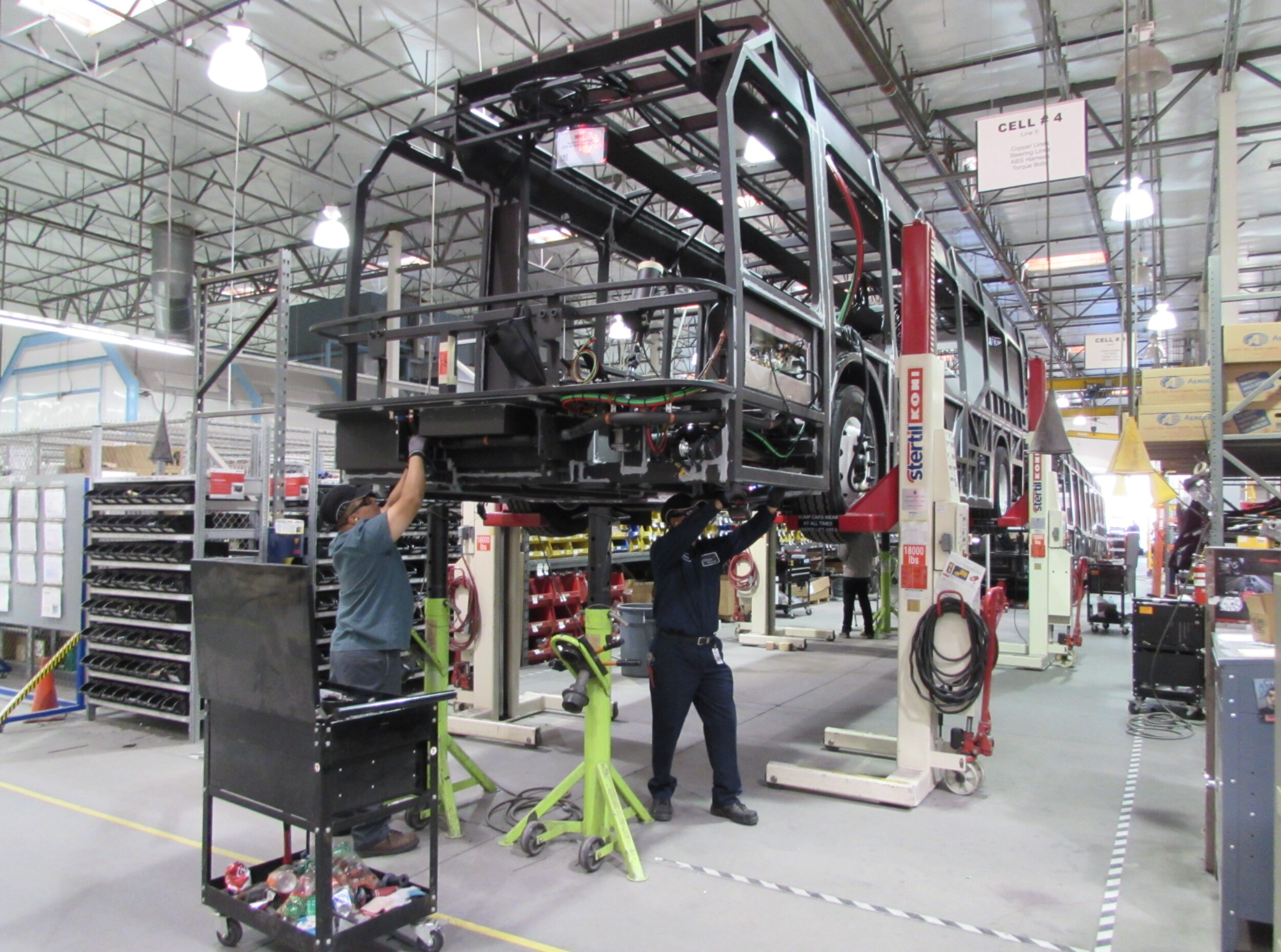
US heavy-duty transit bus manufacturing supported around 34,100 jobs and contributed $5.1 billion to US GDP in 2025, while battery-electric buses accounted for around 20% of recent deliveries, according to Oxford Economics.

The figures come from Buses Mean Business: The Economic Impact of US Heavy-Duty Transit Bus Manufacturing, a September 2026 report developed by Oxford Economics and sponsored by Business Members of the American Public Transportation Association (APTA). The report was launched in conjunction with APTA Advocacy Day in Washington, D.C. and the bus coalition’s “Built in America: The Private-Sector Engine Behind Transit Buses” panel on Capitol Hill.

The study analyzes the economic activity generated directly by US heavy-duty transit bus manufacturers, through their domestic supply chains and through household spending by workers. Oxford Economics estimates that the industry also supported $1.1 billion in federal, state and local tax revenue in 2025, with economic impacts recorded across all 50 states.

Beyond the economic impact calculations, the report provides data on the age and composition of the US transit bus fleet, annual vehicle deliveries and changes in propulsion technologies.

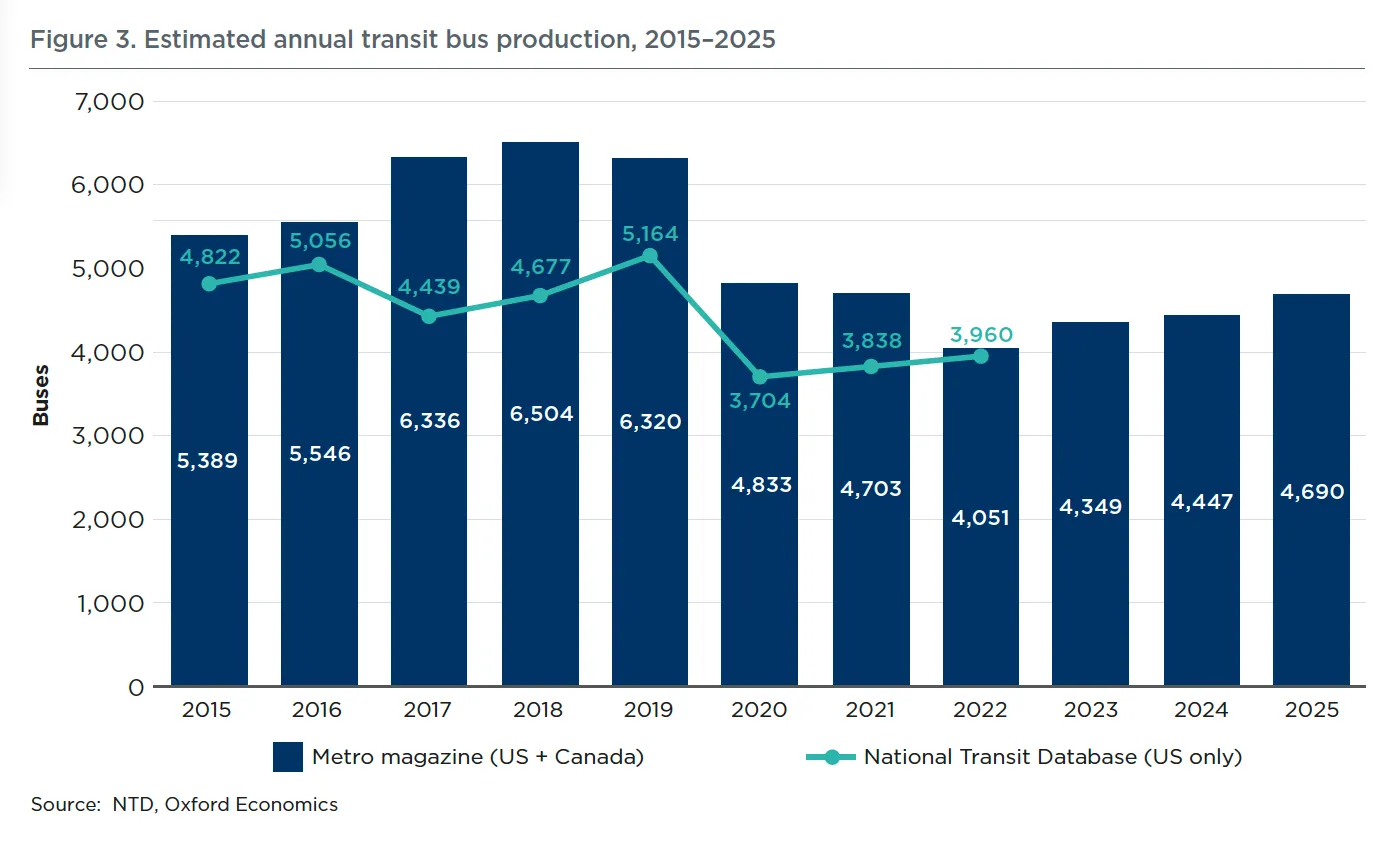
US bus deliveries at 4,690 units in 2025, still below pre-Covid

Approximately 4,690 transit buses were delivered in the United States and Canada in 2025, according to industry delivery data reported by Oxford Economics. This compares with 4,447 units in 2024 and 4,349 in 2023.

Deliveries remain below the volumes recorded before the Covid-19 pandemic. The study reports 6,320 buses delivered in 2019.

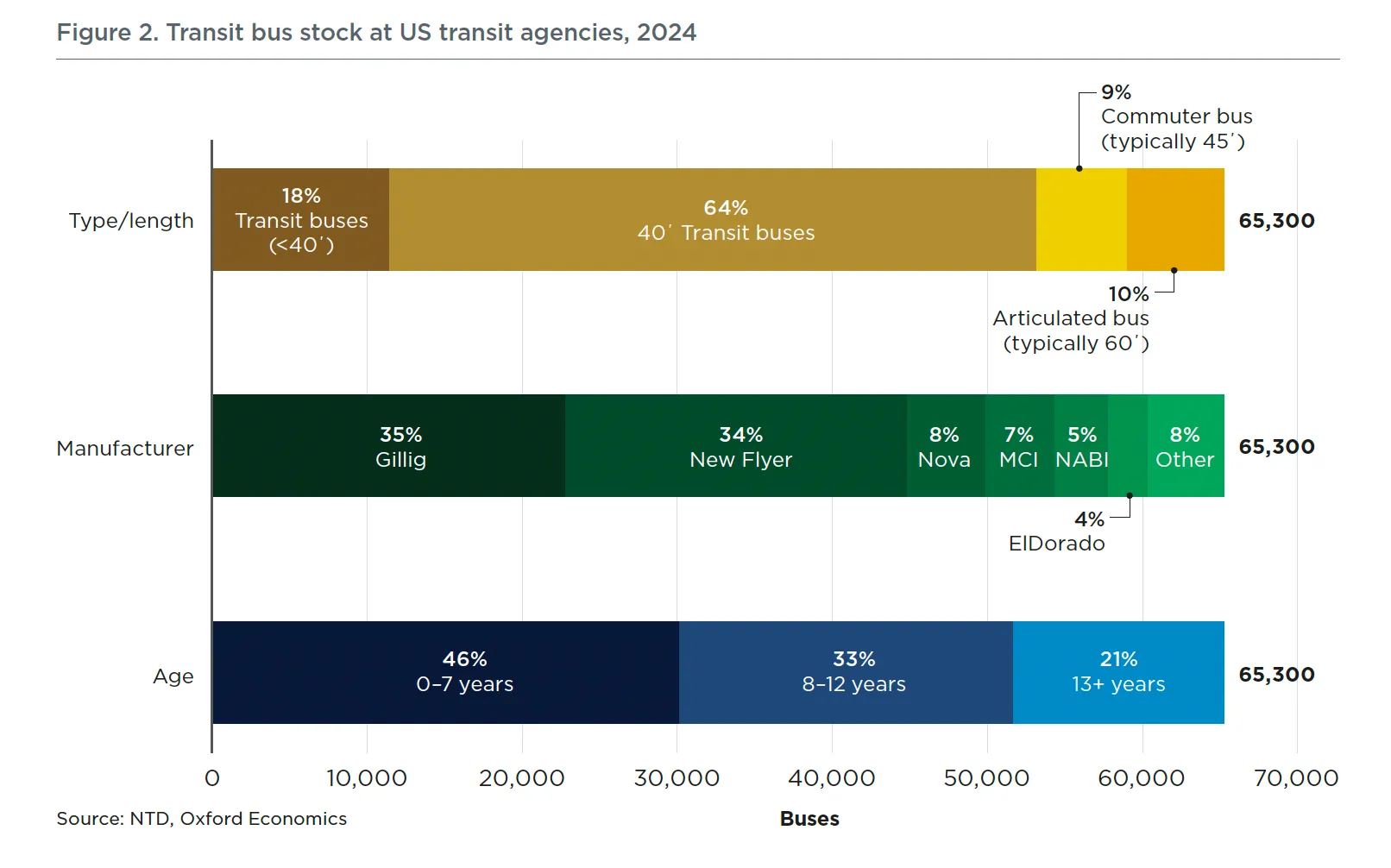
The existing US fleet comprises approximately 65,300 heavy-duty transit buses. Standard transit buses account for 82% of the total, with 40-foot vehicles alone representing 64%. Commuter buses account for 9% and articulated buses for 10%, according to National Transit Database data analyzed by Oxford Economics.

Fleet age is another element covered by the study. The average US transit bus was approximately eight years old in 2024. Around 13,700 vehicles, equivalent to 21% of the fleet, were already more than 12 years old, while another 21,500 buses were between eight and 12 years old.

In total, approximately 35,200 buses, or 54% of the US heavy-duty transit bus fleet, either exceeded or were due to reach within five years the Federal Transit Administration’s minimum useful-life benchmark of 12 years or 500,000 miles for large heavy-duty transit buses.

Transit buses accounted for approximately 3.8 billion passenger trips in the United States in 2025, or more than 10 million trips on an average day. They represented 49% of all US public transit trips during the year.

Battery-electric buses reach 20% of recent US transit bus deliveries

Oxford Economics also records changes in the propulsion technologies represented in recent deliveries.

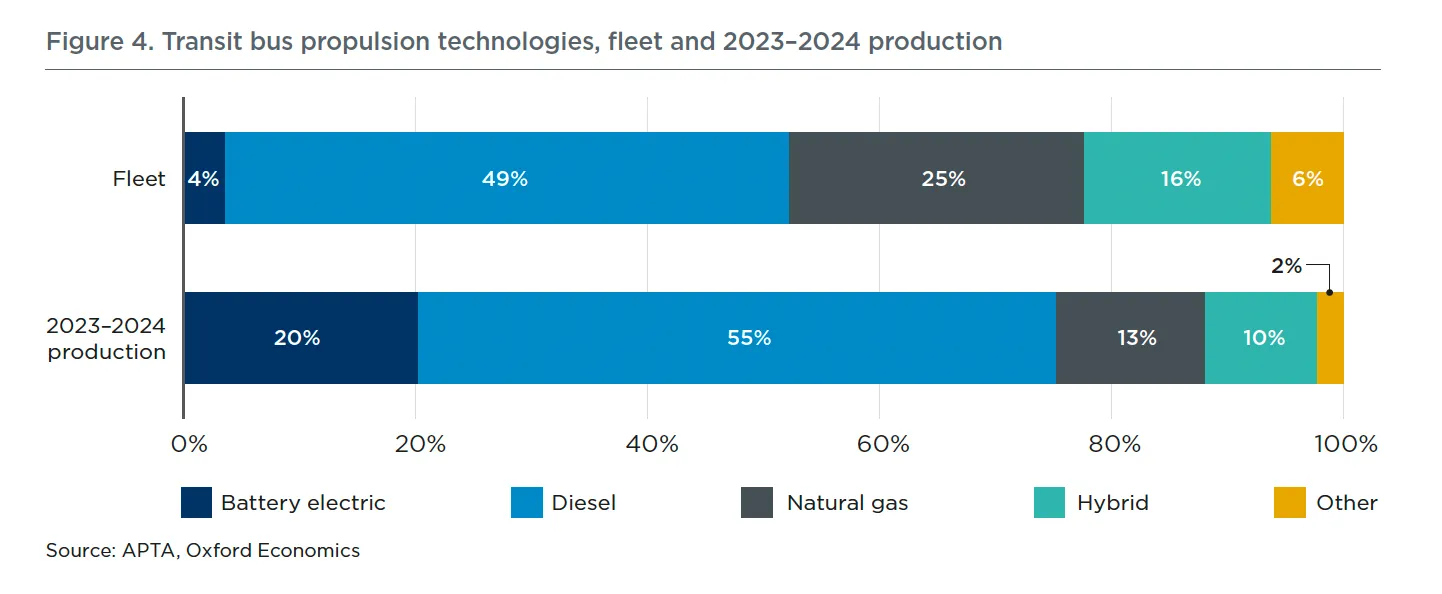
Battery-electric buses accounted for approximately 20% of transit buses delivered in 2023 and 2024, based on APTA Public Transportation Vehicle Database figures included in the report. Battery-electric vehicles represented approximately 4% of the overall fleet in service.

Diesel remained the largest propulsion technology among recent deliveries, accounting for 55% of buses delivered in 2023-2024. Diesel represented 49% of the existing fleet.

In brief

  • How many transit buses were delivered in the US and Canada in 2025?
    Oxford Economics reports approximately 4,690 deliveries, compared with 6,320 in 2019.
  • What share of recent deliveries was battery-electric?
    BEVs accounted for around 20% of 2023-2024 deliveries, versus approximately 4% of the fleet in service.
  • How much of the US bus fleet is at or approaching replacement age?
    Around 54% is already beyond or due to reach the FTA’s 12-year useful-life benchmark within five years.
  • What is the industry’s estimated economic footprint?
    Around 34,100 supported jobs, $5.1 billion in GDP and $1.1 billion in federal, state and local tax revenues.

Natural gas accounted for 13% of 2023-2024 deliveries, compared with 25% of the fleet in service, while hybrids represented 10% of recent deliveries and 16% of the existing fleet. Other technologies accounted for around 2% of recent deliveries and 6% of the fleet.

Separate data from Catalyst Mobility (formerly Calstart), featured in the latest issue of Sustainable Bus magazine, show that, as of July 2025, US transit agencies and other operators had 8,116 full-size zero-emission buses funded, ordered, delivered or deployed, up 16% from 7,028 a year earlier. An additional 1,398 small zero-emission buses had been adopted nationwide.

The report also records ElDorado National’s resumption of transit bus production in 2025 under new ownership and Solaris’ entry into the US market through transit agency procurements. BYD’s US operations, marketed under the RIDE brand, continue to manufacture transit buses in Lancaster, California, while federal restrictions introduced in 2019 limit participation in federally funded transit bus procurements, Oxford Economics notes.

What is interesting, “Buses produced by the top two manufacturers, Gillig and New Flyer (NFI Group), accounted for nearly 70% of vehicles in service in 2024“. And production was even more concentrated in 2025, with the two manufacturers accounting for most heavy-duty transit bus deliveries, following Nova Bus’ US exit and NABI’s earlier integration into New Flyer.

US transit bus manufacturing supports 34,100 jobs

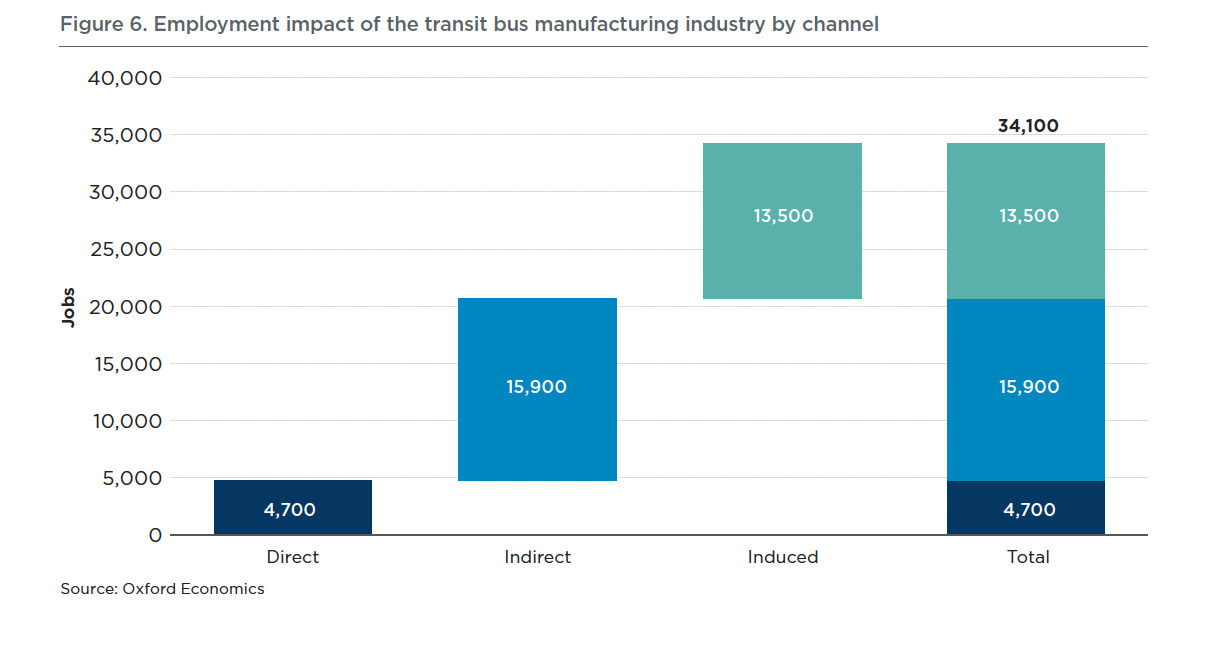
Against this fleet and production background, Oxford Economics estimates that US transit bus manufacturers directly employed approximately 4,700 people in 2025.

A further 15,900 jobs were supported through domestic supplier purchases and 13,500 through household spending by workers whose incomes depended directly or indirectly on transit bus manufacturing. The resulting total was approximately 34,100 jobs.

The report calculates an employment multiplier of 7.3. On this basis, every job directly employed by a transit bus manufacturer supported an additional 6.3 jobs elsewhere in the US economy through supply-chain purchases and household spending.

Manufacturing accounted for around 13,000 of the supported jobs, corresponding to 38% of the total. Trade and transportation accounted for 5,600 jobs, business services for 4,700 and other services for 3,800.

Transit bus industry contributes $5.1 billion to US GDP

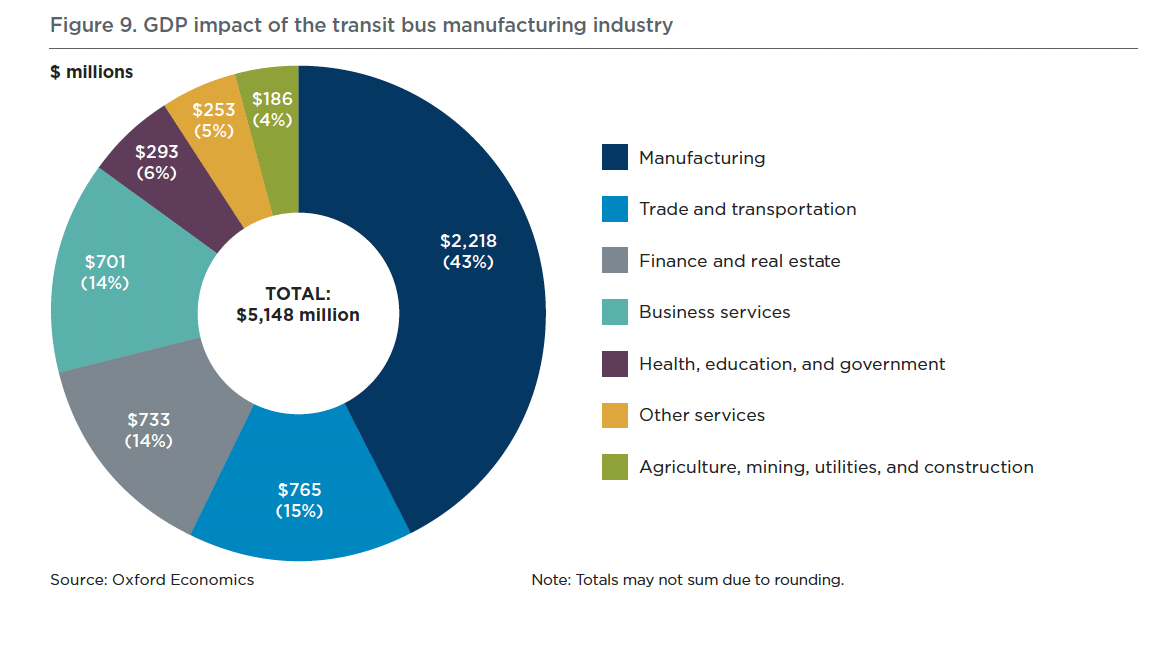
Oxford Economics calculates a total GDP contribution of approximately $5.15 billion in 2025.

Of this amount, $817 million was generated directly by transit bus manufacturers. Domestic supplier activity accounted for another $2.56 billion, while $1.78 billion was associated with household spending by workers.

Manufacturing represented approximately $2.2 billion, or 43%, of the total GDP impact. Trade and transportation accounted for $765 million, finance and real estate for $733 million and business services for $701 million.

The report calculates a GDP multiplier of 6.3, meaning that every dollar of value added generated directly by transit bus manufacturers was associated with an additional $5.30 in GDP through domestic supplier purchases and household spending.

Tax revenues associated with the three channels of economic activity totaled approximately $1.124 billion. Federal taxes represented $749 million, or 67% of the total, while state taxes amounted to $216 million and local taxes to $159 million.

Oxford Economics records economic impacts across all 50 states. Major transit bus assembly facilities identified in the report are located in Alabama, California, Minnesota, Nevada, New York and North Dakota.

Free Training

Source link

U.S. Manufacturing Investment and Productivity Momentum Set Stage for IMTS 2026


The United States continues to see renewed manufacturing investment and output growth, but sustaining reindustrialization depends on accelerating productivity. At IMTS – The International Manufacturing Technology Show, the manufacturers and job shops that build America will find the technologies, ideas, and connections that translate capital investment into greater efficiency, resilience, and long-term competitiveness.

U.S. manufacturing generates trillions of dollars in economic output, and IMTS serves as a marketplace connecting manufacturers with technology providers. According to the U.S. Manufacturing Technology Orders Report, in the first half of 2026, new orders of metalworking machinery reached a record total of $3.44 billion, up 36% year over year and the strongest half since USMTO began tracking orders in 1998. New orders for manufactured durable goods increased $3.6 billion, or 1.1%, to $339.3 billion in July, according to the U.S. Census Bureau, marking the fourth increase in five months. The ISM Manufacturing PMI registered 54.6 in August, the eighth straight month of manufacturing sector expansion, while ISM’s broader economic indicator has now shown growth for 22 consecutive months.

“Economic momentum, demand for a stronger U.S. industrial base, continued reshoring and foreign direct investment, new incentives for capital investment, and the launch of cutting-edge technologies are creating one of the most exciting moments manufacturing has seen in years – and one of the most important reasons to attend IMTS,” says Douglas K. Woods, president of AMT – The Association For Manufacturing Technology, which owns and produces IMTS. “Across aerospace, defense, medical, AI infrastructure, and other high-demand sectors, manufacturers are looking for the technologies, partners, and productivity gains that will help them compete and grow.”

Manufacturing sector labor productivity increased 2.4% in the second quarter of 2026, as output increased 5.4% and hours worked increased 2.9%, according to the U.S. Bureau of Labor Statistics. Durable-goods manufacturers performed even better, increasing productivity 3.6% as output grew 7.3%. Manufacturing unit labor costs decreased 0.3%, with productivity gains offset by higher hourly compensation.

U.S. and foreign companies have announced $11 trillion in U.S. investment commitments, according to investments tracked by the White House, underscoring the scale of opportunity for manufacturers and technology providers gathering at IMTS.

The investment momentum aligns with reshoring trends that continue to reshape U.S. manufacturing.

“Manufacturing is surging,” confirms Harry Moser, founder of the Reshoring Initiative. “Much of that strength is due to reshoring and foreign direct investment staying strong and being projected to reach a near-record 338,000 jobs announced in 2026 alone.”

Moser says balancing the country’s $1.3 trillion goods trade deficit will require a 40% increase in manufacturing and a surge in investment and productivity. The award-winning shops demonstrate how manufacturers can help close that gap.

“As a country, we need to make more things here. Reindustrializing America depends on increasing our total productivity factor by adopting new technologies and business approaches,” says John “Jay” Rogers, co-founder and CEO of Haddy. 

For machine shops, equipment represents their largest capital investment, making IMTS an important venue for evaluating technologies that can improve productivity, expand capacity, and support more confident purchasing decisions.

“By investing in the best-of-the-best CNC and fabrication equipment, we’re able to produce better parts faster, with fewer defects and less postprocessing, which ultimately lowers costs and improves reliability for our customers,” says Jim Belosic, founder and CEO of SendCutSend, an on-demand manufacturing company specializing in custom sheet metal and CNC machining. 

“Walking the IMTS floor shows you the technology. Presentations on the IMTS+ Main Stage, conferences, and networking events provide insight on how to make investment decisions with greater confidence and deliver lasting value,” says Payne.

Van Metre adds, “IMTS brings together the people that have solved these challenges before. We’ll interview these experts so visitors can learn from their experience instead of starting from scratch.”

For more information, visit IMTS.com.

Free Training

Source link

US Transit Bus Industry Generates $5.1 Billion Economic Impact


The US heavy-duty transit bus manufacturing industry supported around 34,100 jobs and contributed 5.1 billion USD to the US economy in 2025, according to a new report from Oxford Economics.

The report, Buses Mean Business, examines the economic contribution of domestic transit bus manufacturers and their supply chains. It was commissioned by business members of the American Public Transportation Association (APTA).

ENC bus manufacturing

ENC bus manufacturing

© ENC

Of the 34,100 jobs supported by the industry, approximately 4,700 were employed directly by transit bus manufacturers. A further 29,400 jobs were supported through the wider supply chain and the spending of workers’ earnings.

Oxford Economics calculates that every direct job at a transit bus manufacturer supported an additional 6.3 jobs elsewhere in the US economy. Manufacturing accounted for around 13,000 of the total jobs supported.

The industry also generated an estimated 1.1 billion USD in federal, state and local tax revenue in 2025. The report estimates that every dollar of GDP generated directly by transit bus manufacturers supported a further 5.30 USD through supply-chain and household-spending effects.

The report found that the economic impact of transit bus manufacturing extended across all 50 states. States with major bus assembly facilities, including Alabama, California, Minnesota and New York, recorded some of the largest impacts. Significant activity was also identified in Illinois, Indiana, Michigan, Pennsylvania and Texas.

Research from APTA has previously shown that federal investment in public transport supports a wide manufacturing network across the United States.

The analysis covers three forms of economic impact: direct activity from bus manufacturers, indirect activity generated through their domestic supply chains, and induced activity resulting from workers spending their earnings elsewhere in the economy.

The research focuses specifically on heavy-duty transit buses, defined as vehicles of at least 30 feet operated by public transit agencies. This includes standard and articulated buses, commuter coaches, double-deckers and other heavy-duty transit vehicles.

The report also highlights the age of the US transit bus fleet as a factor supporting future manufacturing demand. US transit agencies operated approximately 65,300 heavy-duty transit buses in 2024. Around 13,700 were already more than 12 years old, while another 21,500 were between eight and 12 years old. Together, those vehicles represented more than 54% of the fleet and either already exceeded, or are expected to reach within five years, the Federal Transit Administration’s 12-year useful-life benchmark.

Transit buses carried approximately 3.8 billion passenger trips in the US during 2025, representing around 49% of all public transport trips and more than 10 million trips on an average day. However, bus deliveries have yet to return to pre-pandemic levels. Around 4,700 transit buses were delivered in the US and Canada in 2025, compared with more than 6,300 in 2019.

Electric Buses

The composition of new bus deliveries is also changing. Battery-electric buses represented around 4% of the existing US transit bus fleet, but accounted for approximately 20% of transit buses delivered during 2023 and 2024. Diesel buses remained the largest category of new deliveries, representing roughly half of vehicles delivered during the period.

Oxford Economics notes that domestic procurement requirements, including federal Buy America provisions applying to federally funded transit investment, have helped support the US manufacturing and supplier base. Looking ahead, this trend may change, as the current administration has stated that it intends to give priority to low-emission projects over zero-emission proposals where permitted.

The report’s findings come as US transit agencies face a sizeable fleet replacement requirement, while manufacturers and suppliers adapt to changes in propulsion technology.

The research does not attempt to quantify the wider economic effects of operating transit services or investing in depots, charging infrastructure and other transit capital projects. Its analysis is limited to the manufacturing of heavy-duty transit buses and the domestic supply chain supporting their production.

Tags

Free Training

Source link

2.1 Million Manufacturing Jobs Could Go Unfilled by 2030


The manufacturing skills gap in the U.S. could result in 2.1 million unfilled jobs by 2030, according to a new study by Deloitte and The Manufacturing Institute, the workforce development and education partner of the NAM. The cost of those missing jobs could potentially total $1 trillion in 2030 alone.

The study’s dramatic findings come from online surveys of more than 800 U.S.-based manufacturing leaders, as well as interviews with executives across the industry and economic analyses. All told, they paint a worrying picture of manufacturing’s labor shortage. The lack of skilled labor was the industry’s major challenge even before the pandemic, according to the NAM’s quarterly outlook surveys—and this new study shows it’s still a major concern today.

The hard data: About 1.4 million U.S. manufacturing jobs were lost during the early days of the pandemic, according to the study, setting back the manufacturing labor force by more than a decade. However, the industry has largely recovered those lost jobs and is now urgently seeking more workers.

  • While the manufacturing industry recouped 63% of jobs lost during the pandemic, the remaining 570,000 had not been added back by the end of 2020, despite a near record number of job openings in the sector.

The inside scoop: Manufacturers surveyed reported that finding the right talent is now 36% harder than it was in 2018, even though the unemployment rate has nearly doubled the supply of available workers.

  • Executives reported they cannot even fill higher paying entry-level production positions, let alone find and retain skilled workers for specialized roles.
  • A long-term challenge: 77% of manufacturers say they will have ongoing difficulties in attracting and retaining workers in 2021 and beyond.

Deloitte says: “Given the foundational role the manufacturing sector plays in our nation’s economy, it is deeply concerning that at a time when jobs are in such high demand nationwide, the number of vacant entry-level manufacturing positions continues to grow,” said Paul Wellener, Deloitte vice chairman and U.S. industrial products and construction leader. “Attracting and retaining diverse talent presents both a challenge and solution to bridging the talent gap. To attract a new generation of workers, the industry should work together to change the perception of work in manufacturing and expand and diversify its talent pipeline.”

The Institute says: “Manufacturers are proud to lead efforts to build stronger, more diverse and inclusive workplaces because we are committed to being the solution,” said Carolyn Lee, executive director of the Institute. “As we expand our programs at The Manufacturing Institute, and work with the National Association of Manufacturers on initiatives like our Creators Wanted campaign and tour, we’re making sure that Americans of all backgrounds in all states can find a home in manufacturing and get equipped with the skills to seize these opportunities.”

Free Training

Source link